

Dog Accessory Durability: What Every Owner Must Know
TL;DR:
- Durable dog accessories resist wear and environmental damage through quality materials and construction. Choosing gear based on durability ratings ensures safety and longevity tailored to your dog’s behavior. Proper maintenance and inspection further extend the lifespan of high-quality, American-made products.
Dog accessory durability is defined as a product’s ability to resist wear, stress, and environmental damage through repeated daily use without structural failure. The industry term for this standard is product durability rating, and it covers everything from collar webbing to toy geometry. Choosing gear based on durability indicators rather than price tags or brand names is the single most reliable way to protect your dog and your wallet. This guide breaks down the materials, construction methods, and behavioral factors that separate gear built to last from gear built to sell.
What is dog accessory durability, and why does it matter?
Dog accessory durability is not just about toughness. It is the result of specific material choices, construction techniques, and design decisions working together under real conditions. A collar that holds on a 20-pound Beagle may fail on a 90-pound Labrador Retriever pulling at full strength. Durability is always relative to the dog using the product.
The stakes are real. A snapped leash in traffic or a frayed harness buckle on a trail puts your dog at direct risk. Durable accessories are not a luxury. They are a safety requirement for any responsible owner.
Understanding what defines durable pet accessories starts with knowing which variables matter most: material grade, stitch pattern, hardware alloy, and product geometry. Each of these factors compounds. A collar made from premium nylon but fitted with zinc alloy hardware will still fail early at the buckle.
What materials and hardware define durable dog accessories?
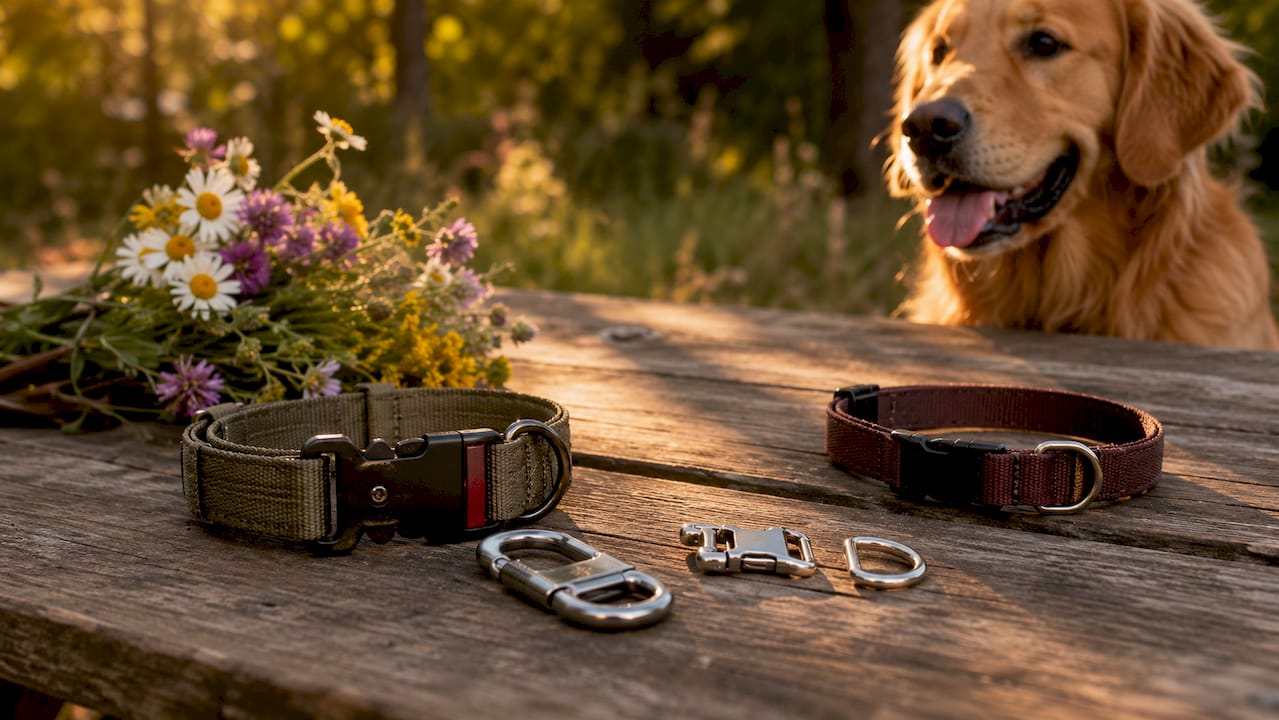
Material grade is the single biggest predictor of how long a dog accessory will last. Not all nylon is equal, and not all metal hardware performs the same under stress.
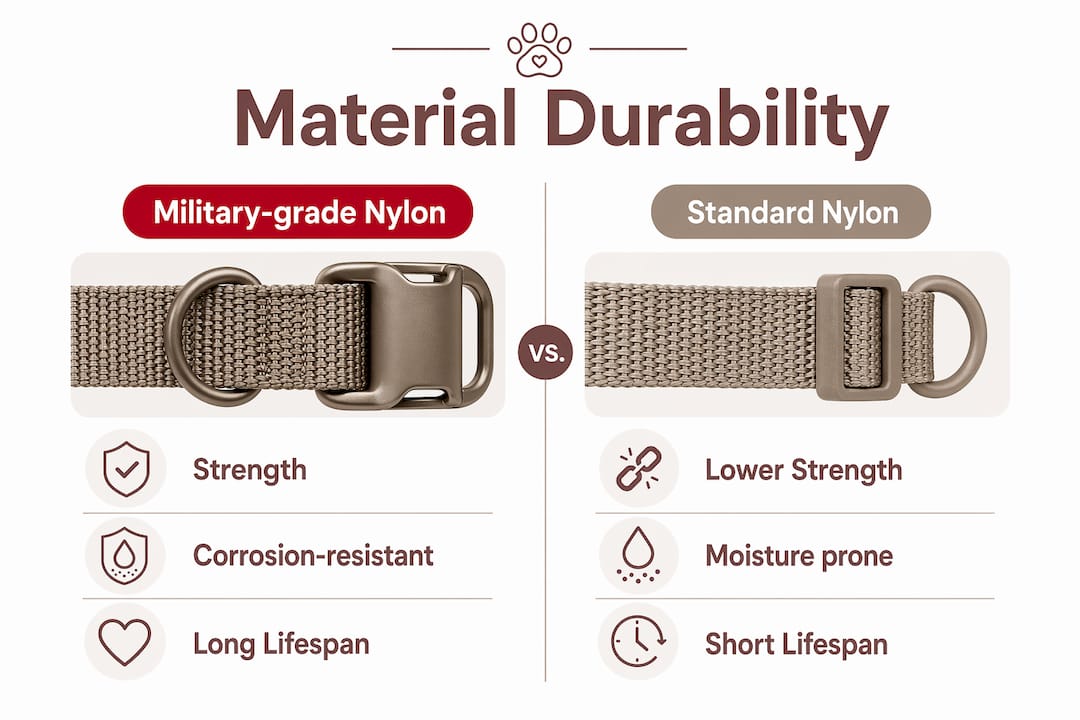
Military-grade nylon vs. standard nylon
Military-grade nylon withstands 3–4 times more tension before wear than standard nylon. That difference is not cosmetic. It means a military-grade collar can absorb repeated lunging, pulling, and abrasion from concrete or gravel without fraying. Standard nylon collars often show visible wear within months of daily outdoor use.
The weave density in military-grade nylon also resists moisture absorption. Wet nylon weakens over time, and standard webbing holds water against your dog’s skin, accelerating both material breakdown and skin irritation.
Stainless steel vs. zinc alloy hardware
Marine-grade stainless steel resists corrosion and structural failure even under prolonged moisture and salt exposure. Zinc alloy hardware, which appears on most budget collars and leashes, corrodes within months when exposed to rain, sweat, or saltwater. Corroded hardware does not just look bad. It becomes brittle and snaps under load.
The Body Glove BioThane Dog Collar is one example of a product that pairs waterproof webbing with quality hardware to address both failure points simultaneously.
Material comparison table
| Material | Strength | Corrosion Resistance | Typical Lifespan |
|---|---|---|---|
| Military-grade nylon | Very high | Moderate | 3–7 years |
| Standard nylon | Moderate | Low | 6–18 months |
| Marine-grade stainless steel | Very high | Excellent | 10+ years |
| Zinc alloy | Low to moderate | Poor | 6–12 months |
| Natural rubber (thick-walled) | High | Excellent | 2–5 years |
| Foam (orthopedic beds) | Moderate | Low without covers | 1–3 years |
Pro Tip: When shopping for collars or leashes, flip the hardware over and look for a stamped grade marking. Hardware labeled 304 or 316 is stainless steel. Unmarked hardware is almost always zinc alloy.
How does construction quality influence durability in dog accessories?
Material grade gets most of the attention, but construction quality determines whether those materials actually perform. Two collars made from identical nylon can have dramatically different lifespans based entirely on how they are assembled.
Key construction elements that determine lifespan
-
Stitch pattern at stress points. Box-X stitching provides up to 5 times more durability than single-line stitching at stress points. Single-line seams unravel from one end when a thread breaks. Box-X stitching distributes load across multiple thread paths, so one broken thread does not cascade into full seam failure.
-
Hardware-to-fabric junction reinforcement. The connection between hardware and fabric is the most common failure point in dog accessories. Bar-tack stitching and heat sealing at these junctions prevent early failure by locking the webbing in place under tension.
-
Product geometry. Rounded, thicker-walled parts distribute biting pressure evenly across a larger surface area. Sharp corners and thin sections concentrate stress, which is why cheap plastic toys crack at edges first.
-
Edge finishing. Raw nylon edges fray under abrasion. Heat-sealed or bound edges resist unraveling and extend the usable life of webbing products by months or years.
-
Layered reinforcement at D-rings. D-rings on harnesses and collars bear the full force of leash tension. Products with double-layered webbing stitched around the D-ring distribute that load rather than concentrating it at a single thread.
Pro Tip: Before buying any collar or harness, grip the D-ring and pull firmly while watching the stitching. If threads pucker or shift, the construction will not hold under real load. Quality gear shows zero movement at the junction.
Maintenance also plays a direct role in construction longevity. Unclean covers trap moisture, which degrades foam and fabric from the inside out. Washing covers weekly and air-drying accessories after wet outings prevents biological breakdown that no stitch pattern can stop.
How does your dog’s behavior and activity affect accessory durability?
Durability is a dynamic property shaped by the match between product design and your dog’s specific behavior. A toy rated for tough chewers will outlast a standard toy by years on a Pit Bull Terrier. That same toy may be unnecessary overkill for a Cavalier King Charles Spaniel that carries toys gently.
Matching gear to your dog’s behavior is how you get real value from a durability rating. Consider these factors before buying:
- Chewing intensity. Heavy chewers need toys with thick rubber walls and rounded geometry. Thin rubber or rope toys disintegrate within hours for breeds like Rottweilers or Belgian Malinois. The USA-K9 Stars and Stripes rubber toy is built specifically for this level of use.
- Outdoor and water exposure. Dogs that swim or hike in wet conditions degrade standard nylon and zinc hardware far faster than dogs in dry indoor environments. Marine-grade hardware and waterproof webbing are not optional for water dogs. They are the baseline.
- Pulling strength. A dog that pulls hard on leash puts constant tension on collar and leash hardware. For these dogs, reinforced construction at every junction is non-negotiable.
- Dog size and weight. A 100-pound dog generates far more force on gear than a 20-pound dog. Always check the manufacturer’s weight rating, and size up if your dog is near the upper limit.
- Activity frequency. A dog that walks twice daily puts twice the wear on gear compared to a once-a-day walker. High-frequency use demands higher-grade materials from the start.
Heavy chewers need reinforced gear unlike light players. Buying a standard toy for a power chewer is not a cost-saving move. It is a replacement cycle that costs more over time.
How long can durable dog accessories realistically last?
Lifespan expectations vary significantly by material and maintenance habits. The table below reflects realistic ranges based on material science and usage patterns.
| Accessory Type | Material | Expected Lifespan | Key Wear Factor |
|---|---|---|---|
| Collar or leash | Military-grade nylon | 3–7 years | UV exposure, abrasion |
| Collar hardware | Marine-grade stainless steel | 10+ years | Saltwater, moisture |
| Collar hardware | Zinc alloy | 6–12 months | Corrosion |
| Dog bowl | 304 stainless steel | 40–100 years | Minimal |
| Dog bowl | Plastic | 6 months | Bacteria, cracking |
| Orthopedic bed foam | High-density foam | 1–3 years | Moisture, compression |
| Rubber chew toy | Thick natural rubber | 2–5 years | Chewing intensity |
304-grade stainless steel pet products can last 40–100 years, while plastic equivalents require replacement every 6 months in heavy-use scenarios. That comparison reframes the cost conversation entirely. A stainless steel bowl costs more upfront but eliminates dozens of replacement cycles over a dog’s lifetime.
Warranties are a reliable proxy for durability confidence. Pet accessories with warranties of 5–10 years or lifetime coverage indicate structural integrity and design built for repeated, high-stress use. A 30-day warranty on a dog collar signals that the manufacturer does not expect it to last.
Industrial principles favor testing gear for repeated load cycles over aesthetics. The best durable dog products are engineered to pass stress tests, not just look good on a shelf.
Key takeaways
Dog accessory durability depends on material grade, construction technique, and behavioral matching working together rather than any single factor alone.
| Point | Details |
|---|---|
| Material grade drives lifespan | Military-grade nylon and marine-grade stainless steel outlast standard alternatives by years. |
| Construction determines real-world performance | Box-X stitching and reinforced hardware junctions prevent the most common failure points. |
| Behavior matching extends durability | Selecting gear rated for your dog’s size, strength, and activity prevents premature wear. |
| Maintenance protects materials | Regular cleaning and air-drying prevent moisture-driven breakdown in foam and fabric products. |
| Warranties signal quality | Products with 5–10 year or lifetime warranties are built to withstand repeated high-stress use. |
What i’ve learned after years of watching gear fail
The most expensive collar in the room is not always the most durable one. I have seen premium-branded leashes with zinc alloy hardware corrode within a single summer of beach walks, while a mid-priced military-grade nylon collar with stainless steel hardware lasted six years on a 90-pound dog that swam daily.
The failure point I see most often is the D-ring junction. Owners inspect the webbing and the buckle, but they rarely look at the stitching where the D-ring sits. That is where most collars and harnesses give out first. Before you buy any new piece of gear, spend 10 seconds pulling on that junction with both hands. If it moves, pass on it.
My other strong opinion: stop treating dog accessories as disposable. The math on heirloom-quality gear is straightforward. A stainless steel bowl or a well-constructed collar costs more once and lasts years. Cheap replacements cost less per unit but more per year. The dog bed durability guide at Americanbarkbliss makes this case well for bedding specifically, and the same logic applies across every product category.
Invest in gear that matches your dog’s actual behavior, inspect it monthly, clean it regularly, and replace it only when it shows real structural wear. That approach saves money, reduces waste, and keeps your dog safer than any brand name will.
— Christopher
Durable dog gear worth owning from Americanbarkbliss
If you are ready to move past disposable pet products, Americanbarkbliss carries a curated selection of USA-made accessories built to the durability standards this article describes.
The USA-K9 Stars and Stripes rubber chew toy is made for power chewers and built with the thick-walled geometry that distributes biting force rather than concentrating it. For training rewards, the Americana Chicken Chips are made in the USA with consistent quality you can count on. Every product on Americanbarkbliss is selected for durability, safety, and American craftsmanship. Browse the full collection and buy gear your dog will still be using years from now.
FAQ
What is dog accessory durability?
Dog accessory durability is a product’s ability to resist wear, stress, and environmental damage through repeated daily use without structural failure. It depends on material grade, construction quality, and how well the product matches the dog’s behavior and activity level.
What materials make dog accessories most durable?
Military-grade nylon and marine-grade stainless steel are the most durable materials in dog accessories. Military-grade nylon withstands 3–4 times more tension than standard nylon, and stainless steel hardware resists corrosion far longer than zinc alloy alternatives.
How long do durable dog accessories last?
Lifespan varies by material. Stainless steel bowls can last 40–100 years, military-grade nylon collars typically last 3–7 years, and thick rubber chew toys last 2–5 years depending on chewing intensity and maintenance habits.
What construction features should i look for in dog accessories?
Look for box-X stitching at stress points, reinforced bar-tack stitching at hardware junctions, and rounded thick-walled geometry in toys. These three features address the most common failure points in dog gear.
Do warranties indicate better durability in dog accessories?
Yes. Pet accessories with warranties of 5–10 years or lifetime coverage signal that the product is engineered for repeated high-stress use. Short warranties of 30 days or less suggest the manufacturer does not expect the product to last under normal conditions.
Leave a comment