

The Role of Pet Accessories in Training Your Dog
TL;DR:
- Pet accessories are essential communication tools that enhance training, safety, and behavioral reinforcement between handler and dog. High-quality gear improves training precision and durability, while matching toys to training goals helps manage arousal and focus. Proper use, regular inspection, and owner education are crucial for effective, safe, and consistent training outcomes.
Pet accessories are defined as physical tools that facilitate communication, behavioral reinforcement, and safety between a handler and a dog during structured training. The role of pet accessories in training goes far beyond convenience. Collars, leashes, harnesses, clickers, treat pouches, and toys each serve a specific function within a training system, and choosing the right tool for the right moment determines whether a dog learns quickly or stalls. What separates effective trainers from frustrated owners is rarely talent. It is almost always the quality of their gear and their understanding of how to use it.
How do different pet accessories enhance training communication and control?
Training accessories are communication aids. Each one translates handler intent into a signal the dog can read, and training tool effectiveness depends critically on consistent, knowledgeable application rather than the tool’s inherent qualities. A flat collar on a loose leash tells a dog nothing. The same collar used with precise leash pressure and a clear release signal becomes a complete sentence.
Here is how the core accessories function in practice:
- Collars and leashes establish the physical channel between handler and dog. A standard flat collar works for dogs that already walk calmly. Martingale collars prevent slip-outs for sighthound breeds like Greyhounds and Whippets without applying constant pressure.
- Harnesses redistribute pressure away from the neck and are particularly effective for dogs that pull or have tracheal sensitivity. Front-clip harnesses like the Ruffwear Front Range redirect a dog’s forward momentum back toward the handler, making loose-leash walking easier to teach.
- Clickers create a precise, consistent marker signal that bridges the gap between a desired behavior and the delivery of a reward. The click fires at the exact moment of correct behavior, giving the dog unambiguous feedback that a verbal “good boy” cannot match in speed or consistency.
- Treat pouches keep high-value rewards immediately accessible, which shortens the reward delivery window and strengthens the behavior-reward association. The Heouvo treat pouch with clicker combines both tools in one unit, which is practical for solo training sessions.
- Remote collars and prong collars carry real risks when misused. Prong collars applied correctly, positioned high on the neck and paired with positive reinforcement, can be gentler than a flat collar under sustained pulling pressure. Applied incorrectly, they cause injury and erode trust.
Pro Tip: Start every training session by checking that all gear fits correctly. A harness that rides too far forward restricts shoulder movement and creates discomfort that the dog will associate with training itself.
What are the benefits of high-quality gear compared to basic accessories?

Higher quality accessories correlate strongly with better training performance, precision, and safety. Low-quality gear introduces friction into the training process. A leash that stiffens in cold weather, a collar buckle that slips under pressure, or a treat pouch that jams mid-session all pull the handler’s attention away from the dog at the exact moment focus matters most.
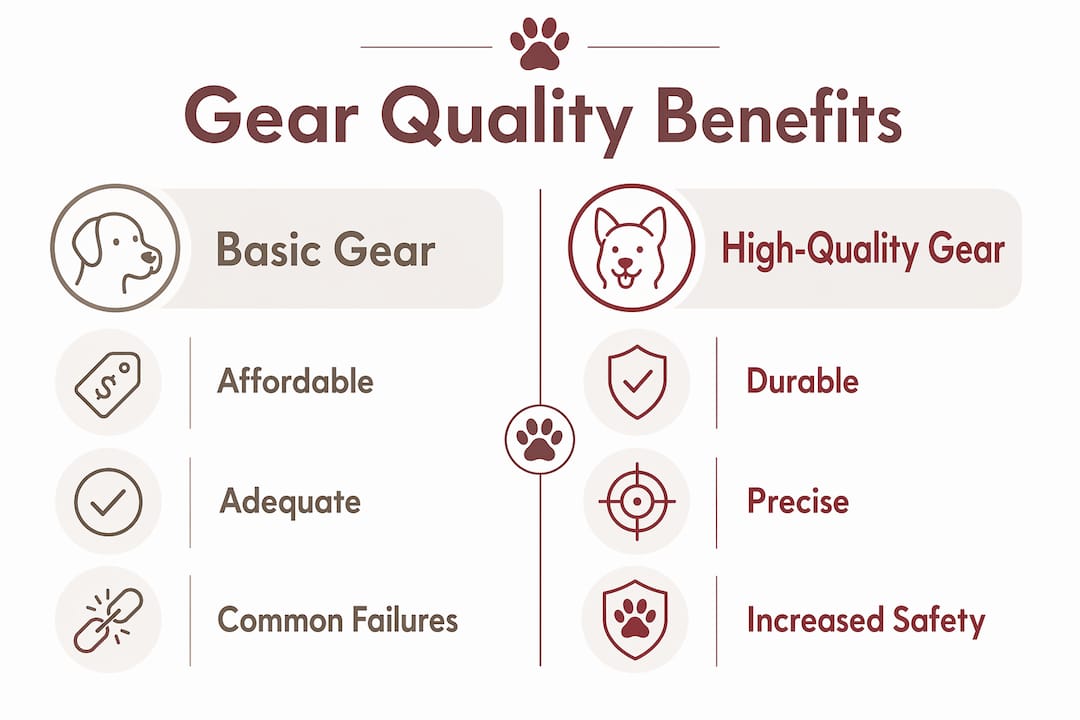
| Gear quality level | Training impact | Common failure points |
|---|---|---|
| Basic or budget gear | Adequate for casual reinforcement | Poor durability, imprecise fit, distracting to handler |
| Mid-range gear | Suitable for most home training | Occasional hardware failure, limited adjustability |
| Professional-grade gear | Maximizes precision and safety | Higher upfront cost, requires proper sizing |
Sales of specialized dog training gear have increased 15% year-on-year, which reflects a broader shift in how owners view their investment in training equipment. Owners are no longer treating gear as a one-time purchase. They are treating it as a training infrastructure decision.
A recommended starting budget of $200 to $400 covers a harness, crate, bed, and toys at a quality level that supports real training progress. Spending beyond that range typically yields diminishing returns unless you are training for dog sports or working dog roles. For most pet owners, the goal is not professional-grade competition equipment. It is gear that fits well, holds up, and does not get in the way.
Pro Tip: Before upgrading any piece of gear, identify the specific problem you are trying to solve. A dog that pulls on leash needs a front-clip harness, not a more expensive flat collar.
How do different types of toys serve specific training and behavioral roles?
Toys are functional training tools, not rewards you hand out to keep a dog busy. Puzzle feeders and tug toys impact dog energy and behavior differently, and matching the toy to the training goal is as deliberate a decision as choosing the right collar.
The distinction matters because arousal level directly affects a dog’s ability to learn. A dog in a high-arousal state after ten minutes of tug play cannot easily shift into focused heel work. A dog that has worked through a puzzle feeder is calm, mentally engaged, and primed for low-stimulation training tasks.
| Toy type | Primary behavioral function | Best training application |
|---|---|---|
| Tug toys | Builds drive, arousal, and handler engagement | Reward for high-energy obedience or sport training |
| Puzzle feeders | Promotes calm problem-solving and focus | Pre-session warm-up or post-session wind-down |
| Chew toys | Reduces anxiety and redirects destructive behavior | Crate training, separation tolerance work |
| Comfort toys | Provides emotional security | Settling exercises, new environment exposure |
Choosing toys without intention misses a training opportunity and can actively worsen behavior. A high-drive dog given a squeaky toy before a calm-focus session will spend the next twenty minutes unable to settle. The same dog given a textured chew toy for ten minutes beforehand arrives at the session in a workable state.
Tug toys, specifically, build the handler-dog relationship in a way that treat rewards alone cannot. The tug toy becomes the reward itself, which is useful for dogs with lower food motivation or for training in high-distraction environments where treats lose their value.
What best practices should owners and trainers follow when using training accessories?
Effective use of pet training accessories follows a clear set of principles that protect the dog, improve outcomes, and build the handler’s skill over time.
-
Prioritize handler education before introducing any new tool. Misuse of e-collars and head halters produces negative behavior and physical discomfort. The tool is not the problem. The application is. Take a course, work with a certified trainer, or at minimum watch structured instructional content before using any aversive or pressure-based accessory.
-
Apply positive reinforcement as the foundation of every session. Clickers, treat pouches, and reward-based toys all work within a positive reinforcement framework that builds behavior through association rather than avoidance. This approach produces dogs that are confident, engaged, and willing to work.
-
Use accessories consistently and on schedule. A dog that sometimes wears a training harness and sometimes wears a flat collar receives inconsistent signals about what is expected. Consistency in gear use reinforces consistency in behavior expectations.
-
Inspect and maintain all gear regularly. Frayed leash webbing, cracked buckles, and worn collar stitching are safety failures waiting to happen. Cleaning dog accessories on a regular schedule extends gear life and prevents skin irritation from bacteria buildup on collars and harnesses.
-
Match the accessory to the individual dog, not the training trend. A prong collar that works for a 90-pound Rottweiler is inappropriate for a 12-pound Beagle. A front-clip harness that redirects a Labrador Retriever may frustrate a Dachshund with a different body structure. Gear selection is always individual.
Pro Tip: Keep a training log that notes which accessories you used in each session and how the dog responded. Patterns emerge quickly, and you will identify which tools produce the best results for your specific dog.
Crates alone do not resolve anxiety. They must be paired with structured training protocols to be effective. This principle applies to every piece of gear in your kit. The accessory supports the protocol. It does not replace it.
Key takeaways
The most effective training accessories are those selected deliberately, fitted correctly, and applied consistently within a structured positive reinforcement protocol.
| Point | Details |
|---|---|
| Accessories as communication tools | Collars, leashes, and clickers translate handler intent into signals dogs can read and respond to. |
| Quality directly affects outcomes | Professional-grade gear reduces handler distraction and improves precision during training sessions. |
| Toys are behavioral instruments | Matching toy type to training goal shapes arousal level and improves a dog’s readiness to learn. |
| Handler skill outweighs tool quality | Even the best gear produces poor results without proper education and consistent application technique. |
| Maintenance protects safety | Regular inspection and cleaning of all accessories prevents equipment failure and skin irritation. |
What I have learned about gear after years of watching dogs train
The most common mistake I see is owners treating accessories as a shortcut. They buy a prong collar because the dog pulls, or a puzzle feeder because the dog is destructive, and then they wait for the gear to do the work. It never does. Gear supports training protocols, not the other way around.
What I have found actually works is this: spend more time on handler mechanics than on gear selection. A skilled handler with a basic flat collar and a $3 clicker will outperform an unskilled handler with a $200 remote collar every single time. The gear matters, but it is the second variable, not the first.
That said, I do think the quality conversation is worth having honestly. A poorly fitted harness that rubs a dog’s armpit raw will associate training with discomfort. A leash that transmits no tactile feedback teaches the handler nothing. Gear quality sets the ceiling on what is possible. Handler skill determines whether you reach it.
My advice is to build your kit around three non-negotiables: a well-fitted harness or collar appropriate to your dog’s size and temperament, a reliable marker system (clicker or verbal), and high-value rewards you can deliver within two seconds of the desired behavior. Everything else is refinement. The types of dog accessories available today are genuinely impressive, but the fundamentals have not changed. Clear communication, timely reinforcement, and consistency win every time.
— Christopher
Gear worth having for your next training session
Americanbarkbliss carries a curated selection of training-focused pet accessories built for durability and real-world use. The Heouvo treat pouch with clicker is one of the most practical tools for positive reinforcement training, keeping rewards and your marker signal in one hand. For drive-building and reward-based work, the tug toys collection offers durable options that hold up to high-energy sessions. If you are looking to reward your dog with something genuinely high-value, the duck breast dog treats from Jack PetPals are handcrafted and made to motivate even the most distracted dogs. All products ship from within the USA and are selected with training function, not just aesthetics, in mind.
FAQ
What is the role of pet accessories in training?
Pet accessories function as communication and reinforcement tools that translate handler intent into signals a dog can understand and respond to. Collars, leashes, clickers, harnesses, and treat pouches each serve a distinct purpose within a structured training system.
Do high-quality training accessories actually improve results?
Yes. Higher quality gear improves training precision and reduces handler distraction, which directly affects how clearly a dog receives feedback during sessions. A recommended starting budget of $200 to $400 covers the core accessories needed for meaningful training progress.
Are toys considered training tools?
Toys are behavioral instruments with specific functions. Tug toys build arousal and handler engagement, while puzzle feeders promote calm focus. Matching toy type to training goal shapes the dog’s mental state before and during a session.
Can gear alone fix a dog’s behavior problems?
No. Crates, collars, and harnesses support training protocols but do not replace them. A dog with separation anxiety needs a structured desensitization program alongside a crate, not a crate alone.
How often should training accessories be inspected and cleaned?
Inspect all gear before each session for fraying, cracked hardware, or worn stitching. Clean collars and harnesses weekly to prevent bacteria buildup that causes skin irritation and shortens gear life.
Leave a comment