

Must-Have Dog Walking Accessories for Safe, Happy Walks
Every walk with your dog should feel good, not stressful. Yet most dog owners stand in a pet store or scroll through product pages feeling genuinely overwhelmed by the sheer number of must-have dog walking accessories out there. Some gear is genuinely life-changing. Some is pure marketing. Knowing the difference saves you money, protects your dog, and makes every walk more enjoyable. This guide cuts through the noise and gives you exactly what you need to know, organized by priority, purpose, and real-world use.
Table of Contents
- Key takeaways
- 1. Must-have dog walking accessories: key criteria first
- 2. A quality 6-foot leash
- 3. A front-clip harness with proper fit
- 4. A treat pouch for training on the go
- 5. Poop bags and a dispenser
- 6. A portable water bottle and bowl
- 7. Reflective gear and clip-on lights
- 8. Supportive walking shoes for you
- 9. A compact first aid kit
- 10. Gear for specific conditions and situations
- 11. Gear comparison: making the right call
- My honest take on building a walking kit
- Gear up with Americanbarkbliss for every walk
- FAQ
Key takeaways
| Point | Details |
|---|---|
| Safety comes first | Prioritize reflective gear, a quality leash, and a first aid kit before anything else. |
| Harness over collar | Front-clip harnesses reduce pulling significantly and protect your dog’s trachea. |
| Start simple, upgrade later | A basic setup costs $135 to $200 and covers every core need for daily walks. |
| Comfort matters for both of you | Good walking shoes for owners and padded gear for dogs reduce fatigue and injury. |
| Tailor gear to your environment | Weather, terrain, and your dog’s size all determine which accessories actually serve you. |
1. Must-have dog walking accessories: key criteria first
Before you buy anything, you need a clear filter. Here is how to think about each purchase so you spend money on gear that actually earns its place on every walk.
Safety features to prioritize:
- Visibility in low light (reflective stitching, clip-on lights)
- Control under pressure (padded handles, secure clips, carabiner attachments)
- Emergency preparedness (first aid kit, ID tags, backup leash)
Comfort for your dog and for you:
- Proper fit on harnesses and collars to prevent chafing or restricted breathing
- Ergonomic handle design on leashes to reduce hand strain
- Breathable, lightweight materials that work across seasons
Practical convenience on the go:
- Accessories that clip to your belt or bag so your hands stay free
- Gear that packs small but performs big
- Products that are easy to clean after muddy or rainy walks
Durability and weather resistance matter more than most people realize. A leash that frays after six months costs you more than a quality one that lasts three years. Look for reinforced stitching, rust-proof hardware, and water-resistant materials.
Budget reality check: complete gear costs about $135 to $200 when you include walking shoes, and that covers every core item covered in this guide. You do not need to spend more than that to be fully prepared.
Pro Tip: Buy the leash and harness first. Get those right before spending a dollar on anything else. They are the foundation of every safe walk.
2. A quality 6-foot leash
A standard 6-foot nylon or rope leash is the single most important piece of gear you own. It gives you enough control to manage your dog in tight spaces while allowing enough slack for comfortable movement. The length matters. Too short and your dog feels restricted. Too long and you lose control at a moment’s notice.
Retractable leashes are dangerous and banned by many professional dog walking platforms. They tangle around legs, fail at critical moments, and give dogs far too much freedom near traffic or other dogs. Avoid them entirely.
Look for padded handles and carabiner clips for safety and comfort, especially if your dog pulls. Americanbarkbliss carries several strong options, including a padded grip leash for dogs that pull hard and a rope leash for durability-first owners.
3. A front-clip harness with proper fit
Collars alone are not enough for most dogs. Front-clip harnesses reduce pulling by up to 60% and remove all pressure from the trachea, which is something no collar can claim. The American Veterinary Society of Animal Behavior recommends front-clip designs for exactly this reason.
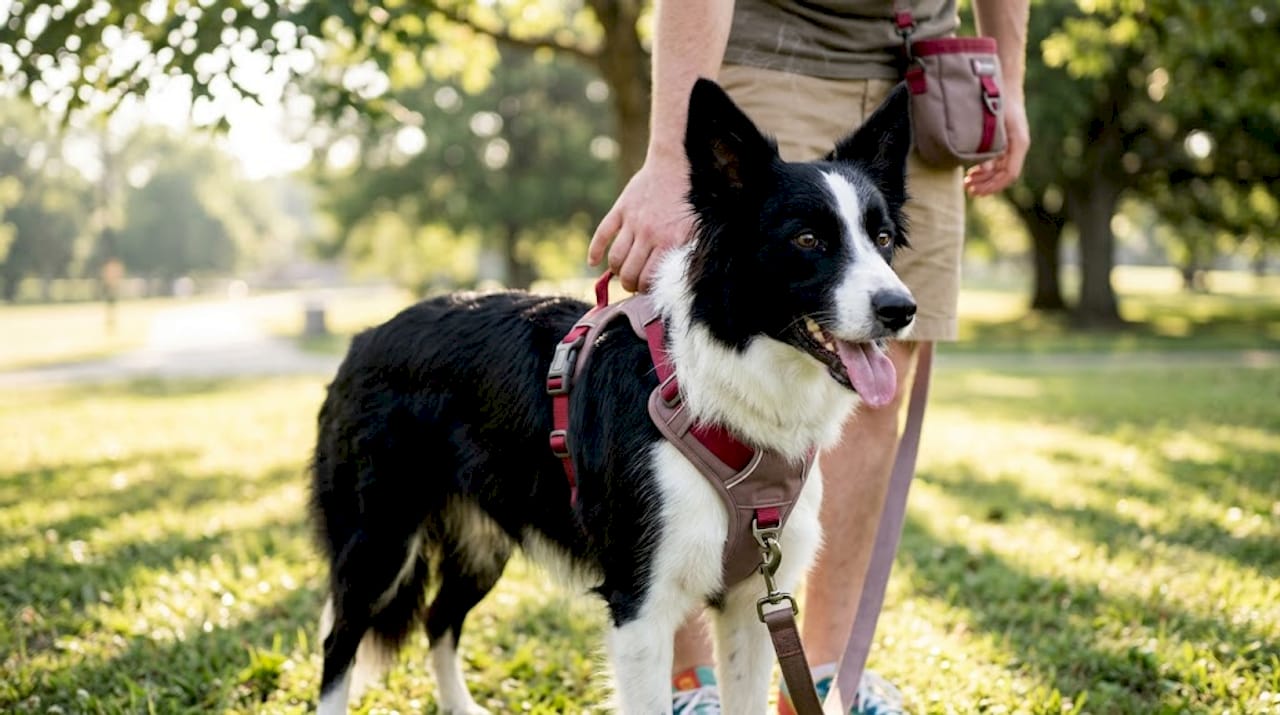
The fit is everything. A harness that sits too loose slips off. One that is too tight restricts shoulder movement and causes sores. You should be able to slide two fingers under every strap comfortably. Americanbarkbliss has a detailed guide on fitting a dog harness correctly that is worth reading before you buy.
Front-clip harnesses with padded straps prevent chafing and make adjustment easy, especially important for energetic or strong breeds. The Asanoha harness at Americanbarkbliss combines that padded comfort with a clean, stylish design made for everyday use.
4. A treat pouch for training on the go
Walks are not just exercise. They are your best opportunity to reinforce good behavior, redirect your dog away from distractions, and build a stronger communication foundation. None of that works if you are fumbling in your pockets for treats while your dog lunges at a squirrel.
Belt-clip treat pouches run about $10 to $20 and give you instant, one-handed access to rewards. That speed is what makes the difference between a timely reinforcement and a missed training moment. Look for a magnetic closure or a drawstring top so treats do not spill when you move fast.
Pro Tip: Fill your treat pouch with high-value, small treats before every walk. Save the good stuff, like real meat pieces, for the moments that matter most: crossing a busy street, passing another dog, coming when called.
5. Poop bags and a dispenser
This one is non-negotiable. Every single walk. Carry more bags than you think you need because dogs have a talent for going more than once, and running out in the middle of a park is genuinely embarrassing.
A dispenser that clips to your leash keeps bags accessible without taking up pocket space. Refillable dispensers are more economical and produce less plastic waste over time. Keep a backup roll in your car or bag so you are never caught short.
6. A portable water bottle and bowl
Dogs overheat faster than most owners realize. A collapsible water bottle that doubles as a drinking vessel is one of the most practical items on this list. It takes up almost no space and gets used on every walk longer than 20 minutes.
For dogs that prefer drinking from a bowl, a separate floating design bowl works well at rest stops or on trails. In hot weather, hydration is not optional gear. It is safety gear.
7. Reflective gear and clip-on lights
If you walk your dog at dawn, dusk, or after dark, visibility is the difference between a safe walk and a serious accident. Reflective vests and clip-on lights are considered non-negotiable by professional dog walkers. Reflective gear runs $15 to $30. A clip-on light costs around $12. For what they protect against, that is some of the best money you will spend on any dog walking safety accessory.
Attach lights to both your dog’s harness and your own jacket or bag. Drivers and cyclists need to see both of you, not just one.
8. Supportive walking shoes for you
This one gets skipped constantly, and it should not. Good walking shoes protect against foot pain and injury on long or frequent walks, running $80 to $130, and needing replacement every 6 to 9 months with daily use. Worn-out soles on slippery pavement are a real fall risk, especially when a dog pulls unexpectedly.
Look for cushioning, arch support, and grip. Running shoes or trail shoes both work well. Do not walk miles on flat-soled casual shoes and wonder why your knees hurt.
9. A compact first aid kit
Minor accidents happen on walks. A thorn in the paw, a small cut from rough terrain, or a bee sting can turn into a bigger problem if you have nothing to address it with. A dog walker’s first aid kit typically includes bandages, gauze, antiseptic, tweezers, and gloves, costing about $20 to $25.
You do not need to become a veterinary technician. You just need enough to stabilize a situation until you can get home or to a vet. A small kit fits in any bag and stays there permanently.
10. Gear for specific conditions and situations
Once your core kit is solid, these additions make walks better in specific circumstances.
- Backup slip lead: A simple loop lead that slips over the head in seconds. If your main leash or harness fails, this saves the walk and keeps your dog safe. Costs about $5.
- Multi-dog leash coupler: If you walk two dogs, a coupler attaches both leashes to a single handle so you are not juggling two separate leads.
- Waterproof leash and collar: For rainy-day walks, a waterproof leash and a waterproof collar resist mildew and dry fast, saving you from that sour wet-dog-gear smell that builds up over time.
- Cooling bandana or paw wax: In summer heat, cooling bandanas help regulate body temperature. Paw wax protects pads from hot pavement that can cause real burns.
- Cleaning wipes: A pack of pet-safe wipes in your bag handles muddy paws, dirty ears, or anything your dog decides to roll in before you get home.
11. Gear comparison: making the right call
Use this table to compare options across the most commonly debated categories.
| Gear type | Options | Best for | Price range |
|---|---|---|---|
| Leash material | Nylon vs. rope vs. padded grip | Nylon: everyday use. Rope: durability. Padded: strong pullers. | $15 to $35 |
| Harness clip style | Front-clip vs. back-clip vs. dual-clip | Front: pulling dogs. Back: calm walkers. Dual: maximum control. | $25 to $65 |
| Treat pouch closure | Magnetic vs. drawstring vs. snap | Magnetic: fastest access. Drawstring: secure for small treats. | $10 to $20 |
| Lighting and visibility | Reflective vest vs. clip-on light vs. LED collar | Use reflective gear AND a light together for best coverage. | $12 to $30 |
| Water bottle style | Collapsible vs. insulated | Collapsible: short walks. Insulated: hot weather or long hikes. | $10 to $25 |
My honest take on building a walking kit
I’ve watched a lot of dog owners spend way too much money, way too fast, on gear that looks impressive but never actually gets used. The expensive GPS tracker sits in a drawer. The designer treat vest gets replaced with a zip-top bag. The fancy hands-free leash feels awkward and gets swapped out by week two.
What I’ve found actually works is starting with five things: a solid 6-foot leash, a properly fitted front-clip harness, a simple treat pouch, poop bags, and water. That is it. Get those right and your walks improve immediately. Everything else is an upgrade you add when a real need shows up.
The thing most people overlook is owner comfort. Your shoes matter. Your hand fatigue matters. When you are uncomfortable, you cut walks short, you tense up on the leash, and your dog feels it. The gear that improves your experience directly improves your dog’s experience too.
My other honest observation: the best essential dog walking gear is gear you actually use consistently. A $20 treat pouch used on every single walk beats a $60 one that stays on the shelf because it is annoying to refill. Buy practical before you buy premium.
— Christopher
Gear up with Americanbarkbliss for every walk
Americanbarkbliss carries American-made dog walking gear built for real daily use, not just good photos. From premium leash options with stylish designs to hydration solutions and harnesses that fit properly, every product on the site is chosen for quality that holds up walk after walk. If you are building your kit from scratch or upgrading one weak link, the full product range at Americanbarkbliss gives you options across every category covered in this guide. You can also pick up a carry-everything tote to keep your walking essentials organized and ready by the door. Shop domestically made gear that your dog will benefit from on every single walk.
FAQ
What are the most important dog walking accessories?
A quality 6-foot leash, front-clip harness, treat pouch, poop bags, and portable water are the five core items every dog owner needs before anything else.
Are retractable leashes safe for dog walking?
No. Retractable leashes pose serious risks including tangling, loss of control near traffic, and injury to both the dog and handler. Stick with a standard 6-foot leash.
How much does basic dog walking gear cost?
A complete starter kit covering all core walking needs costs about $135 to $200, including walking shoes. You can spend less if you already own footwear.
Do I really need a harness instead of a collar?
For most dogs, yes. Front-clip harnesses reduce pulling by up to 60% and remove all pressure from the throat, making them safer and more comfortable for daily use than collars alone.
What should I bring on a longer dog walk or hike?
Beyond your basics, add a compact first aid kit, insulated water bottle, paw wax for rough terrain, and a backup slip lead. Reflective gear or a clip-on light is also worth packing if you might return after dark.
Leave a comment