

Why Use American-Sourced Materials: Benefits for U.S. Buyers
TL;DR:
- Using American-sourced materials shortens lead times, improves quality, and supports U.S. manufacturing.
- “Made in USA” requires all significant parts and labor to originate domestically, while “American-sourced” indicates U.S. origin of raw materials or components.
Use American-sourced materials when you want shorter lead times, clearer quality controls, and a measurable boost to the U.S. economy. The Federal Trade Commission’s “Made in USA” standard requires that “all or virtually all” of a product’s content originate domestically, and Buy America/Build America (BABA) policies extend that logic to federally funded infrastructure. OSHA-backed manufacturing oversight adds another layer of accountability that most offshore suppliers simply cannot match.
The core reasons to prioritize domestic sourcing:
- Economic impact: Domestic spending recirculates through local supply chains, supporting manufacturing jobs and tax revenue.
- Supply-chain resilience: Shorter distances mean faster delivery and far less exposure to port congestion, tariff swings, and currency volatility.
- Quality and compliance: U.S. manufacturers operate under stricter federal safety and environmental standards.
- Traceability: Domestic production makes it easier to document provenance, which matters for green certifications and corporate reporting.
- Trade-offs: American-sourced materials sometimes carry a higher sticker price and limited availability for niche inputs — total cost of ownership tells a different story than unit cost alone.
Table of Contents
- What do “American-sourced,” “Made in USA,” and “Buy America” actually mean?
- How does American sourcing support U.S. jobs and local economies?
- Does domestic sourcing actually shorten lead times?
- Why do American-made materials often produce better quality outcomes?
- What are the environmental and traceability benefits of domestic sourcing?
- When does American sourcing cost more, and when do imports still make sense?
- How do you verify that a product is genuinely American-sourced?
- What do industry experts and case evidence say about domestic sourcing?
- How did perceptions of American-sourced materials evolve over time?
- How does American sourcing affect brand reputation and consumer trust?
- Which industries and products benefit most from American sourcing?
- What government policies and incentives encourage American sourcing?
- What challenges go beyond cost and availability?
- Key Takeaways
- The case for domestic sourcing is stronger than the price tag suggests
- American-made pet products, sourced and verified
- FAQ
- Useful sources
What do “American-sourced,” “Made in USA,” and “Buy America” actually mean?
The labels are not interchangeable, and the differences carry real consequences for buyers.
“Made in USA” is the FTC’s unqualified claim. To use it, a product must be “all or virtually all” made in the United States — meaning all significant parts, processing, and labor must be domestic. Slapping together foreign components on U.S. soil does not qualify; that is “Assembled in USA,” a weaker claim the FTC treats separately.
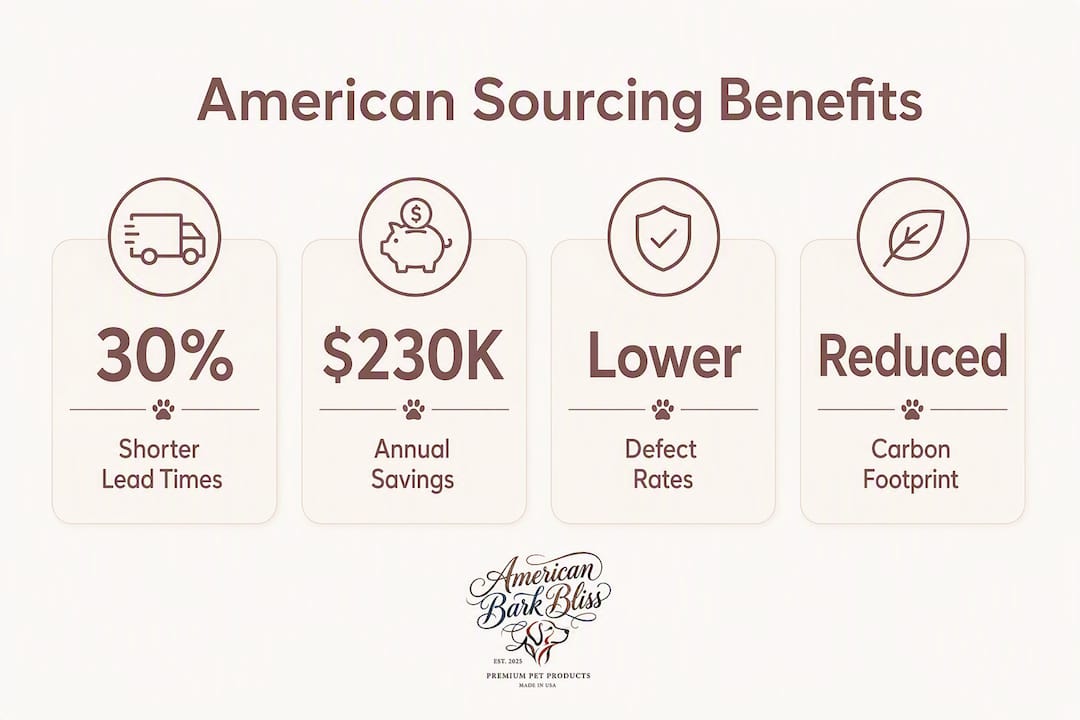
“American-sourced” is a broader, informal term. It typically means raw materials or components originate in the U.S., even if final assembly happens elsewhere. Buyers should always ask what percentage of content is domestic and request documentation.
Buy America / Build America (BABA) applies specifically to federally funded projects. The 2021 Infrastructure Investment and Jobs Act expanded BABA requirements to cover broadband, water systems, and other infrastructure categories that were previously exempt. If your project touches federal funding, BABA compliance is not optional.
A short supplier checklist worth keeping handy:
- Country-of-origin statement for raw materials
- Percentage of domestic content by value
- Mill test reports or provenance statements
- Bill of materials showing component origins
- Third-party certifications or audit records
How does American sourcing support U.S. jobs and local economies?
Every dollar spent on a domestically made product does more than buy a single item. It supports the supplier who sold the raw material, the trucking company that moved it, and the local tax base that funds schools and infrastructure. That multiplier effect is the economic argument for domestic sourcing in plain terms.

U.S. manufacturing jobs tend to pay above the national median wage, and the sector supports a dense web of upstream suppliers. When a manufacturer sources steel, polymers, or textiles domestically, those purchases sustain additional jobs at mills, chemical plants, and logistics firms. Cutting that chain by importing finished goods exports those wages too.
On the procurement side, specifying domestic materials can open eligibility for federally funded contracts and BABA-compliant project bids. Some states layer their own preferences on top of federal rules, creating additional competitive advantages for buyers who document domestic content. Tax incentives tied to domestic manufacturing investment — including provisions in recent federal legislation — add another financial dimension that pure unit-cost comparisons miss.
Key figure: Container shipping rates rose nearly 30% in spring 2024, which increased the total landed cost of imported materials beyond sticker price.
Does domestic sourcing actually shorten lead times?
Yes, and the difference can be dramatic. One documented case involved a custom caster: an international supplier quoted a 20-plus-week lead time; a domestic manufacturer shipped the same part in four weeks. That is not a marginal improvement. For a project on a tight schedule, it is the difference between on-time delivery and a costly delay.
Domestic sourcing also insulates buyers from the unpredictable costs of international logistics. Tariff changes, port congestion, and currency swings all inflate the true cost of imports in ways that are hard to forecast at the time of purchase. U.S.-manufactured products offer steadier pricing and more consistent inventory, which makes project scheduling and budgeting more reliable.
Vertical integration helps too. Domestic manufacturers who control their own raw materials can deliver engineered-to-order solutions faster than far-shore suppliers who depend on multi-tier supply chains they do not own.
Pro Tip: When writing purchase orders for domestically sourced materials, include a lead-time guarantee clause and specify a domestic-content minimum. This protects your schedule and creates a paper trail for BABA compliance or brand claims.
Why do American-made materials often produce better quality outcomes?
U.S. manufacturers operate under federal safety and environmental regulations that have no direct equivalent in many export-heavy countries. OSHA workplace standards, EPA environmental rules, and sector-specific requirements like AS9100 for aerospace create a compliance floor that filters out the shortcuts common in lower-cost offshore production.
The practical result is lower defect rates and more consistent output. Domestic producers can provide mill certificates, lot traceability, and third-party inspection reports on request. That documentation matters when a buyer needs to prove compliance, file a warranty claim, or trace a defect back to its source. With an overseas supplier, that chain of evidence often breaks down at the port.
Local support is another underrated advantage. A domestic supplier can send a technician, replace a part, or adjust a specification in days rather than weeks. That proximity turns a transactional purchase into an ongoing partnership.
For pet product buyers specifically, quality in dog accessories directly affects safety — a point that applies equally to collars, toys, and grooming tools made under domestic oversight.
What are the environmental and traceability benefits of domestic sourcing?
Shorter transport distances mean lower embodied carbon. A product manufactured in Ohio and shipped to a buyer in Tennessee generates a fraction of the transport emissions of the same product shipped from overseas. For buyers pursuing LEED certification or corporate sustainability reporting, that difference shows up in lifecycle assessments and scope 3 emissions disclosures.
Domestic sourcing also improves supply-chain transparency, which is increasingly a differentiator for sustainability-focused buyers. When raw materials and manufacturing stay within U.S. borders, labor practices and environmental compliance are governed by federal law and subject to domestic enforcement. That is a meaningful contrast with supply chains that cross multiple jurisdictions, each with different standards and varying enforcement.
A few sustainability considerations worth noting:
- Traceability from raw material to finished product supports green building certifications and ESG reporting.
- Some U.S. manufacturers use recycled input materials, further reducing environmental impact.
- Domestic production is not automatically lower carbon in every case; a highly efficient foreign plant with renewable energy may outperform a less efficient domestic one. Evaluate lifecycle data, not just geography.
- For sustainable pet accessories, domestic sourcing provides the documentation trail that makes environmental claims credible rather than aspirational.
When does American sourcing cost more, and when do imports still make sense?
Sticker price and total cost of ownership are two different numbers. The $230,000 in annual savings one company achieved by switching from cheap imported casters to U.S.-made, maintenance-free alternatives illustrates the gap. The imported parts were cheaper per unit and needed monthly replacement. The domestic parts cost more upfront and lasted years.
That said, domestic sourcing is not always the right call. Situations where imports remain practical:
- Commodity materials with no domestic equivalent: Some specialized polymers, rare earth components, or high-volume commodity inputs simply are not produced at scale in the U.S.
- Very large scale with offshore economies of scale: When volume is enormous and quality requirements are modest, offshore unit economics can still win even after freight is factored in.
- Niche technical components: Certain precision parts or advanced materials are manufactured primarily abroad, and no domestic alternative exists at comparable specification.
For American-made vs. imported pet goods, the calculus often favors domestic sourcing because safety, durability, and traceability matter more than marginal cost savings on a product your dog uses every day.
How do you verify that a product is genuinely American-sourced?
Labels are a starting point, not proof. Here is what to actually request:
- Country-of-origin statement for every significant input material, not just the finished product
- Mill test reports or certificates of conformance showing where raw materials were processed
- Bill of materials with domestic content percentage by value
- Provenance statements from upstream suppliers
- Third-party audit or inspection reports if the claim is unqualified “Made in USA”
Questions worth asking a sales rep before committing:
- What is your lead-time guarantee, and what happens if you miss it?
- Where are your raw materials sourced, and can you document that?
- What is your return or replacement policy if a defect appears?
- Do you carry product liability insurance under U.S. jurisdiction?
Red flags: vague “assembled in the USA” language with no content percentage, missing mill certificates, inability to name upstream suppliers, and no local service or support contact. Any supplier who cannot answer basic provenance questions is a risk, regardless of what the label says.
What do industry experts and case evidence say about domestic sourcing?
The operational evidence is consistent. The custom caster case cited earlier — four weeks domestic versus 20-plus weeks international — is not an outlier. It reflects a structural advantage: domestic manufacturers can communicate directly with buyers, adjust specifications quickly, and ship without crossing customs.
The $230,000 annual savings from switching to U.S.-made maintenance-free casters reinforces the total-cost-of-ownership argument. The imported alternative was cheaper per unit. Over a year of monthly replacements, it was dramatically more expensive. Procurement teams that model only unit cost systematically underestimate the true cost of imports.
Container shipping rates rose nearly 30% in spring 2024, which increased the total landed cost of imported materials beyond sticker price. Domestic sourcing does not eliminate cost volatility but removes the most unpredictable variable: international freight.
How did perceptions of American-sourced materials evolve over time?
The “Made in USA” label carried near-universal prestige through most of the 20th century, then lost ground during the offshoring wave of the 1980s and 1990s when cost competition drove manufacturing overseas. By the early 2000s, domestic sourcing was often framed as a premium niche rather than a mainstream expectation.
That framing has shifted. Supply-chain disruptions during 2020 and 2021 exposed the fragility of long, globalized supply chains in ways that were impossible to ignore. Buyers who had accepted long lead times as normal suddenly faced months-long waits for basic components. The experience pushed procurement teams, consumers, and policymakers to reconsider the real cost of offshoring. Today, domestic sourcing is increasingly treated as a risk-management strategy, not just a patriotic preference.
How does American sourcing affect brand reputation and consumer trust?
Consumers notice. A “Made in USA” label signals quality, accountability, and a commitment to domestic workers that resonates with a broad segment of American buyers. For brands, it is a differentiator that is difficult to fake — the FTC’s enforcement of the “all or virtually all” standard means a false claim carries real legal risk.
For e-commerce brands in particular, domestic sourcing supports the kind of transparent storytelling that builds long-term customer loyalty. Buyers who care about where their products come from are also buyers who leave reviews, recommend products to friends, and return for repeat purchases. That customer profile is worth more than the margin saved by sourcing offshore.
Which industries and products benefit most from American sourcing?
Defense and aerospace have operated under strict domestic-content requirements for decades, and for good reason: supply-chain integrity in those sectors is a national security issue. U.S. manufacturing is central to economic growth and defense competitiveness.
Construction and remodeling benefit from domestic sourcing through scheduling reliability and consistent quality. Pet products are another strong case: safety standards for materials that contact animals directly, combined with the traceability demands of informed pet owners, make domestic sourcing a clear advantage. Medical devices, food processing equipment, and children’s products follow similar logic — anywhere that safety, traceability, and regulatory compliance matter more than unit cost.
What government policies and incentives encourage American sourcing?
The 2021 Infrastructure Investment and Jobs Act’s Build America, Buy America provisions extended domestic-content requirements to infrastructure categories that were previously exempt. Federal procurement rules under the Buy American Act have long required domestic preference for government purchases, and recent executive orders have tightened those standards.
Beyond mandates, federal and state tax incentives tied to domestic manufacturing investment create financial reasons to source locally even when it is not legally required. The CHIPS and Science Act directed funding toward domestic semiconductor manufacturing. The Inflation Reduction Act included domestic-content bonuses for clean energy projects. These policies reflect a bipartisan consensus that rebuilding domestic manufacturing capacity is a strategic priority, not just an economic preference.
What challenges go beyond cost and availability?
Capacity constraints are real. Some materials and components are not produced domestically at the scale or specification buyers need, and no amount of policy preference changes that in the short term. Specialized advanced materials, certain electronics components, and high-volume commodity inputs often have no viable domestic alternative.
Innovation limitations can also appear. Industries where R&D and manufacturing are concentrated overseas may produce technical advances that reach domestic buyers only through imports. Forcing domestic substitution in those cases can mean accepting an older or less capable product.
Workforce constraints add another layer. Skilled manufacturing labor is in short supply in some regions and sectors, which can limit a domestic supplier’s ability to scale quickly. Buyers who need large volumes on short notice may find that domestic capacity simply cannot absorb the order. These are genuine constraints, not arguments against domestic sourcing — they are reasons to plan ahead, build supplier relationships early, and use mixed sourcing strategies where the trade-offs justify it.
Key Takeaways
American-sourced materials deliver the strongest value when lead time, safety compliance, and traceability matter more than unit cost alone.
| Point | Details |
|---|---|
| FTC “Made in USA” standard | Requires “all or virtually all” domestic content — simple assembly does not qualify; always request documentation. |
| Total cost of ownership | One company saved $230,000 annually by switching from cheap imported parts to U.S.-made alternatives with longer service life. |
| Lead-time advantage | Domestic production can cut lead times from 20-plus weeks to four weeks, as documented in real procurement cases. |
| Sustainability and traceability | Shorter transport distances lower embodied carbon, and domestic labor/environmental oversight supports credible green claims. |
| Americanbarkbliss | Carries American-made pet accessories — treats, toys, collars, and grooming tools — that meet domestic quality and traceability standards. |
The case for domestic sourcing is stronger than the price tag suggests
The conventional framing treats American-sourced materials as a premium you pay for patriotism. That framing is wrong, and it costs buyers real money.
The $230,000 annual savings from switching to U.S.-made casters is not a feel-good story. It is a procurement lesson: the cheapest unit price and the lowest total cost are rarely the same number. When you add replacement frequency, freight volatility, tariff exposure, and the cost of a delayed project, domestic sourcing often wins on pure economics — before you factor in quality consistency, regulatory compliance, or the ability to call a supplier and get a person on the phone.
What gets underestimated is the risk side of the ledger. Buyers who offshore to save 15% on unit cost are also accepting 20-plus-week lead times, exposure to shipping-rate spikes, and a documentation chain that breaks down at the border. Most procurement models do not price those risks correctly because they are hard to quantify until something goes wrong.
The patriotic argument is real, but it should not have to carry the whole weight. Domestic sourcing is a sound operational decision for any buyer who values reliability, traceability, and a supplier relationship that can actually respond when something needs to change.
American-made pet products, sourced and verified
Americanbarkbliss was built on a straightforward premise: if you are going to buy something your dog uses every day, it should be made somewhere you can actually verify. Every product on the site is selected for domestic sourcing, safety compliance, and durability — not just because “Made in USA” looks good on a label, but because the quality difference shows up in how long the product lasts and how confidently you can stand behind it.
The Americana Chicken Chips for Dogs are made with U.S.-sourced chicken and no imported fillers. The USA-K9 Stars and Stripes Rubber Dog Toy is built to the same durability standard used by professional K9 handlers. Collars like the Wolfdoge Signature Collar, Asanoha Collar, and Polar Bears Nylon Dog Collar are sourced for material integrity, not just style. Grooming tools including THE TOOL KIT, the Pet Grooming Gloves, and the Country Living All-in-One 3-Piece Dog Grooming Kit round out a range built around the same sourcing principles this article covers.
Browse the full collection at Americanbarkbliss and see what domestic sourcing looks like in practice.
FAQ
What does “American-sourced” mean for a product?
“American-sourced” means the raw materials or components originate in the United States. The FTC’s stricter “Made in USA” label requires that “all or virtually all” content be domestic — simple U.S. assembly of foreign parts does not qualify.
What are the main benefits of buying American-made products?
The primary advantages are shorter lead times, stricter safety and quality compliance, better supply-chain traceability, and direct support for U.S. manufacturing jobs and local economies.
Why don’t more buyers choose American-made products?
Higher unit prices and limited domestic capacity for some specialized materials are the most common barriers. Buyers focused on sticker price rather than total cost of ownership often underestimate the freight, tariff, and replacement costs that make imports more expensive over time.
Are there products that are 100% made in the USA?
Yes. Products meeting the FTC’s unqualified “Made in USA” standard must have all significant parts, processing, and labor originate domestically. Pet treats, rubber toys, and nylon accessories are categories where fully domestic production is achievable and verifiable — Americanbarkbliss carries several examples.
How do I verify a supplier’s American-sourcing claims?
Request a country-of-origin statement, mill test reports, a bill of materials with domestic content percentage, and any third-party audit documentation. Vague labeling with no supporting paperwork is a red flag.
Useful sources
These are the primary references used in this article. Each is worth bookmarking if you are making procurement decisions or vetting supplier claims.
- FTC: Complying with the Made in USA Standard — The authoritative source for what “Made in USA” legally requires and how the FTC enforces it.
- Alliance for American Manufacturing: Top Ten Reasons to Buy America — Covers the economic, security, and policy case for domestic purchasing, including BABA context.
- Advanced Manufacturing: “Made in the USA” — It’s More Than Just a Slogan — Operational case studies including the lead-time and cost-savings examples cited above.
- BLS: A Look at Manufacturing Jobs on National Manufacturing Day — Labor market data on U.S. manufacturing employment.
- Americanbarkbliss: American-made dog products — Category-specific examples of domestically sourced pet accessories with sourcing context.
Leave a comment