

Water-Resistant Dog Apparel: What It Is and How to Choose It
TL;DR:
- Water-resistant dog apparel sheds light moisture using surface treatments and lightweight fabrics suitable for daily walks. In heavy rain or prolonged exposure, seam-sealed and membrane-backed waterproof coats become necessary for full protection. Proper fit, maintenance, and breed-specific needs determine whether a dog benefits more from water resistance or waterproof gear.
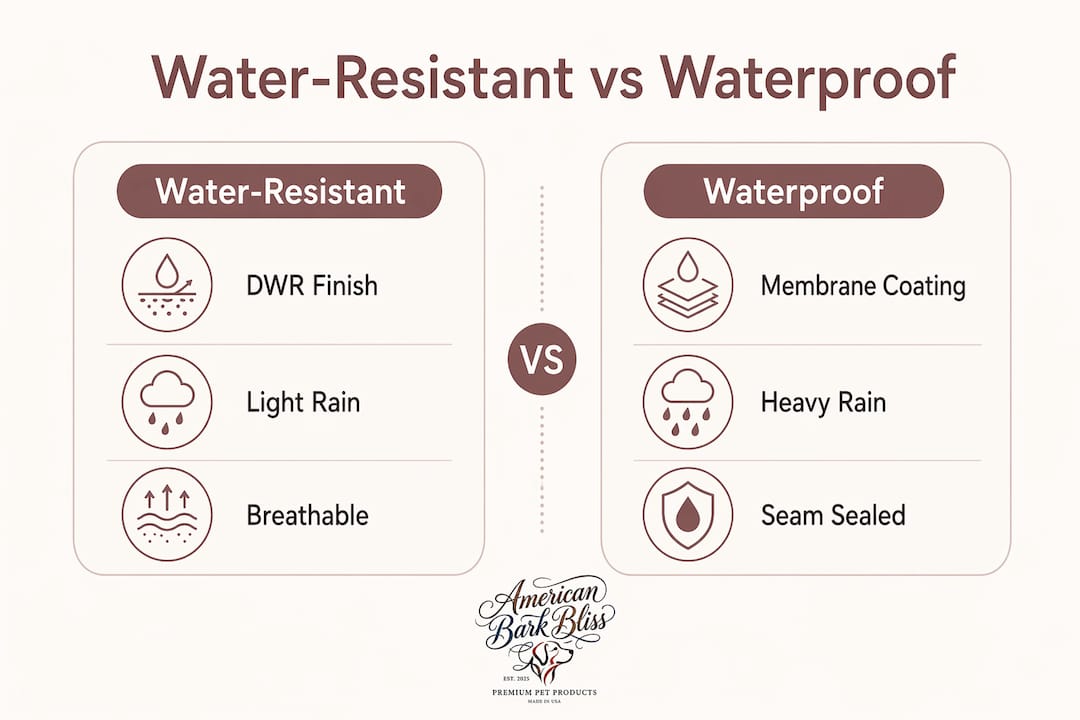
Water-resistant dog apparel is clothing treated or constructed to shed light moisture — drizzle, morning dew, muddy yard runs — while staying breathable and comfortable for your dog. It is not the same as waterproof gear. The key difference: water-resistant garments use surface treatments like DWR (Durable Water Repellent) or tightly woven shells to bead water off the fabric, but they will wet out in steady rain or prolonged exposure. For most daily walks in light to moderate rain, that level of protection is exactly right.
When to reach for water-resistant apparel:
- Short to medium walks in drizzle or light rain
- Muddy yard runs where you want easy cleanup
- Mild, damp climates where breathability matters more than full waterproofing
- Dogs who overheat easily in heavier, membrane-backed coats
When to upgrade to fully waterproof gear: heavy downpours, long hikes in wet weather, cold rain combined with wind, or dogs with medical conditions requiring strict dryness. Look for seam-sealed shells with a breathable membrane rather than DWR alone. Expert guidance confirms that for many short to medium walks in light to moderate rain, water-resistant garments are sufficient — but longer or harsher conditions call for a full waterproof solution.
The AKC specifically flags single-coated breeds, senior dogs, and small breeds as most at risk from damp cold, making water-resistant apparel a practical daily tool for those dogs. Americanbarkbliss carries several American-made options across both protection levels, from the Body Glove Dog Raincoat to the Loft Dog Jacket.
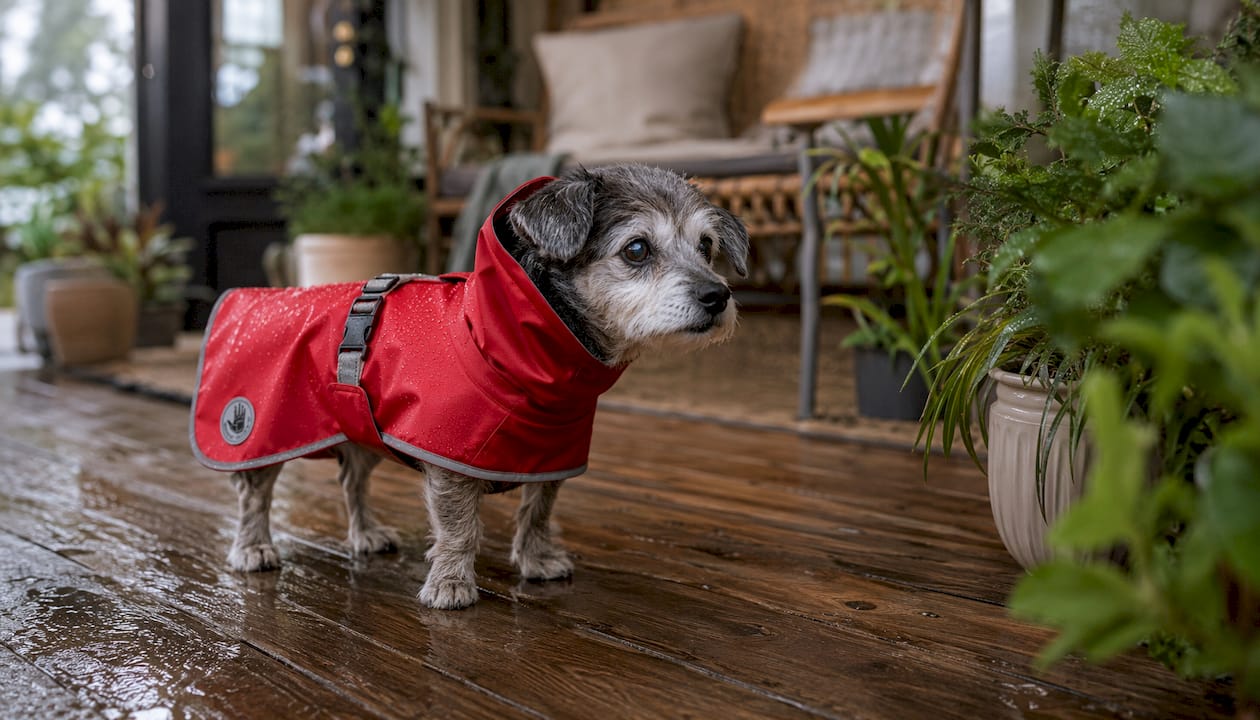
Pro Tip: If your dog’s coat feels damp after a walk even in light rain, that’s your signal to check whether the garment’s DWR is still active — or whether your dog needs a step up in protection level.
Table of Contents
- How water-resistant finishes and membranes actually work
- What fabrics are actually used in water-resistant dog coats?
- Construction details that actually matter for wet-weather protection
- Which dogs benefit from water-resistant apparel — and which usually don’t
- How to choose the right size, fit, and style for your dog
- How to wash, reproof, and store water-resistant dog apparel
- What to expect at different price points — and when to upgrade to waterproof
- Key Takeaways
- Why the “waterproof” label on dog coats is often misleading
- What Americanbarkbliss recommends for wet-weather protection
- Sources and further reading
- FAQ
How water-resistant finishes and membranes actually work
The label “water-resistant” covers a wide range of actual performance, and understanding the mechanics helps you read spec sheets instead of just trusting marketing copy.
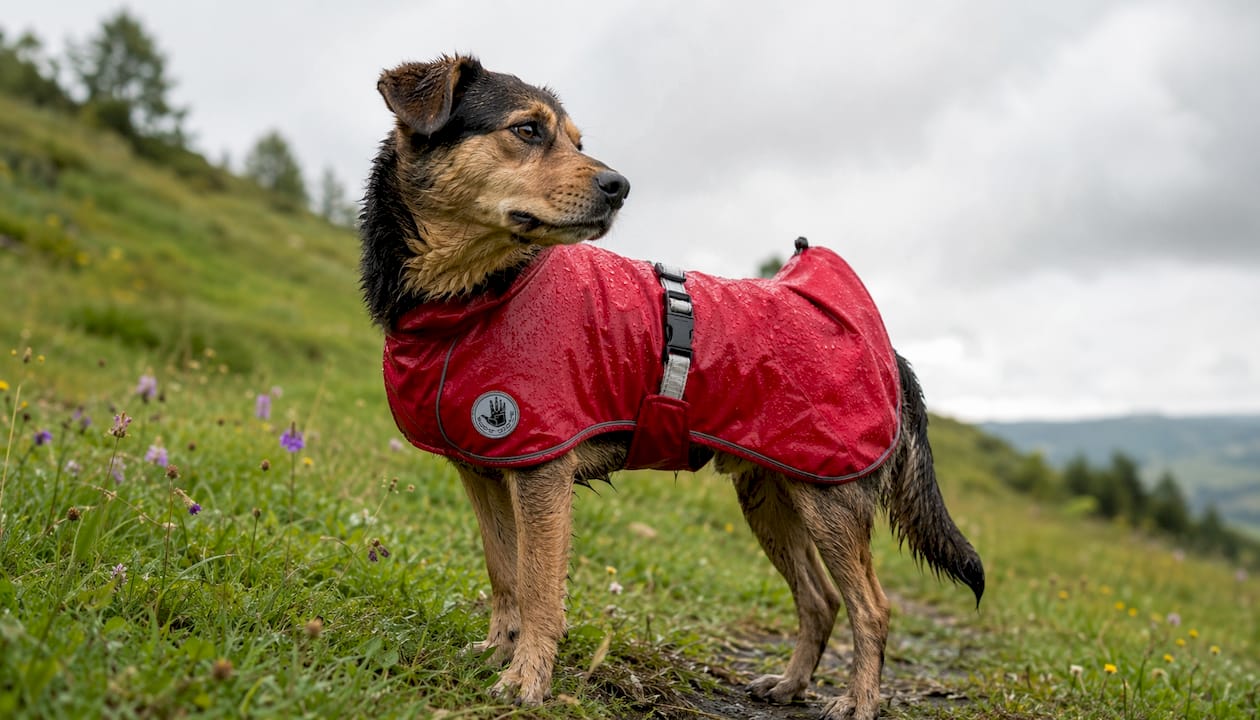
DWR (Durable Water Repellent) is a chemical finish applied to the outer face of a fabric. It causes water to bead up and roll off rather than soaking in. DWR works well when it’s fresh and clean, but it degrades with dirt, abrasion, and washing. A garment with worn-out DWR will “wet out” — the outer fabric absorbs water and feels heavy, even if an inner membrane is still blocking moisture. That’s a maintenance issue, not a product failure, and it’s fixable.
PU (polyurethane) coatings are applied to the inner face of a fabric, creating a physical barrier against water penetration. They add meaningful waterproofing but reduce breathability. PUL (polyurethane laminate) bonds a thin PU film directly to the fabric, which is more durable than a simple coating and common in mid-range dog coats.
Microporous membranes are the gold standard for true waterproofing with breathability. These thin films have microscopic pores too small for liquid water to pass through but large enough for water vapor (body heat) to escape. A coat with a breathable membrane stays dry inside even in heavy rain, without trapping heat the way a fully sealed PU coat does.
Key specs to look for on a product page:
- Hydrostatic head rating (mm): A measure of how much water pressure a fabric can resist. Ratings of 1,000–5,000 mm correspond to light to moderate rain protection, 5,000–10,000 mm handles heavy rain and wet snow, and 10,000+ mm is for extreme conditions.
- Seam-sealed or taped seams: Without sealed seams, water enters through needle holes even if the fabric itself is waterproof.
- Waterproof zippers or storm flaps: Standard zippers leak; storm flaps or waterproof zippers close that gap.
- Membrane type: “Water-resistant” without a membrane means DWR only. “Waterproof” should mean membrane plus sealed seams.
Marketing frequently conflates DWR-treated shells with fully waterproof garments. True waterproof performance depends on seam sealing and membrane presence, not just a surface finish.
What fabrics are actually used in water-resistant dog coats?
The shell fabric determines weight, abrasion resistance, and how well a finish or coating performs over time. Here’s how the common options stack up.
Ripstop nylon is woven with a reinforcing grid pattern that prevents tears from spreading. It’s lightweight, packs down small, and takes DWR coatings well. Most entry-level to mid-range rain jackets use it. The tradeoff: thinner ripstop can feel crinkly and may not hold up to heavy brush or rough terrain.
Taslan nylon is a textured, brushed nylon that feels softer than standard ripstop and has a more casual look. It’s common in everyday dog jackets where comfort and appearance matter as much as technical performance. It handles DWR well and is reasonably durable.
Polyester is heavier than nylon but more resistant to UV degradation and holds color better. Oxford-weave polyester is a popular choice for structured dog coats and raincoats. It’s less packable but often more affordable.
Waxed canvas offers a traditional water-shedding finish without synthetic coatings. It’s durable and develops character with use, but it’s heavy, not breathable, and requires periodic re-waxing to maintain performance.
Neoprene shows up in dog life jackets and boots rather than rain jackets. It insulates even when wet, which makes it useful for water activities, but it’s too warm and restrictive for everyday walking.
| Fabric | Water performance | Breathability | Durability | Best for |
|---|---|---|---|---|
| Ripstop nylon + DWR | Light to moderate | Good | Moderate | Everyday rain jackets |
| Taslan nylon + DWR | Light to moderate | Good | Moderate | Casual daily wear |
| Polyester + PU coat | Moderate to heavy | Low–moderate | High | Structured raincoats |
| Nylon + membrane | Heavy to extreme | High (with membrane) | High | All-weather coats |
| Waxed canvas | Moderate | Low | Very high | Cold, rugged use |
| Neoprene | Moderate (wet activities) | Low | High | Life jackets, boots |
Understanding coat types and maintenance also helps you match the right outer layer to your dog’s natural coat, since a dense double coat behaves very differently under a rain jacket than a thin single coat.
Construction details that actually matter for wet-weather protection
Fabric choice gets most of the attention, but construction is what separates a coat that keeps your dog dry from one that just looks the part.
Seam sealing is the single biggest factor in real-world waterproofing. Every needle hole in a sewn seam is a potential leak point. Taped seams cover those holes with a waterproof tape bonded over the stitching. Fully taped seams cover every seam; critically taped seams cover only the most exposed ones (shoulders, back). Construction, not just label, determines waterproof performance — a seam-sealed shell with a breathable membrane delivers true waterproofing while DWR-only finishes fail in steady rain.
Harness compatibility is the most common real-world design failure. Poor harness compatibility forces awkward workarounds that limit function — a coat that covers the D-ring on your dog’s harness means you can’t clip a leash without removing the coat entirely. Good designs include a leash port (a reinforced opening at the back of the neck), D-ring alignment, or a cut that lets the harness sit properly over or under the coat.
Pro Tip: Before buying, check whether the coat has a leash port or harness slot. If it doesn’t, try it on your dog with the harness in place before committing — some coats work fine over a harness; others make leash attachment impossible.
Other construction features worth checking:
- Storm flaps over zippers: Standard zippers leak at the teeth; a fabric flap over the zipper closes that gap.
- Belly coverage: A coat that stops at the spine leaves the underside exposed. Full belly coverage matters most for low-to-the-ground dogs.
- Leg straps and adjustability: Straps that sit too far forward restrict shoulder movement; too far back and the coat shifts during a run.
- Denier rating: Higher denier (e.g., 600D vs. 210D) means thicker, more abrasion-resistant fabric — worth it for active dogs in rough terrain.
- Reinforced high-wear points: Look for extra stitching or material at the chest, belly strap attachment points, and leash port edges.
Quick checklist before you buy:
- Seams: taped or sealed?
- Zippers: storm flap or waterproof zipper?
- Leash access: port, slot, or D-ring alignment?
- Belly coverage: full or spine-only?
- Leg straps: adjustable and positioned for shoulder freedom?
Which dogs benefit from water-resistant apparel — and which usually don’t
Not every dog needs a rain jacket. Knowing which side of that line your dog falls on saves you money and spares your dog unnecessary discomfort.
Dogs who benefit most:
- Single-coated and short-haired breeds (Greyhounds, Whippets, Boxers, Chihuahuas, Miniature Pinschers): no dense undercoat means no natural insulation against damp cold. These dogs get cold fast.
- Senior dogs: Older dogs regulate body temperature less efficiently. Damp fur on a cold day is a real thermal stress risk for a 10-year-old dog that it isn’t for a healthy 3-year-old.
- Small breeds: Low ground clearance means the belly drags through wet grass and puddles on every walk. Even a water-resistant belly panel makes a significant difference.
- Puppies: Young dogs haven’t fully developed thermoregulation. Short walks in cold rain can chill them quickly.
- Dogs with medical conditions: Arthritis, hypothyroidism, Cushing’s disease, and post-surgical recovery all affect a dog’s ability to handle cold and damp. Expert veterinarians recommend protective apparel for medically vulnerable dogs because damp skin increases the risk of thermal stress and related health problems.
The AKC specifically identifies single-coated breeds, senior dogs, and smaller breeds as most susceptible to cold stress, hypothermia, and dermatitis from prolonged dampness. That’s the core candidate list.
Dogs who usually don’t need it:
Double-coated breeds — Huskies, Malamutes, Golden Retrievers, Bernese Mountain Dogs, German Shepherds — have a dense undercoat that naturally insulates and a water-repellent topcoat that sheds light rain on its own. Putting a rain jacket on a Husky in light drizzle is mostly unnecessary and can actually trap heat. The exception: extreme cold rain combined with wind, or a double-coated dog that has been shaved (which disrupts the natural coat structure).
Context matters too. A 10-minute backyard bathroom break in drizzle is different from a 45-minute trail walk in steady rain. Climate, walk duration, and how quickly your dog dries off afterward all factor into whether water-resistant apparel is worth the routine.
For more on when dogs genuinely need jackets, the winter jacket guide on Americanbarkbliss walks through the medical and behavioral signals to watch for.
How to choose the right size, fit, and style for your dog
Getting the right fit matters more than getting the right brand. A coat that bunches at the shoulders or gaps at the belly fails at its job regardless of how good the fabric is.
How to measure your dog:
- Back length: Measure from the base of the neck (where the collar sits) to the base of the tail. This is the primary sizing dimension for most coats.
- Chest girth: Measure the widest point of the chest, just behind the front legs. Add 1–2 inches for comfort.
- Neck girth: Measure around the neck where the collar sits. Critical for coats with neck closures.
- Belly-to-ground distance: Relevant for low-clearance dogs — tells you whether a coat with belly coverage will drag on the ground.
Fit rules to follow:
- The coat should allow full shoulder rotation. Slip two fingers under the chest strap; if you can’t, it’s too tight.
- Belly coverage should reach the underside without pulling the back of the coat upward.
- Leg straps should sit behind the front legs, not across the shoulder joint.
- The neck opening should be snug enough to stay in place but loose enough for the dog to turn its head freely.
For a full step-by-step measuring walkthrough, the pet apparel buying guide on Americanbarkbliss covers fit, fabric, and safety in detail.
Choosing the right style:
- Rain sheet / poncho: Minimal structure, drapes over the back. Good for quick bathroom breaks. Not ideal for active dogs — shifts around during movement.
- Rain jacket: Fitted shell with leg straps and belly coverage. The right choice for most daily walks in wet weather. Prioritize harness compatibility.
- Insulated waterproof coat: Adds a fill layer (fleece, synthetic insulation) under a waterproof shell. Waterproof coats add insulation and structure. Rain jackets are lighter shells that primarily block water and wind without much insulation. Choose the insulated version for cold, wet climates or dogs with poor thermal regulation.
Harness compatibility checklist:
- Does the coat have a leash port or D-ring opening?
- Can the harness chest strap sit flat under or over the coat without bunching?
- Does the coat’s back panel cover the harness D-ring, and if so, is there a slot for leash access?
The right dog apparel guide on Americanbarkbliss has additional guidance on matching style to activity level and climate.
How to wash, reproof, and store water-resistant dog apparel
DWR doesn’t last forever, but it’s recoverable. Most owners don’t realize their coat has lost its water-shedding ability until they notice the outer fabric soaking through — at which point a quick maintenance cycle usually restores it.
- Wash with technical detergent. Standard laundry detergent leaves residues that clog DWR and reduce breathability. Use a technical cleaner like Nikwax Tech Wash or a similar product designed for outdoor fabrics. Avoid fabric softeners entirely — they coat fibers and permanently degrade DWR.
- Use a gentle cycle and cool water. High heat and aggressive agitation break down both DWR and membrane laminates faster. Check the care label; most dog coats specify cold or warm water on a delicate cycle.
- Check for wet-out after washing. Shake the coat or run water over it. If water beads and rolls off, the DWR is still active. If the fabric darkens and absorbs water, it’s time to reproof.
- Apply a DWR reproofing treatment. DWR finishes degrade with dirt, abrasion, and washing; restoring bead-off performance requires cleaning per instructions and a DWR reproofing treatment when bead-off fails. Spray-on products (Nikwax TX.Direct Spray-On, Grangers Performance Repel) work well for spot treatment; wash-in treatments coat the entire fabric more evenly.
- Activate with low heat if the manufacturer recommends it. Some DWR treatments need heat to bond properly. A short tumble on low heat or a brief pass with a warm iron (on a low setting, with a cloth between iron and fabric) can reactivate the finish.
- Air dry or tumble on low. High heat damages membranes and delaminate PUL coatings. When in doubt, air dry.
- Store dry and loosely folded. Prolonged compression — stuffed in a bag for months — can damage membrane laminates and cause delamination. Store flat or loosely rolled in a dry location.
Pro Tip: If your dog’s coat is visibly dirty, wash it before reproofing. Dirt physically blocks DWR sites on the fabric surface, and reproofing over a dirty coat wastes the treatment.
For product-specific washing instructions, the dog accessories care guide on Americanbarkbliss covers gear cleaning in detail.
What to expect at different price points — and when to upgrade to waterproof
Water-resistant dog apparel spans a wide price range, and the differences between tiers are real.
Entry-level ($15–$35): Basic polyester or nylon shells with a DWR finish. Adequate for occasional light rain and short walks. Seams are typically sewn but not sealed. Harness compatibility is often an afterthought. Sizing tends to run inconsistent. Fine for a dog that rarely needs rain protection.
Mid-range ($35–$80): Better fabric (ripstop nylon, Taslan), more consistent sizing, and usually some form of harness access. DWR is more durable. Some products in this range include a PU coating for added water resistance. Belly coverage and adjustable straps are standard. This is the sweet spot for most dog owners who walk daily in variable weather.
Premium ($80–$150+): Membrane-backed shells, taped or sealed seams, waterproof zippers, and thoughtful harness integration. These coats handle heavy rain and prolonged exposure. Breathability is significantly better than PU-coated alternatives because of the membrane. Worth the investment for dogs in wet climates, working dogs, or dogs with medical needs.
When to upgrade from water-resistant to waterproof:
- Your dog is out in rain for more than 20–30 minutes regularly
- You live in a high-rainfall climate (Pacific Northwest, Gulf Coast, New England)
- Your dog is a senior, medically vulnerable, or single-coated in a cold climate
- The current coat is wetting out despite fresh DWR treatment
When water-resistant is the smarter choice: For everyday walks in mild, damp conditions, a breathable water-resistant jacket is often more comfortable than a fully waterproof coat. Waterproof coats without breathable membranes trap heat and moisture inside, which can make a dog just as uncomfortable as getting wet. For many everyday walks, water-resistant gear offers a better balance of breathability and comfort than fully waterproof coats that lack a breathable membrane.
Durability expectations: a well-maintained mid-range coat with periodic DWR reproofing typically lasts multiple seasons of regular use. Premium membrane-backed coats last longer but require the same maintenance discipline.
On sustainability: Synthetic DWR treatments have historically used PFAS (per- and polyfluoroalkyl substances), which are persistent environmental contaminants. Many manufacturers are transitioning to PFAS-free DWR chemistry (fluorocarbon-free formulations). If this matters to you, look for products that specifically state “PFC-free” or “fluorocarbon-free DWR” on the spec sheet.
Key Takeaways
Water-resistant dog apparel uses DWR finishes or tightly woven shells to shed light moisture, making it the right choice for daily walks in drizzle, but seam-sealed, membrane-backed waterproof gear is needed for heavy rain or prolonged exposure.
| Point | Details |
|---|---|
| Match protection to rain exposure | DWR-only coats handle light drizzle; choose membrane-backed, seam-sealed gear for heavy or prolonged rain. |
| Seam sealing changes everything | A waterproof fabric label means little without taped or sealed seams — needle holes leak regardless of the shell material. |
| Fit and harness access are non-negotiable | Measure chest girth and back length; confirm the coat has a leash port or D-ring slot before buying. |
| Maintain DWR to preserve performance | Wash with technical detergent and reproof when water stops beading — most performance loss is maintenance failure, not product failure. |
| Americanbarkbliss for American-made options | The Body Glove Dog Raincoat, Loft Dog Jacket, and The Dog Face Jacket cover light to full waterproof protection, all available at Americanbarkbliss. |
Why the “waterproof” label on dog coats is often misleading
The outdoor apparel industry has spent decades refining what “waterproof” actually means for human gear. Dog apparel hasn’t caught up. Walk through any pet store and you’ll find coats labeled “waterproof” that have no membrane, no sealed seams, and a DWR finish that will wet out after three walks in steady rain. The label is marketing, not a spec.
The honest framing is this: water-resistant is a performance description, not a failure. A well-made DWR jacket on a Whippet in a Seattle drizzle does exactly what it should. The problem isn’t water-resistant gear — it’s owners buying water-resistant gear expecting waterproof performance, or buying “waterproof” gear that is actually just DWR with a bolder label.
What I’d push back on is the instinct to always buy up. A breathable, well-fitted water-resistant jacket worn daily and maintained properly will keep most dogs more comfortable than a heavy, membrane-backed coat that traps heat on a mild rainy day. The membrane matters in a downpour. On a damp Tuesday morning walk, it’s often overkill. Match the coat to the actual conditions your dog faces, not the worst-case scenario you’re imagining.
American-made construction tends to be more consistent in this regard — tighter quality control on seam finishing and more accurate spec labeling. That’s not a blanket claim, but it’s a pattern worth paying attention to when you’re trying to decode what a product actually delivers.
What Americanbarkbliss recommends for wet-weather protection
Getting the right coat for your dog doesn’t have to mean sorting through hundreds of options with vague specs. Americanbarkbliss carries a focused selection of American-made and vetted wet-weather apparel, each matched to a specific use case.
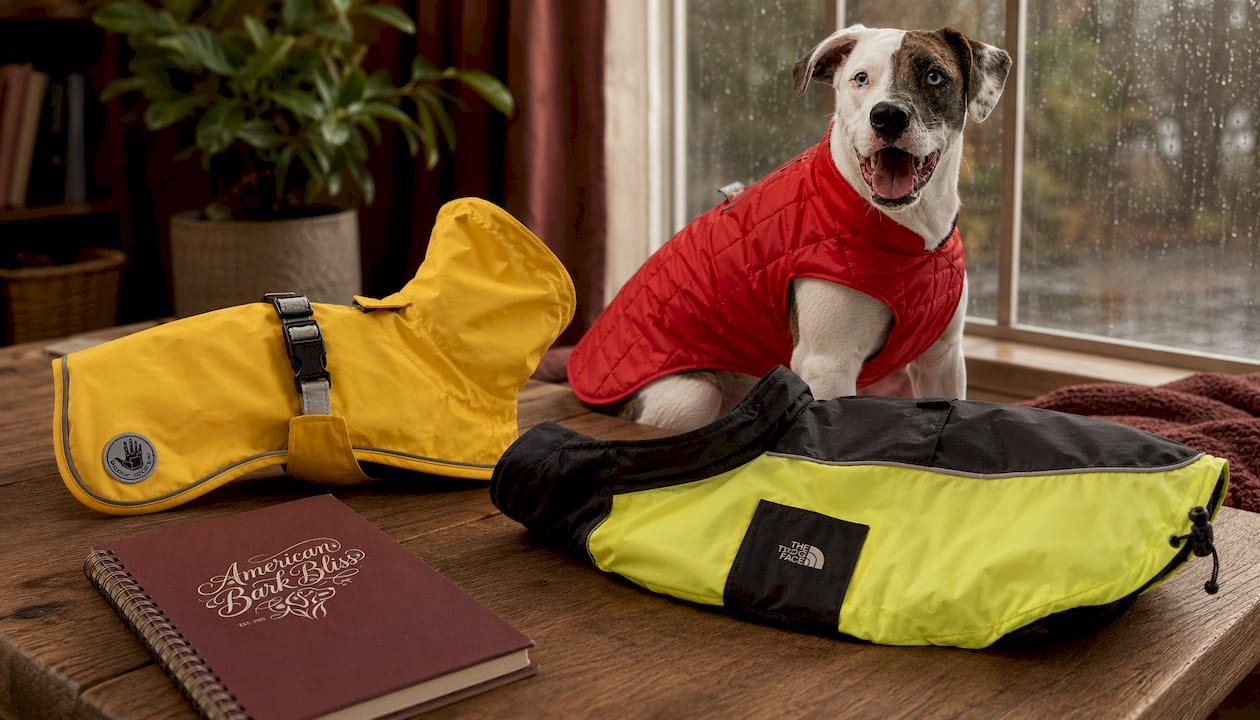
Body Glove Dog Raincoat: Built for dogs that need reliable rain protection on daily walks. The Body Glove design prioritizes coverage and ease of use, with a construction suited to short-haired and single-coated breeds that need consistent protection in wet conditions. Best for: everyday rain walks, breeds without natural water resistance.
Loft Dog Jacket: A reversible, water-resistant jacket with an athletic fit, machine-washable fabric, and reflective detailing for low-light visibility. The Loft Jacket is the daily-driver option — light enough for mild damp weather, reflective enough for early morning or evening walks, and easy to clean. Best for: active dogs, daily commuter walks, owners who want low-maintenance gear.
The Dog Face Windproof Waterproof Reflective Jacket: When conditions get serious, this jacket steps up. Windproof and waterproof construction with reflective panels makes it the right call for cold, wet, windy days or dogs that need full protection. Best for: senior dogs, medically vulnerable dogs, wet-climate owners, and anyone whose daily walk involves real weather rather than a light mist.
All three are available at Americanbarkbliss. Browse the full selection, check sizing guides, and reach out with fit questions before you order.
Sources and further reading
The claims in this article draw on the following sources. Each is worth reading if you want to go deeper on a specific topic.
- AKC — Dog Raincoats: The American Kennel Club’s expert guidance on which breeds benefit from rain protection and why. The primary reference for breed-specific recommendations.
- PuppySimply — Weatherproof Dog Coat Characteristics: Detailed breakdown of DWR, seam sealing, and membrane types. Useful for understanding what product specs actually mean.
- Petsflow — How to Choose a Dog Raincoat: Practical, walk-tested guidance on harness compatibility and the water-resistant vs. waterproof decision.
- PetswellGroup — Water-Resistant vs. Waterproof Materials: The clearest explanation of hydrostatic head ratings and how they map to real weather conditions.
- The Conversation — Five Reasons Your Dog Might Benefit from Canine Clothing: Veterinary-backed rationale for protective apparel, particularly for senior and medically vulnerable dogs.
- Lakewood Ranch Doodles — Dog Coat Maintenance: Practical coat care guidance from a breeder perspective, useful for understanding how natural coat types interact with outerwear.
- Americanbarkbliss — Pet Apparel Buying Guide: Step-by-step measuring and safety guidance for choosing the right fit.
- Americanbarkbliss — How to Clean Dog Accessories: Product-specific care instructions for maintaining water-resistant gear.
FAQ
What fabric is best for waterproof dog coats?
Nylon or polyester shells with a bonded microporous membrane and taped seams offer the best waterproof performance. For water-resistant (not fully waterproof) coats, ripstop nylon or Taslan nylon with a DWR finish handles light to moderate rain well.
Is water-resistant the same as waterproof?
No. Water-resistant garments use DWR coatings or tightly woven shells to shed light moisture but will wet out in steady rain. Waterproof garments add a membrane and sealed seams to block water entirely, even under prolonged exposure.
Which dog breeds have water-resistant coats naturally?
Double-coated breeds like Huskies, Golden Retrievers, Labrador Retrievers, and German Shepherds have a dense undercoat and a water-repellent topcoat that naturally sheds light rain. Single-coated breeds like Greyhounds, Whippets, and Chihuahuas lack this protection and benefit most from water-resistant apparel.
Which is the best waterproof dog coat for everyday use?
For daily walks in light to moderate rain, a mid-range water-resistant jacket with DWR, harness access, and belly coverage is usually the right call. For heavy rain or cold, wet climates, a membrane-backed, seam-sealed coat like The Dog Face Windproof Waterproof Reflective Jacket from Americanbarkbliss provides full protection without sacrificing breathability.
Can dogs wear waterproof jackets safely?
Yes, provided the jacket fits correctly and doesn’t restrict shoulder movement, breathing, or harness function. The main risk is overheating in a non-breathable coat on a mild day. Choose a coat with a breathable membrane for active dogs, and always check that the fit allows full range of motion at the shoulders.
Leave a comment