

Reinforced Pet Stitching: Durable Collars and Toys
TL;DR:
- Reinforced pet stitching involves multiple patterns, heavier thread, and hardware to prevent seam failure. It is essential at load points like D-rings and buckles for durable collars, leashes, and toys. Americanbarkbliss offers American-made gear built with these reinforced construction standards.
Reinforced pet stitching is a set of sewing patterns, extra thread passes, and hardware attachments designed to distribute load and prevent seam failure at high-stress points. It’s the difference between a collar that holds when your dog lunges and one that splits at the D-ring on the third walk.
What makes stitching “reinforced” comes down to five things:
- Stitch pattern: box-X, bar-tack, zigzag, or triple parallel lines
- Extra passes: two or more rows of stitching over the same seam
- Thread weight: upholstery-grade or polyester-wrapped thread instead of standard all-purpose
- Hardware: welded D-rings, forged buckles, and rivets at attachment points
- Seam finishing: serging, zigzag edges, or bound seams to stop fraying from the inside out
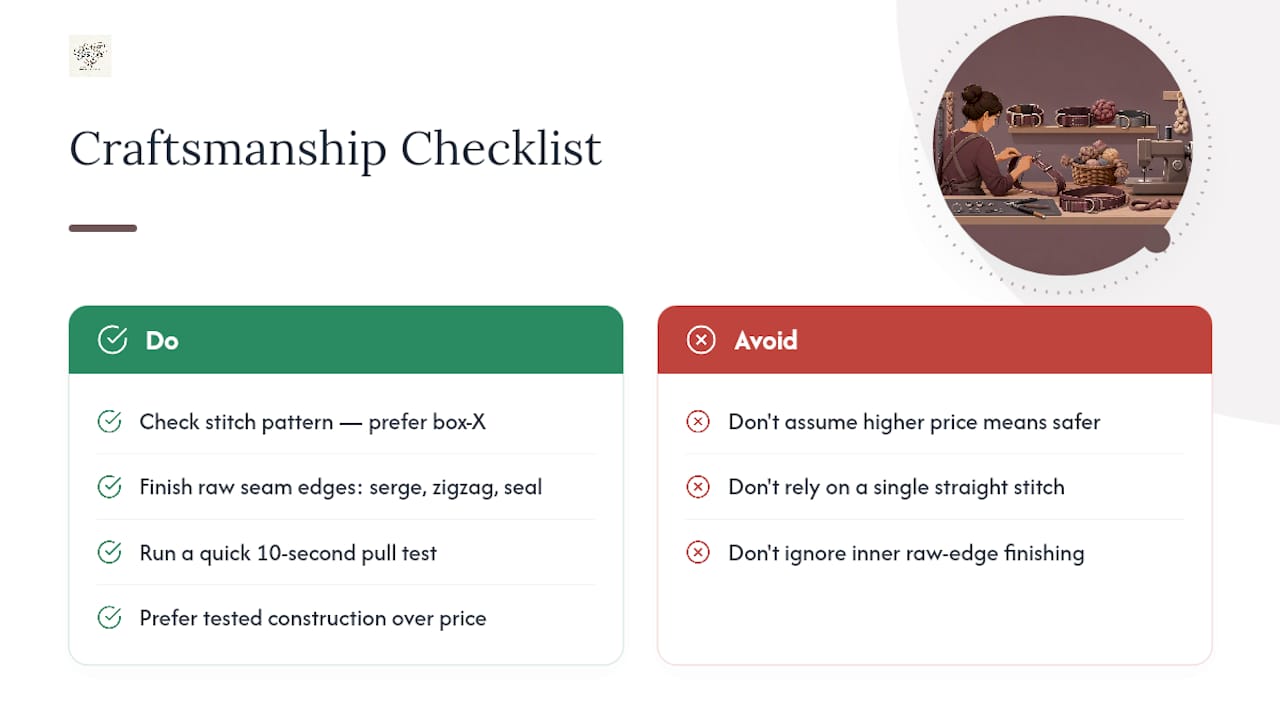
Durability depends as much on seam finishing and reinforcement patterns as on fabric weight alone. Americanbarkbliss builds this principle into every collar, leash, and toy it carries, using American-made construction that prioritizes tested seam strength over appearance.
Pro Tip: Before you cut a single piece of fabric, identify every point where hardware attaches or where a pet’s teeth or claws will contact the seam. Those are your reinforcement targets.
Table of Contents
- What reinforced stitching is, and how it differs from stitchbond fabric
- Which stitch patterns actually hold under load
- How to reinforce a collar or leash, step by step
- When RPET stitchbond fabric is the right choice
- Key Takeaways
- Why craftsmanship standards matter more than most people realize
- Americanbarkbliss has the durable gear already built for you
- Useful sources for further reading
- FAQ
What reinforced stitching is, and how it differs from stitchbond fabric
Reinforced stitching is a technique applied at the sewing machine or by hand: you run multiple passes, change the stitch pattern, or add backing material to increase how much force a seam can absorb before it fails. The goal is redundancy. If one thread breaks, the seam holds because three more are carrying the load.
Stitchbond nonwoven fabric is something different. It’s a manufacturing process where yarns are mechanically stitched through a fiber web using needle gauges such as 10, 14, or 22, creating a dimensionally stable fabric with high tensile strength before you ever touch a sewing machine. Polyester stitchbond nonwovens insert yarns vertically through a polyester fiber web, producing mechanical stability that ordinary nonwovens can’t match.
The practical split: reinforce seams when you’re working with woven fabrics like canvas or nylon webbing. Choose stitchbond as your base material when you need a lightweight, tear-resistant layer for linings, padding, or eco-friendly pet accessories.
Pro Tip: Needle gauge and stitch density interact directly with tear resistance. A finer needle on tightly woven webbing creates smaller perforations and less fabric weakening, while a heavier needle on loose canvas gives thread more grip. Match the needle to the fabric, not just the thread.
Which stitch patterns actually hold under load
Pattern choice determines how force travels through a seam. A single straight line concentrates stress at two points: the first and last stitch. Reinforced patterns spread it across the whole attachment zone.
- Box-X (square with X inside): The standard for D-ring and buckle attachment. The box distributes lateral force; the X handles diagonal pulls. Reinforcement via box-X and bar-tack stitching is widely recommended for hardware points on professional pet gear source.
Set stitch length at 2.5–3.0 mm for most reinforced seams. Shorter stitches (2.0 mm) increase density but can perforate fabric if the needle gauge is too heavy. Thread tension should be snug enough that neither the top nor bobbin thread pulls to one side.
Pro Tip: When sewing over webbing or multiple fabric layers, slow your machine speed and hold light backward tension on the fabric. This prevents the feed dogs from stretching the webbing and keeps stitch spacing consistent through thick sections.
How to reinforce a collar or leash, step by step
Materials: 1.5-inch nylon webbing, canvas or denim backing strip, upholstery thread (Tex 70), size 16–18 needle, welded D-ring, forged side-release buckle, rivets (optional).
- Cut webbing to length plus 3 inches for hardware loops. Cut a backing strip the same width.
- Layer the backing under the webbing at the D-ring end and pin in place.
- Fold the D-ring loop: thread webbing through the D-ring, fold back 2 inches, and pin.
- Sew the box-X pattern over the folded loop. Stitch the box perimeter first, then the two diagonals. Repeat the full pattern once.
- Attach the buckle end the same way: fold, pin, box-X twice.
- Topstitch both long edges of the collar with a single straight line, 2 mm from the edge.
- Set rivets at strap ends if using them. File any sharp edges smooth.
Quality checklist before use:
- Stitch density is consistent with no skipped stitches
- Thread tension is even on both sides of the fabric
- Hardware sits flat with no gap between the ring and the webbing fold
- No raw edges are exposed; all ends are sealed with a lighter flame or seam sealant
- Pull the D-ring firmly by hand. The seam should not shift or pucker.
Pro Tip: Test every finished collar or leash with a static pull before putting it on your dog. Loop one end around a fixed post, grip the other, and apply steady pressure for 10 seconds. Any seam movement means the box-X needs another pass.
When RPET stitchbond fabric is the right choice
RPET stitch-bonded nonwoven fabric is made from recycled PET bottles. The stitchbond process bonds the fibers mechanically, without chemical adhesives, producing a flexible, reasonably strong fabric with a lower environmental footprint than virgin synthetics.
Where it works well for pet accessories:
- Linings for beds and carriers where abrasion load is low
- Eco-style tote-format pet bags and lightweight travel pouches
- Backing layers under canvas or denim in double-layer constructions
- Light apparel items where the outer fabric carries the structural load
Where to stick with canvas or denim: load-bearing collars, leashes, and harnesses. RPET stitchbond handles light-to-medium loads well, but woven canvas at 10–12 oz still outperforms it on tensile strength for direct hardware attachment. Stitchbond nonwovens also retain a flatter, softer surface than needle-punch alternatives and can be treated for water repellency, which suits linings and lightweight items well.
For eco-conscious crafters, pairing an RPET stitchbond lining with a canvas outer layer gives you the sustainability benefit without compromising structural performance. See Americanbarkbliss’s eco-friendly dog accessories guide for finished product examples using recycled materials.
Key Takeaways
Reinforced pet stitching prevents seam failure by combining load-distributing stitch patterns, heavier thread, and rated hardware at every stress point.
| Point | Details |
|---|---|
| Reinforce hardware points first | Box-X and bar-tack at D-rings and buckles carry the most load; start there. |
| Match thread, needle, and fabric | Upholstery thread (Tex 70+) with a size 16–18 needle handles canvas and webbing without skipping. |
| Test before every use | A 10-second static pull on hardware points reveals seam weakness before it becomes a safety failure. |
| Fabric weight alone isn’t enough | Seam finishing and reinforcement patterns matter as much as fabric choice for long-term durability. |
| Americanbarkbliss for ready-made gear | Browse durable collars and toys at Americanbarkbliss for American-made options built to these standards. |
Why craftsmanship standards matter more than most people realize
The conventional wisdom in pet gear is that you buy expensive and assume it’s safe. What the construction details actually show is that price and durability don’t correlate as cleanly as the marketing suggests. A $60 collar with a single straight stitch at the D-ring is structurally weaker than a $20 collar with a proper box-X, regardless of the leather finish or the brand name on the tag.
What I find consistently underestimated is the role of seam finishing. Most DIY guides and even some commercial products focus entirely on the visible stitching and ignore what’s happening at the raw edge inside the fold. That’s where fraying starts, and fraying works inward silently until the seam fails under a load that should have been routine. The fix is unglamorous: serge the edge, run a zigzag, or seal it with a lighter before you fold and stitch. It adds two minutes to a project and doubles the service life.
The other thing worth saying plainly: manufacturer-level pull testing is not out of reach for a home crafter. You don’t need a tensile testing machine. You need a fixed anchor point, your hands, and 10 seconds of steady pressure. That test catches 90% of the failures that would otherwise show up on a walk. Americanbarkbliss applies this standard to its American-made gear, and it’s a standard any crafter can replicate at home.
Americanbarkbliss has the durable gear already built for you
Crafting your own reinforced pet gear is genuinely satisfying, and the techniques above will get you there. But if you want tested, American-made construction without the sewing machine setup, Americanbarkbliss carries products built to the same standards described in this article.
The Dog Toys 3-Piece Set for Aggressive Chewers uses leather construction designed for dogs that destroy standard toys. The TPR Boomerang Dog Chew Toy pairs a removable squeaker with treat-fill design, built for repeated chewing sessions. For apparel, the Pet Dog Jumpsuit delivers reinforced closure stitching on a finished garment. Browse the full range at Americanbarkbliss and check product specs for stitch details, or contact the team directly for customization questions.
Useful sources for further reading
These sources back the technical claims in this article and are worth bookmarking if you want specification-level detail:
- Stitchbond nonwoven fabric: The ultimate guide to strength, versatility & modern applications
- RPET Stitch Bonded Nonwoven Fabric for eco shopping bags
- Tailoring for tail waggers: sewing pet apparel with reinforced stitching
- Sewing durable pet toys: fun and safe projects for cats and dog
- What is the polyester stitchbond nonwoven fabric?
- How to improve stitching strength in pet accessories | OEM Guide
- What hardware and stitching make the best custom thick dog collars fail-proof?
- Dog collar manufacturer: complete guide to materials, stitching & quality control
FAQ
What is reinforced pet stitching in simple terms?
Reinforced pet stitching uses multiple stitch passes, load-distributing patterns like box-X or bar-tack, and heavier thread to prevent seam failure at high-stress points on collars, leashes, harnesses, and toys.
Which stitch pattern is strongest for a D-ring attachment?
The box-X pattern, a stitched square with an X through it, is the standard for D-ring and buckle points because it distributes both lateral and diagonal forces across the full attachment zone.
Can I use regular sewing thread for pet collars?
Standard all-purpose thread breaks under the sustained daily load a collar or leash sees. Use upholstery-grade polyester thread at Tex 70 or heavier with a size 16–18 needle for any load-bearing pet gear.
What needle size should I use for nylon webbing?
A size 16 or 18 heavy-duty needle handles nylon webbing and double-layer canvas without skipping stitches or bending. Using a size 12 on thick webbing is one of the most common causes of failed seams in DIY pet gear.
Does Americanbarkbliss sell reinforced pet toys and accessories?
Yes. Americanbarkbliss carries American-made toys, apparel, and accessories built with durable construction, including the Tennis Ball Dog Toy Variety Pack and the tug toys collection for dogs that need gear that holds up.
Leave a comment