

What Is a USA-Certified Dog Product? Your 2026 Guide
TL;DR:
- A “Made in USA” label on a dog product reflects manufacturing origin but does not guarantee ingredient safety or testing. The FTC’s “all or virtually all” rule governs unqualified claims, while AAFCO sets separate nutritional standards. Buyers should verify sourcing, safety testing, and industry standards beyond just the origin label for true quality assurance.
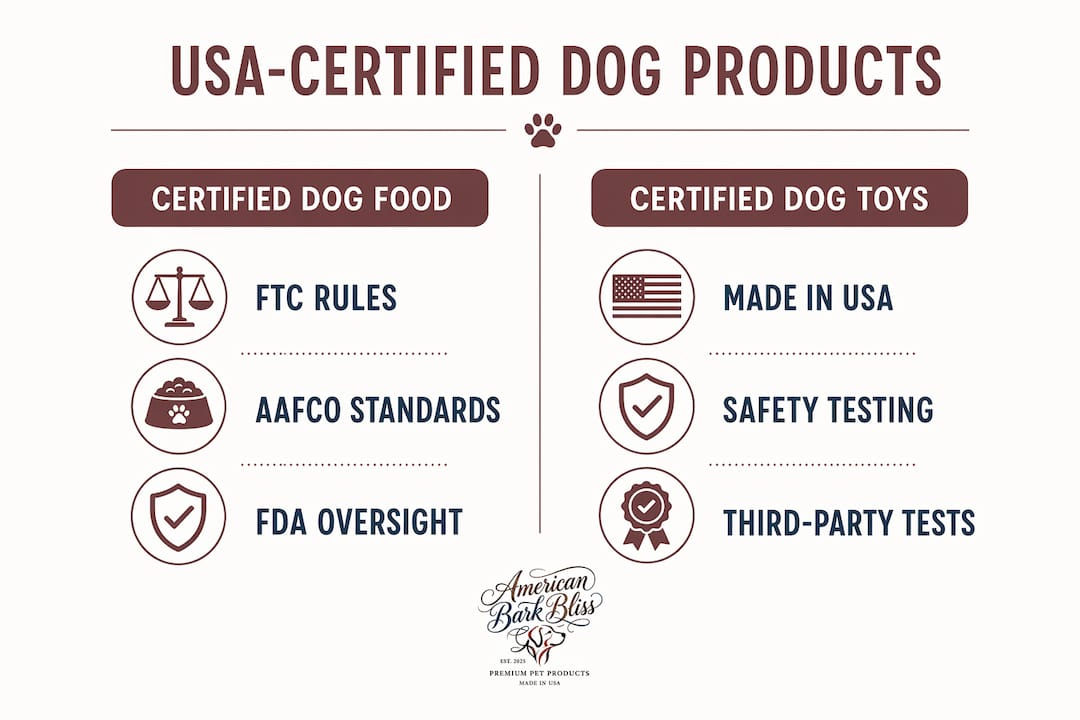
A USA-certified dog product is an item that carries a domestic manufacturing claim under the Federal Trade Commission’s “Made in USA” labeling rule, though no single government-backed certification defines this term for all dog products. The phrase “USA-certified” is widely used in pet marketing, but it does not correspond to one official stamp or federal program. What actually governs these claims is a mix of FTC labeling rules, FDA oversight for food items, AAFCO nutritional standards, and voluntary third-party testing for non-food accessories. Understanding each layer helps you buy with confidence rather than rely on label language alone.
What is a USA-certified dog product under FTC rules?
The FTC’s Made in USA labeling rule, codified at 16 CFR Part 323, is the closest thing to an official USA pet product certification for manufactured goods. The rule took effect on August 13, 2021, and it sets the legal standard for what a domestic origin claim actually means. Any brand placing an unqualified “Made in USA” label on a dog product must meet the “all or virtually all” threshold. That means all significant parts, processing, and labor must occur in the United States.
The rule draws a clear line between two types of claims:
- Unqualified claims (“Made in USA”): The product must be “all or virtually all” domestically made, with no or negligible foreign content.
- Qualified claims (“Made in USA with imported ingredients”): The product contains some foreign components, and the label must say so clearly.
The FTC enforces these rules and can pursue civil penalties against brands that misuse unqualified claims. That enforcement matters because it creates real accountability for domestic manufacturers. A brand that labels a dog collar “Made in USA” without meeting the threshold faces legal exposure, not just a public relations problem.
Pro Tip: When you see “Made in USA with domestic and imported ingredients” on a dog food bag, that qualified claim is often more honest than a plain “Made in USA” label. Synthetic vitamins and mineral premixes are almost always imported, even in otherwise domestic formulas.

The label tells you where the product was made. It does not tell you whether the ingredients are safe, whether the product was tested for toxins, or whether it will hold up under daily use. That distinction is the most important thing to understand about USA dog product standards.
How AAFCO standards apply to USA-made dog food
AAFCO, the Association of American Feed Control Officials, sets the nutritional model standards that states enforce for dog food sold in the United States. AAFCO is not a certifier. It does not inspect facilities or issue certificates. Instead, it publishes nutrient profiles that manufacturers must meet to print “complete and balanced” on their packaging.
A dog food earns a “complete and balanced” claim through one of two paths:
- Formulation method: The recipe is formulated to meet AAFCO nutrient profiles using lab analysis. No dogs are fed the food during this process.
- Feeding trial method: The food is fed to real dogs over a defined period. Feeding trials for maintenance require at least 8 dogs over 26 weeks to assess health outcomes.
The feeding trial method is the higher bar. A food that passes a 26-week trial with eight dogs has demonstrated real-world nutritional performance, not just a formula on paper. That difference matters when you are choosing between two bags that both say “complete and balanced.”
AAFCO compliance is entirely separate from the “Made in USA” label. A dog food can be AAFCO-compliant and manufactured in China, or it can be made entirely in the United States without meeting AAFCO standards. The two claims measure different things. When you evaluate best dog food brands made in USA, look for both the origin claim and the AAFCO nutritional adequacy statement on the same label.
Pet food manufactured in U.S. facilities also falls under FDA oversight through the Food Safety Modernization Act, which focuses on contamination prevention and recall effectiveness. That layer of federal oversight does not apply to most imported pet food in the same way. Domestic manufacturing carries a measurable accountability advantage for food products specifically.
Safety standards for non-food dog products labeled USA-made
Non-food dog products, including toys, leashes, beds, and collars, lack federal mandatory safety certifications. No government agency requires a dog toy to pass a toxicity test before it reaches store shelves. This is the sharpest gap between food and non-food regulation in the pet industry.
Responsible domestic manufacturers fill that gap voluntarily. The most common approaches include:
- ASTM standards: ASTM International publishes voluntary standards for mechanical strength, chemical safety, and material durability that U.S. manufacturers can adopt for pet products.
- Third-party lab testing: Industry experts highlight third-party labs for testing dyes, phthalates, and mechanical stress as the most reliable safety signal for non-food accessories.
- GOTS certification: The Global Organic Textile Standard applies to organic fabric products like dog beds and bandanas, confirming that textiles meet defined chemical and processing criteria.
- AS 5810 and EN 13432: These certifications apply specifically to compostable dog waste bags, confirming home and industrial compostability respectively.
The “Made in USA” label on a dog toy tells you it was assembled domestically. It does not tell you whether the rubber is free of phthalates or whether the dye is non-toxic. A toy that passes third-party toxicity testing provides a stronger safety signal than the origin label alone.
Pro Tip: When shopping for USA-made dog toys, look for brands that publish their third-party test results or list specific certifications on their product pages. A brand willing to share that data has nothing to hide.
For durable rubber toys specifically, domestic production does carry a practical advantage. U.S. manufacturers using natural rubber compounds are subject to domestic labor and environmental standards that affect material quality. Products like the USA-K9 Skull chew toy and the Stars and Stripes rubber chew ball are examples of USA-made dog toys built for durability and interactive play. Knowing they are manufactured domestically is a useful starting point, but the material quality and construction are what actually protect your dog.
How to evaluate USA-certified dog products effectively
The “Made in USA” label is a useful signal, but it is an incomplete one. Brands that publish feeding trial results and detailed sourcing earn higher consumer trust than those relying on origin claims alone. Here is how to go beyond the label when choosing certified dog supplies.
- Check the recall history. The FDA maintains a public database of pet food recalls. A brand with a clean or transparent recall record demonstrates consistent quality control. A brand with repeated recalls for the same issue does not.
- Read the ingredient origin disclosures. Some U.S. dog food brands source their meat domestically but import vitamin premixes. A qualified claim like “Made in USA with domestic and imported ingredients” is more transparent than an unqualified label that obscures this reality.
- Look for AAFCO feeding trial statements. The label should say “Animal feeding tests using AAFCO procedures substantiate” the nutritional claim. That language confirms a feeding trial was conducted, not just a formula analysis.
- Ask about third-party testing for accessories. For leashes, collars, and toys, contact the brand directly or check their website for published test results. Brands committed to safety make this information easy to find.
- Evaluate the company’s transparency overall. A brand that lists its manufacturing facility, names its ingredient suppliers, and publishes safety data is operating at a higher standard than one that only prints a flag on the package.
Understanding American-made vs. imported pet goods requires looking at the full picture: origin, nutrition standards, safety testing, and company accountability. No single label covers all four. You need to check each one independently to make a fully informed decision.
Key Takeaways
A USA-certified dog product is defined by FTC origin rules and industry standards, not a single federal certification, so evaluating safety requires checking AAFCO compliance, recall history, and third-party testing alongside the “Made in USA” label.
| Point | Details |
|---|---|
| No universal certification exists | “USA-certified” refers to FTC origin labeling rules, not one official government stamp. |
| FTC sets the origin standard | The “all or virtually all” rule under 16 CFR Part 323 governs unqualified “Made in USA” claims. |
| AAFCO covers nutrition, not origin | Dog food must meet AAFCO nutritional profiles separately from any domestic manufacturing claim. |
| Non-food items rely on voluntary testing | Dog toys and accessories have no mandatory federal safety certification; third-party lab testing fills the gap. |
| Transparency beats label language | Brands that publish feeding trials, sourcing details, and test results provide stronger safety assurance than labels alone. |
Why the “Made in USA” label is only half the story
The most common mistake I see dog owners make is treating “Made in USA” as a quality guarantee. It is not. It is a manufacturing location claim. I have reviewed products that carry the label proudly while using imported synthetic ingredients and skipping third-party safety testing entirely. The label tells you where the product was assembled. It says nothing about what went into it or whether anyone tested it on your dog’s behalf.
What I have found actually works is treating the origin claim as a filter, not a final answer. Domestic manufacturing does matter. FDA oversight, AAFCO enforcement by state agencies, and ASTM voluntary standards create a regulatory environment that is genuinely more rigorous than what most imported products face. That accountability advantage is real. But it only protects you if the brand is actually participating in those systems.
The brands worth trusting are the ones that go further. They publish their AAFCO feeding trial statements. They list their ingredient suppliers. They submit their toys to third-party labs and share the results. When I look at signs of high-quality dog accessories, transparency is always at the top of the list. A brand that hides behind a flag graphic and nothing else is not earning your trust. It is borrowing it.
My honest recommendation: use “Made in USA” as your starting point, then verify. Check the AAFCO statement. Search the FDA recall database. Email the brand and ask where their ingredients come from. The ones with nothing to hide will answer quickly and completely.
— Christopher
USA-made dog products worth trusting at Americanbarkbliss
Americanbarkbliss curates dog products from domestic manufacturers that back their origin claims with real construction quality. Every product on the platform is sourced with American craftsmanship in mind, from feeding accessories to durable play gear.
For dog owners who want toys that hold up to serious chewing, the USA-K9 Stars and Stripes reward toy is built from ultra-durable rubber and made entirely in the United States. Domestic production means consistent material standards and no supply chain surprises. Browse the full range of best American-made dog products at Americanbarkbliss to find supplies that combine verified origin with genuine quality.
FAQ
What does “USA-certified” mean on a dog product?
“USA-certified” is a marketing phrase, not an official government designation. The closest legal standard is the FTC’s “Made in USA” rule, which requires products to be “all or virtually all” made domestically under 16 CFR Part 323.
Is AAFCO a certification body for dog food?
AAFCO is not a certifier. It publishes model nutritional standards that state agencies enforce, and dog food brands use AAFCO profiles to substantiate “complete and balanced” claims through formulation or feeding trials.
Are USA-made dog toys required to pass safety tests?
No federal law requires dog toys to pass safety testing before sale. Responsible manufacturers voluntarily submit products to third-party labs for toxicity, dye safety, and durability testing under ASTM voluntary standards.
How do I find certified dog products I can trust?
Check for an AAFCO feeding trial statement on dog food, search the FDA recall database for the brand’s history, and look for published third-party test results on non-food accessories. Transparency from the brand is the strongest indicator of quality.
Does “Made in USA” guarantee ingredient safety?
No. The “Made in USA” label confirms manufacturing origin, not ingredient safety or sourcing. A product can carry the label while using imported micro-ingredients, so reading the full label and checking qualified claims is always the right move.
Leave a comment