

Training Treats Calories: How to Reward Often Without Overfeeding
Keep training treats to about 10% of your dog’s daily calories. That’s the number veterinary nutrition guidance keeps landing on, and it’s the one rule you need before you fill your treat pouch for a session. All treats, table scraps, and training rewards count toward that 10%, not just the ones sold as “treats.” The AKC frames it as a calorie limit, not a limit on how many pieces you hand out.
Here’s the fast version:
- Find your dog’s daily calorie target (the food bag or a vet-approved calculator gets you close).
- Multiply that number by 0.10. That’s your treat budget for the day, in calories.
- Pick treats that run 1 to 5 kcal per piece, or use plain kibble, so you can reward often and stay under budget.
Once you know that number, everything else in training gets easier.
Key Takeaways
| Point | Details |
|---|---|
| Apply the 10% rule | Treats, table scraps, and rewards together should stay under 10% of daily calories. |
| Calculate before training | Multiply your dog’s daily kcal target by 0.10 to get a firm treat budget. |
| Favor low-cal pieces | Kibble, minis, and vegetables run roughly 1 to 5 kcal per piece for frequent rewards. |
| Limit high-cal chews | Bully sticks and pig ears can run 90 to 300 kcal per item, so use them sparingly. |
| Use toys to fill the gap | Options like the Knuckle Bone Nylon Dog Chew Toy from Americanbarkbliss add enrichment without extra calories. |
Table of Contents
- How to Calculate Your Dog’s Treat Calorie Budget
- What Low-Calorie Training Treats Should You Use?
- How Do You Train Often Without Adding Extra Calories?
- Should You Cut Meal Portions When You Add Treats?
- How Do You Read a Treat Label for Calories Per Piece?
- American Bark Bliss’s Take on Low-Calorie Training
- Products Built for Calorie-Conscious Training
- Why the 10% Rule Gets Misapplied in Real Training Sessions
- Sources
- FAQ
How to Calculate Your Dog’s Treat Calorie Budget
You need two numbers before you touch the treat bag: your dog’s daily calorie target, and 10% of it.
Start with the dog food label. Most bags list kcal per cup, or you can run your dog’s weight and activity level through a maintenance calorie calculator. A moderately active 30 pound dog typically needs about 700 kcal a day. A 60 pound dog usually needs around 1,200 kcal, depending on activity and metabolism. Puppies and very active working dogs need more per pound of body weight, so adjust upward if your dog fits either group.
Once you have that daily number, the math is simple:
- Take your dog’s daily kcal target.
- Multiply by 0.10.
- That result is your treat calorie budget for the entire day, spread across every session.
A dog eating 1,456 kcal a day lands at roughly 146 kcal available for treats, according to AKC’s framing of the 10% guideline. For a 30 pound dog eating around 730 kcal daily, that’s about 73 kcal to work with. For a 60 pound dog at 1,200 kcal, you’re looking at roughly 120 kcal. Neither number is a lot once you start counting bully sticks.
What Low-Calorie Training Treats Should You Use?
Most kibble pieces and commercial training minis run 1 to 4 kcal each, which is exactly why trainers who do a lot of repetition lean on them instead of bigger treats. FurCalc’s sample data puts popular minis like Zuke’s Mini Naturals around 3 kcal per piece and Blue Buffalo Training Bits closer to 1.5 kcal, small enough that you can reward 20 or 30 times in a session without denting your budget.
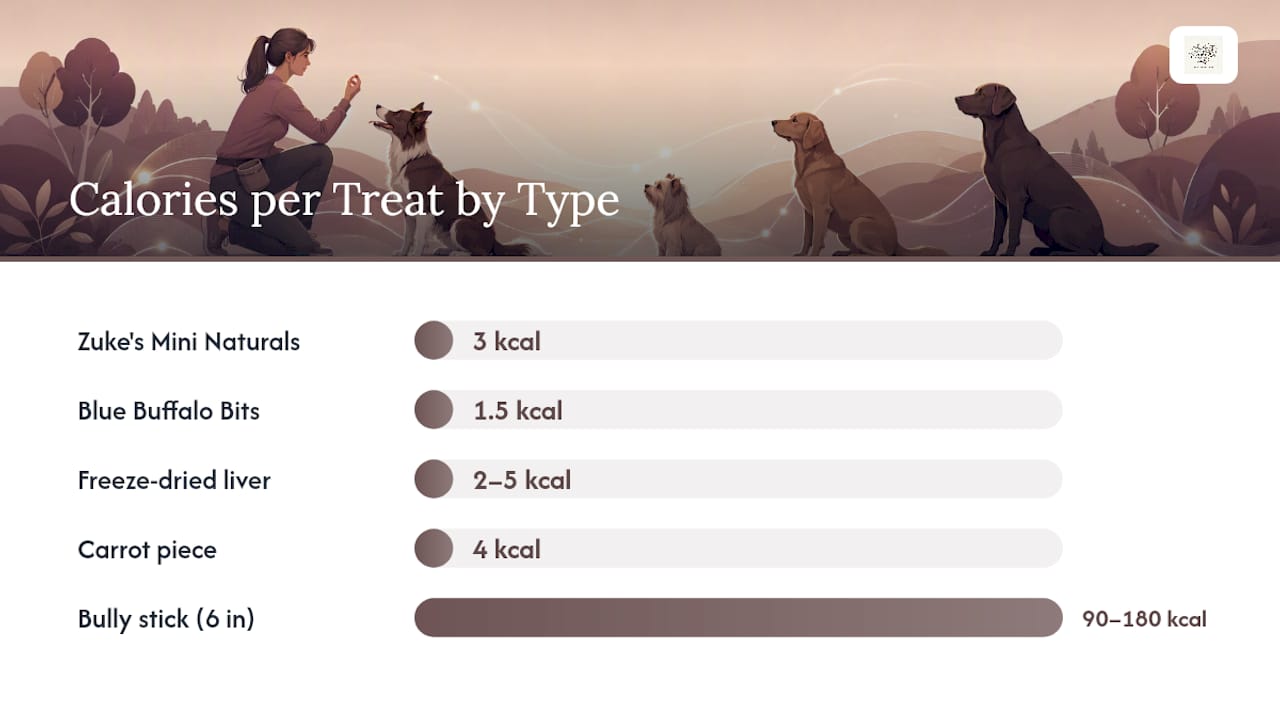
Freeze-dried liver and similar high-value bites usually fall in the 2 to 5 kcal range per piece, still cheap enough to use often but potent enough to work as a step up from kibble when a dog needs extra motivation. Some brands market treats even smaller than that; Wowzers advertises under 1 calorie per treat, which is a manufacturer claim worth checking against the label rather than a universal standard for the category.
Whole foods work too. Carrot pieces run around 4 kcal each, green beans are lower still, and a single blueberry barely registers. These are worth mixing in for variety.
Where things go wrong fast: bully sticks, pig ears, and full-size jerky strips. A 6-inch bully stick can carry 90 to 180 kcal, a pig ear runs 150 to 300 kcal, and a piece of rawhide often lands between 100 and 200 kcal. One pig ear can blow past a small dog’s entire treat budget for the day. Save those for occasional enrichment, not repeated training reps.
- Kibble pieces and mini training bites: 1–4 kcal each
- Freeze-dried liver and similar high-value bites: 2–5 kcal each
- Carrots, green beans, blueberries: roughly 1–4 kcal each
- Bully sticks, pig ears, large jerky: 90–300 kcal per item, use sparingly
How Do You Train Often Without Adding Extra Calories?
The trick isn’t finding the perfect treat. It’s rethinking where the calories come from in the first place.
- Measure out a portion of your dog’s daily kibble in the morning and use it as your training currency for the day. This adds zero extra calories since it’s food he was already going to eat.
- Break larger treats into pea-sized pieces. A single training treat can often be split into three or four rewards, stretching your budget without stretching the calorie count.
- Reserve high-value, higher-calorie treats for the behaviors that matter most, like a solid recall around distractions, and use kibble or low-cal bites for everything else.
- Mix in an occasional jackpot reward, a higher-value treat given after an especially strong response, while keeping the bulk of your rewards low-cal. Purina’s training guidance points to this kind of variable reinforcement as a way to keep a dog motivated without inflating the calorie count of every session.
- Carry pre-measured portions in a pouch instead of grabbing treats loose from a bag or, worse, tossing table scraps mid session.
Pro Tip: Split your daily kibble allotment into two piles before you start: one for meals, one for training. When the training pile is gone, you’re done rewarding with food for the day, no math required mid session.
Should You Cut Meal Portions When You Add Treats?
Yes, and the adjustment is proportional. If your dog eats 100 extra treat calories on a heavy training day, trim roughly that amount from the day’s meals, split across breakfast and dinner rather than skipping a meal outright.
- Reduce daily food portions by roughly the same number of calories the treats added.
- Check body condition score every few weeks. You should feel ribs with light pressure and see a visible waist from above.
- Weigh your dog monthly if you’re training heavily, since small gains creep up quietly over a few months.
- Talk to a veterinarian if your dog’s weight shifts more than a few percent, or if you’re working with a puppy, senior, or dog with a medical condition where calorie needs are less predictable.
VCA’s guidance on training and treats backs the same approach: measure treats, and shift meal portions to compensate rather than letting treat calories stack on top of a full ration.
How Do You Read a Treat Label for Calories Per Piece?
Some labels make this easy. Others bury it, or skip it entirely.
- Check the guaranteed analysis panel first, then look for a “calorie content” statement, which is required on most commercial pet treats sold in the US.
- If the label only gives kcal per cup or per 100 grams, weigh a few pieces on a kitchen scale and do the math: divide the total kcal by the number of pieces in that weight.
- Watch for treats with tiny stated serving sizes. A label showing “10 kcal per serving” sounds great until you notice the serving size is one quarter of a treat.
When a label gives you nothing usable, check the manufacturer’s website. Most list per-piece calorie counts for their training-specific lines even when the packaging doesn’t.
American Bark Bliss’s Take on Low-Calorie Training
We build our training treats around the same math this article walks through: small, USA-made bites low enough in calories to reward often. Enrichment toys matter here too, since a treat-stuffed chew stretches a low-cal snack into a longer session instead of another handful of calories. For deeper reading, our healthy dog treat guide covers ingredient quality alongside portion control.
Products Built for Calorie-Conscious Training
Not every reward has to come from a bag of treats.
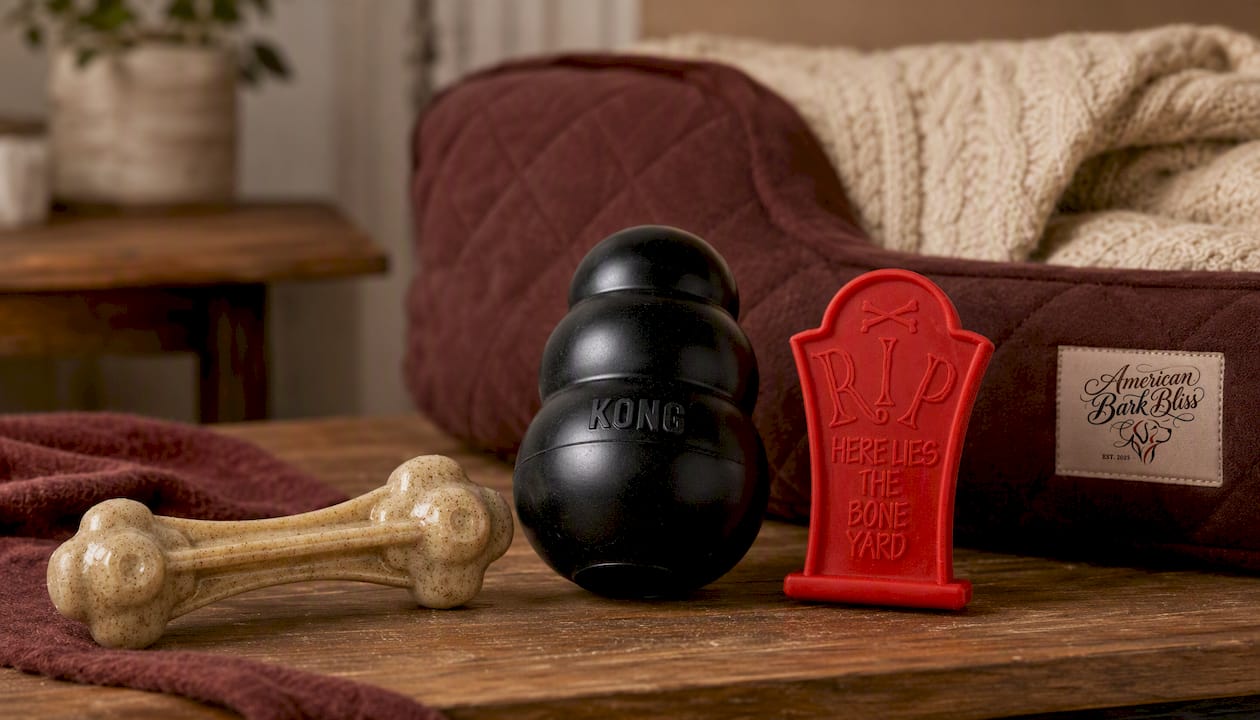
The Knuckle Bone Nylon Dog Chew Toy for Aggressive Chewers is a solid pick for dogs that go through soft treats too fast to matter as a reward. It’s made in the USA, built for dogs that chew hard, and it gives a calorie-free outlet for the kind of jaw work a bully stick would otherwise provide at 150 kcal a pop.
The KONG Extreme Treat-Stuffing Dog Toy solves a different problem. Stuff it with a portion of your dog’s kibble or a few low-cal minis, and a snack that would take ten seconds to eat now takes ten minutes, stretching the same calorie count into real enrichment.
For power chewers who need something tougher than a rubber toy but shouldn’t be getting daily high-calorie chews, the Headstone Ultra Durable Nylon Dog Chew Toy holds up without adding a single calorie to the day’s count. Keep counting treat calories the way you learned above, and let toys like these pick up the slack when your dog wants more than the budget allows. Browse the full lineup at Americanbarkbliss and build a training kit that fits your dog’s calorie goals.
Why the 10% Rule Gets Misapplied in Real Training Sessions
Most owners understand the 10% rule in theory and blow past it in practice, because nobody’s counting calories mid session. They’re counting successful reps. That gap between what people know and what they actually do during training is the real problem, not a lack of low-cal treat options on shelves.
The kibble-as-treat method solves this better than any product can, because it removes the decision entirely. You’re not calculating anything at rep 40 of a recall drill. You already know the food in your pouch is zero net calories, so you can reward as often as the training actually requires instead of rationing out of guilt or guesswork.
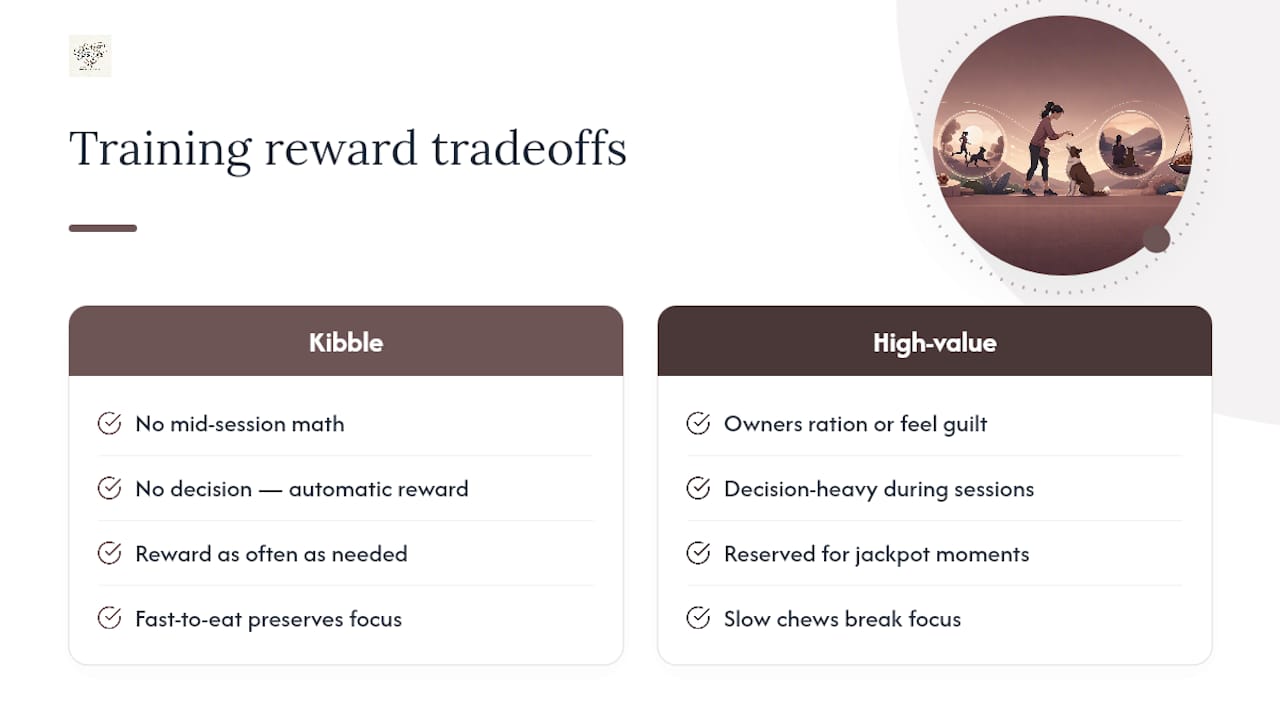
What gets underestimated is how much a treat’s texture and delivery speed matter more than its flavor. A pea-sized, fast-to-eat treat keeps a dog’s attention on you between reps. A treat that takes ten seconds to chew breaks focus and slows the whole session down, regardless of how many calories it costs. Purina’s own training guidance leans on this point, and it’s worth taking more seriously than most articles on treat calories do.
The honest tradeoff nobody likes to admit: low-calorie treats sometimes have less pull for a distracted or nervous dog than a genuinely high-value reward. That’s fine. Save the higher-calorie jackpot treats for the moments that need them, and let kibble carry the volume.
— Christopher
Sources
For calculating your dog’s exact calorie needs, the AKC’s treat guidance explains the 10% rule in detail. VCA Animal Hospitals covers practical training and feeding adjustments. Purina offers guidance on treat sizing and reward timing. FurCalc provides a calculator with sample kcal-per-piece values for common treats.
- How Many Treats Can a Dog Have? | AKC
- Using food and treats for training dogs | VCA Animal Hospitals
- Dog Treat Calorie Calculator — 10% Rule Guide | FurCalc
- How to Use Dog Treats for Training, Bonding & Rewarding | Purina US
FAQ
How many calories should training treats be per day?
Training treats, along with any other treats or scraps, should stay under 10% of your dog’s total daily calorie intake, based on AKC guidance.
What’s the lowest-calorie option for training treats?
Plain kibble and small vegetable pieces like carrots or green beans typically run 1 to 4 kcal per piece, making them ideal for high-repetition sessions.
Can I use kibble instead of treats for training?
Yes. Measuring out a portion of daily kibble for training adds no extra calories since it replaces food your dog was already going to eat, a method VCA veterinarians recommend.
How do I calculate my dog’s treat calorie budget?
Find your dog’s daily calorie target from the food label or a calculator, then multiply that number by 0.10 to get the calories available for treats.
Are bully sticks too high in calories for training?
Yes for repeated training use. A 6-inch bully stick can run 90 to 180 kcal, enough to use up most of a small dog’s daily treat budget in one chew.
Leave a comment