

The Role of Comfort in Dog Harnesses Explained
Most dog owners pick a harness based on looks or price and call it done. But the role of comfort in dog harnesses goes far deeper than that. A harness that pinches, rubs, or restricts movement doesn’t just annoy your dog. It can change how they walk, how they behave on leash, and even affect their long-term joint and tracheal health. This guide breaks down exactly what makes a harness truly comfortable, why proper fit is non-negotiable, and how the right design choices directly shape your dog’s safety and enjoyment on every walk.
Table of Contents
- Key takeaways
- How harness design influences comfort and safety
- Getting the fit right
- Health and behavioral benefits of a comfortable harness
- Choosing the right harness for your dog
- My honest take on harness comfort
- Walk better with Americanbarkbliss
- FAQ
Key takeaways
| Point | Details |
|---|---|
| Design shapes comfort | Y-shaped harnesses allow free shoulder movement and prevent gait problems other designs cause. |
| Fit requires regular checks | Use the two-finger rule and recheck straps after weight changes, coat growth, or activity shifts. |
| Comfort improves behavior | A well-fitted harness reduces pulling, prevents neck strain, and supports better leash manners. |
| Materials matter significantly | Breathable mesh and soft padding reduce heat buildup and skin irritation during longer walks. |
| Collar plus harness works best | Keep a collar for ID tags and use a harness for walking to cover both safety and control. |
How harness design influences comfort and safety
Not all harnesses are built the same. The shape, strap placement, and attachment points create very different experiences for your dog’s body, and understanding the differences is the first step toward making a smart choice.
The most common harness types
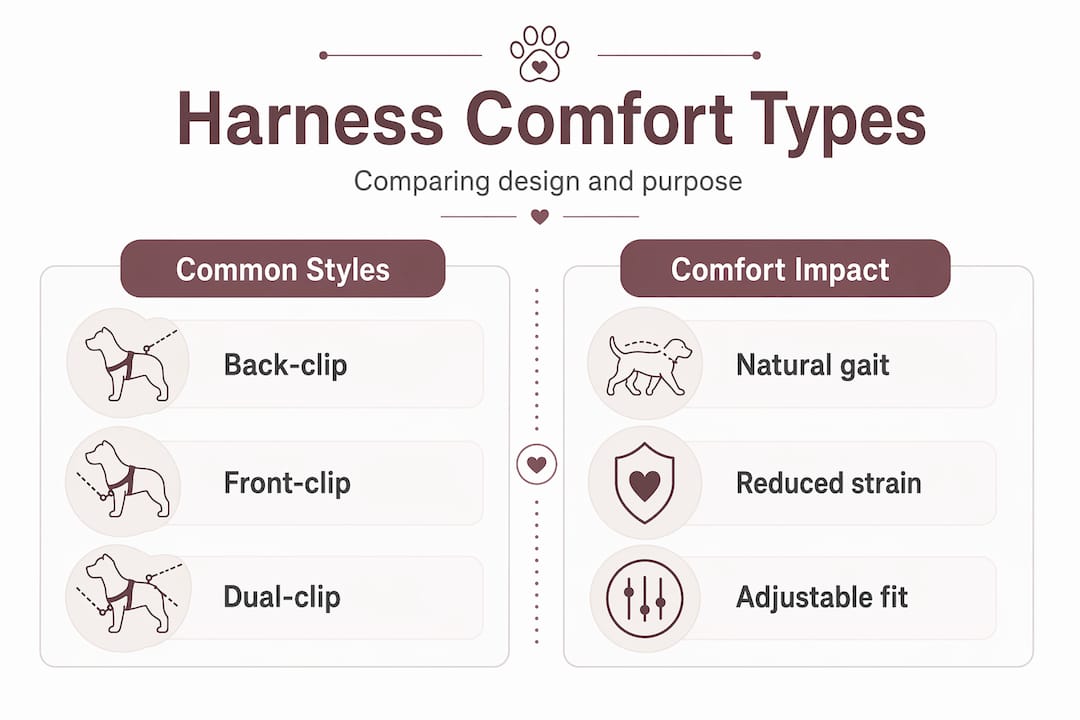
Back-clip harnesses attach the leash at the dog’s back between the shoulder blades. They’re easy to put on and work well for calm dogs or casual strolls. The downside is they give very little control over pulling behavior and can actually reinforce it over time.
Front-clip harnesses connect the leash at the chest. This placement shifts a dog’s center of gravity sideways when they pull, making pulling physically inefficient. Dogs learn quickly that lunging forward doesn’t get them where they want to go.
Dual-clip harnesses offer both attachment points and give you flexibility depending on the situation. A training walk might call for the front clip; a relaxed trail hike might use the back clip.
Y-shaped harnesses are the design most veterinary professionals recommend for physical health. The key difference is the chest strap position. Y-shaped chest straps sit above the shoulder joint, which allows the shoulder blades to move freely through a natural range of motion. Many popular harness styles use a horizontal chest strap that crosses directly over the shoulder joint, restricting movement with every stride.
Harness type comparison
| Harness type | Comfort impact | Best use case |
|---|---|---|
| Back-clip | Good for calm dogs; may encourage pulling | Casual walks, well-trained dogs |
| Front-clip | Redirects pull force away from neck | Dogs that pull, training walks |
| Dual-clip | Versatile fit with multiple control options | Mixed activities, varied environments |
| Y-shaped | Best shoulder freedom, lowest gait risk | Active dogs, long walks, all breeds |
Here’s what most harness marketing won’t tell you. A label that says “no-pull” doesn’t automatically mean comfortable or biomechanically safe. Harnesses sitting too high or crossing the shoulder blade area can cause discomfort and long-term joint stress, regardless of what the packaging promises. The design has to support free shoulder movement. That’s what separates a good harness from a great one.
Getting the fit right
Even the best-designed harness becomes a problem if it doesn’t fit your dog correctly. Improper fit is the most common cause of harness-related injuries and behavioral resistance, and it’s entirely preventable.
Four steps to check harness fit
- Apply the two-finger rule. Slide two fingers under every strap. You should feel a snug but not tight resistance. This prevents skin irritation and avoids leaving the harness so loose your dog could back out of it.
- Check armpit clearance. The chest strap should sit at least two finger-widths above the armpits. Straps that sit too close to armpits cause chafing sores within days, especially on dogs with shorter coats or sensitive skin.
- Watch your dog walk. Put the harness on and observe your dog’s gait from the side. Any shortening of the front stride or hesitation in shoulder extension suggests the straps are crossing the wrong place.
- Test for escape. Gently try to slip the harness backward over your dog’s head. If it comes off without real resistance, it’s too loose and creates a safety risk on walks near traffic or other dogs.
Fit also changes over time. Proper harness fit is a dynamic process because dogs gain or lose weight, coats thicken in winter and thin in summer, and puppies simply grow fast. Building a monthly harness check into your routine takes about two minutes and prevents problems that take weeks to heal.
Pro Tip: After grooming or a bath, always recheck harness fit before the next walk. A freshly brushed coat can add enough volume to tighten straps that were fine before, and wet fur compresses differently, sometimes creating unexpected pressure points.
Restricted shoulder movement doesn’t just cause discomfort in the moment. Over months and years, it can alter your dog’s gait mechanics and place uneven stress on joints. The importance of dog harness fit is about more than avoiding a chafe spot. It’s about protecting how your dog moves for their entire life.
Health and behavioral benefits of a comfortable harness
The difference a comfortable harness makes goes well beyond pleasant walks. There’s real, measurable impact on your dog’s physical health and how they respond to leash guidance.
Dogs switched from collars to well-fitted harnesses show reduced coughing and improved leash behavior within weeks. This makes sense anatomically. A collar concentrates all leash force on the trachea and cervical spine. Even padded collars do not sufficiently distribute pressure away from those structures. A harness spreads force across the chest and shoulders, which are built to handle it.
The physiological effects of neck pressure go further than most people realize. When dogs pull against a collar, it increases intraocular pressure in the eye. This matters especially for breeds already prone to eye conditions. Harnesses eliminate that pressure pathway entirely.
“Veterinary experts highlight that harnesses protect the trachea and cervical spine better than collars, reducing risks especially for small or brachycephalic breeds.” Source
Here’s what the comfortable dog harness benefits look like in practice:
- Reduced pulling. Front-clip harnesses reduce pulling by up to 60% and remove tracheal pressure entirely, according to the American Veterinary Society of Animal Behavior.
- Less reactivity. Dogs in pain or physical discomfort are more reactive to stimuli. A comfortable harness removes a constant source of irritation that can trigger defensive or anxious behavior.
- Skin and coat health. Breathable materials and proper fit prevent the redness, hair loss, and open sores that develop around the chest and armpits from ill-fitting harnesses.
- Better training results. Training improves when dogs are comfortable, making a well-fitted harness a direct factor in how quickly your dog learns leash manners.
- Calmer overall energy. Dogs who aren’t bracing against physical discomfort during walks are generally easier to redirect and more receptive to commands.
Choosing the right harness for your dog
Knowing why comfort matters is half the battle. The other half is knowing what to actually look for when you’re standing in front of a wall of options or scrolling through product listings.
Materials and construction
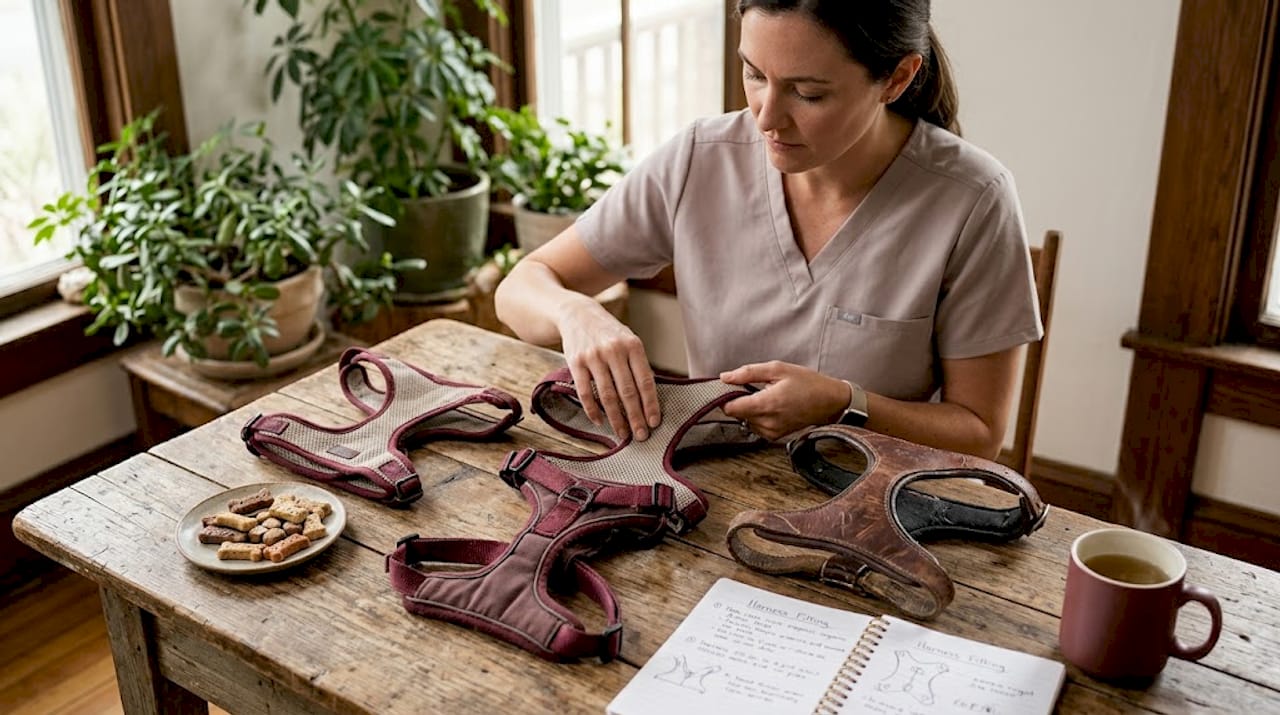
The fabric your harness is made from directly determines how comfortable your dog will be over long walks. Breathable mesh materials with airflow channels reduce heat and moisture buildup under the harness, which is the primary cause of skin irritation during warmer months. Look for smooth stitching with no exposed edges near the armpit or chest areas, soft padding on any rigid sections, and hardware that lies flat rather than pressing into the body.
Adjustability points
A quality adjustable dog harness for comfort will have at minimum four adjustment points: two on the girth strap and one on each shoulder. More adjustability means you can dial in a truly balanced fit across different body shapes, rather than accepting a “close enough” fit that creates pressure spots. Dogs with deep chests, wide shoulders, or unusual proportions (Greyhounds and Bulldogs come to mind) benefit most from high-adjustability designs.
Pro Tip: When trying a new harness, take your dog on a short five-minute test walk before committing to a longer outing. Watch for pawing at the harness, slowing down, or refusing to move. These are the clearest signals that something in the fit or design needs adjusting.
Features to prioritize
| Feature | Why it matters |
|---|---|
| Breathable mesh panels | Reduces heat and moisture; prevents skin irritation |
| Padded chest and belly straps | Distributes pressure without creating hard edges |
| Reflective trim | Safety during low-light walks |
| Multiple D-rings | Flexibility for leash attachment styles |
| Quick-release buckles | Easy on and off, especially for anxious dogs |
Pair your harness with a padded grip leash to extend comfort from the harness all the way to your hand. Leash material and handle padding affect how you manage tension, and softer transitions between harness and leash mean less jerk force reaching your dog’s body. Also follow the expert recommendation to use a collar for ID and reserve the harness for walking control. A dual-gear approach covers identification, safety, and physical comfort in one setup.
My honest take on harness comfort
I’ve watched a lot of dog owners make the same mistake. They buy a harness, clip it on, and assume that if the dog isn’t yelping, everything is fine. But discomfort doesn’t always announce itself loudly. What I’ve seen more often is a dog that gradually starts lagging on walks, becomes harder to get through the door, or develops low-grade reactivity that the owner chalks up to personality. Half the time, the harness is the culprit.
What I’ve learned from looking closely at this across different breeds and activity levels is that fit degradation is the most underestimated problem. A harness that fit perfectly in October might be causing armpit chafing by January because a winter coat added volume the owner didn’t account for. These are not dramatic problems. They’re quiet ones. And quiet problems in dogs often show up as behavioral ones before anyone thinks to check the gear.
My honest take on why comfort matters in dog harnesses is this: a comfortable dog is a trainable dog. When the physical experience of a walk is neutral or pleasant, dogs have mental bandwidth to respond to you. When something hurts or pinches, that bandwidth disappears. The magnetic dog harness designs that prioritize both ease of use and even pressure distribution are the kinds of solutions that make a real daily difference, not just a theoretical one. Prioritize comfort, check the fit every month, and your dog’s walking behavior will reflect it.
— Christopher
Walk better with Americanbarkbliss

At Americanbarkbliss, every harness and walking accessory is selected with the criteria in this article in mind. Comfort, adjustability, breathable materials, and clean construction aren’t extras here. They’re the baseline. If you’re ready to put what you’ve learned into practice, explore the full range of premium dog gear on the site, from padded walking harnesses to reflective leashes and grooming tools that keep your dog’s skin healthy under the harness. While you’re there, check out the 3-piece dog grooming kit to keep your dog’s coat clean and itch-free, which makes a direct difference in how well any harness fits and feels. Your dog deserves gear that works as hard as you do.
FAQ
What is the role of comfort in dog harnesses?
Comfort directly affects your dog’s physical health, gait, behavior, and willingness to walk. A harness that fits poorly causes skin irritation, restricts shoulder movement, and can increase pulling and reactivity on leash.
Can a dog harness be too tight?
Yes. A harness that’s too tight restricts breathing, causes chafing around the armpits and chest, and limits shoulder movement. Use the two-finger rule under every strap to find the right balance between security and comfort.
What type of harness is best for comfort?
Y-shaped harnesses are widely recommended because the chest strap sits above the shoulder joint, allowing natural gait without restricting the shoulder blades. Pair this design with breathable materials and multiple adjustment points for the best result.
How often should I check my dog’s harness fit?
Check the fit at least once a month and after any significant change in your dog’s weight, coat thickness, or activity type. Seasonal coat changes and growth in puppies can alter fit quickly.
Do front-clip harnesses really reduce pulling?
Yes. Front-clip harnesses shift a dog’s center of gravity sideways when they pull, making forward momentum physically inefficient. Research from the American Veterinary Society of Animal Behavior supports a reduction in pulling behavior of up to 60% compared to collar-only walking.
Leave a comment