

Function First: How to Choose Dog Supplies That Work
TL;DR:
- Dog supplies must perform a specific, observable function for safety, control, comfort, health, enrichment, training, or containment. Owners should identify the intended job before purchasing, ensuring the product fits and meets safety standards to avoid costly mistakes. Regular inspections and research help maintain safety, especially since most dog gear lacks strict regulatory oversight in the U.S.
Every dog supply you buy should solve a specific, observable job for your dog — safety, control, comfort, health, enrichment, training, or travel/containment. That’s the role of function in dog supplies in one sentence: the product is “hired” to do a defined task, and if it can’t do that task reliably, the design, the color, and the price tag are irrelevant.
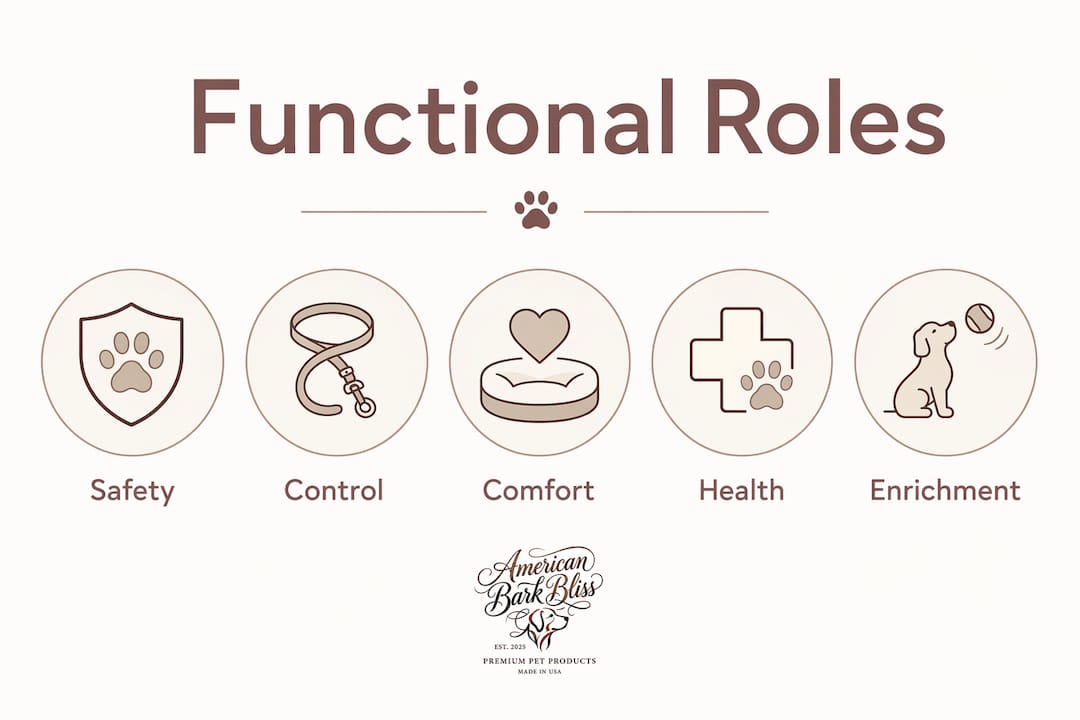
The primary functional roles break down like this:
- Safety: prevents injury or escape (crash-tested car restraints, breakaway collars)
- Control: manages movement and behavior (leashes, harnesses, training tools)
- Comfort: reduces physical stress during rest or activity (orthopedic beds, padded harnesses)
- Health: supports biological needs (AAFCO-compliant food, supplements, dental chews)
- Enrichment: satisfies mental and sensory needs (puzzle feeders, treat dispensers)
- Training: reinforces behavior patterns (treat pouches, clickers, crates)
- Travel/Containment: keeps dogs secure in transit or confined spaces (crates, car barriers)
Before you spend a dollar, write one sentence: What specific problem is this product hired to solve for my dog? That question, recommended by Americanbarkbliss and backed by the five-question buying framework, cuts impulse buys and bad fits faster than any review roundup.
Table of Contents
- What the seven functional roles actually mean for your dog
- How function shows up across every product category
- What materials and construction actually tell you
- How to choose: the hiring lens in five steps
- U.S. safety and regulation: what’s covered and what isn’t
- How functional priorities shift by dog type and situation
- How Americanbarkbliss selects products
- Key Takeaways
- The part most owners get wrong
- Americanbarkbliss: shop functional, American-made dog supplies
- Useful sources and where to check recalls
- FAQ
What the seven functional roles actually mean for your dog
Roles overlap constantly, and that’s fine as long as you know which one is dominant. A front-clip harness, for example, covers safety (no neck pressure), control (redirects pulling), and comfort (distributes force across the chest). The dominant job is control. Once you name it, you know which spec to prioritize: attachment point placement and chest-panel width matter more than color.
Safety is the non-negotiable baseline. A product that looks great but creates a choking hazard, a pressure point, or an escape route has failed its job before the dog even wears it. Harness-based walking is generally safer than collar corrections for dogs that pull because harnesses distribute force across the chest and shoulders rather than the trachea. Veterinary behaviorists consistently recommend this approach for both safety and training outcomes.
Enrichment is the role most owners underinvest in. Dogs sleep many hours a day, and the waking hours they spend without mental stimulation often produce the destructive behavior owners blame on “bad temperament.” Puzzle feeders, chew toys, and interactive dispensers address a real neurological need, not a luxury preference. The ASPCA’s canine enrichment guidance frames mental stimulation as a welfare requirement, not an optional add-on.
Aesthetics become a problem only when they override function. A bandana on a well-fitted harness? Fine. A decorative collar so stiff it causes pressure sores? That’s a product that failed its job. Style is acceptable as a secondary consideration; it becomes harmful when it changes the fit, restricts movement, or uses materials that can’t be cleaned.
How function shows up across every product category
Collars, harnesses, and leashes
The job: attach your dog to you safely and communicate direction. For collars, the critical specs are width relative to neck size, buckle strength, and ID-tag attachment. For harnesses, fit and durability determine whether the product actually delivers its safety promise. A harness that slips over the shoulders on a strong pull has failed its primary job.
Pro Tip: Run two fingers under every strap after fitting. You should feel slight resistance. Too loose means escape risk; too tight means pressure sores within an hour of wear.

Leash length matters more than most owners realize. A 6-foot flat leash is the standard for everyday walks and most training scenarios. Retractable leashes reduce control and create entanglement risk, which is why most trainers recommend against them for dogs still learning leash manners.
Toys and enrichment
Toys are hired to do one of three jobs: physical exercise, mental stimulation, or dental maintenance. A natural rubber chew toy handles all three when sized correctly. The thumbnail test is the fastest safety check: press your thumbnail into the material. No dent means the toy is likely too hard and risks cracking a tooth. Natural rubber passes; nylon and antler often don’t.
For interactive play, a classic durable toy gives dogs an everyday outlet that doesn’t require owner participation every minute. The RSPCA notes that toys reduce anxiety, prevent destructive behavior, and support physical health — the job is real, not decorative.
Feeding and water
The job is precise nutrition delivery and hydration. Stainless steel and ceramic bowls are the functional standard: non-porous, dishwasher-safe, and resistant to bacterial biofilm that builds up in plastic over time. Elevated feeders serve a specific medical function for large breeds with megaesophagus or post-surgical recovery needs, but they aren’t a universal upgrade. Match the tool to the actual need.
Pet food falls under FDA and AAFCO oversight, which sets minimum nutritional standards. That regulatory coverage does not extend to most bowls, toys, or gear — a distinction that matters when you’re evaluating safety claims on packaging.
Bedding
Dogs sleep many hours a day, which means a bed is joint protection and recovery support, not decoration. For seniors or large breeds, orthopedic memory foam addresses a real biomechanical need. The functional checklist: washable cover, non-slip base, foam density appropriate for the dog’s weight, and sides low enough for easy entry if mobility is limited.
Grooming tools
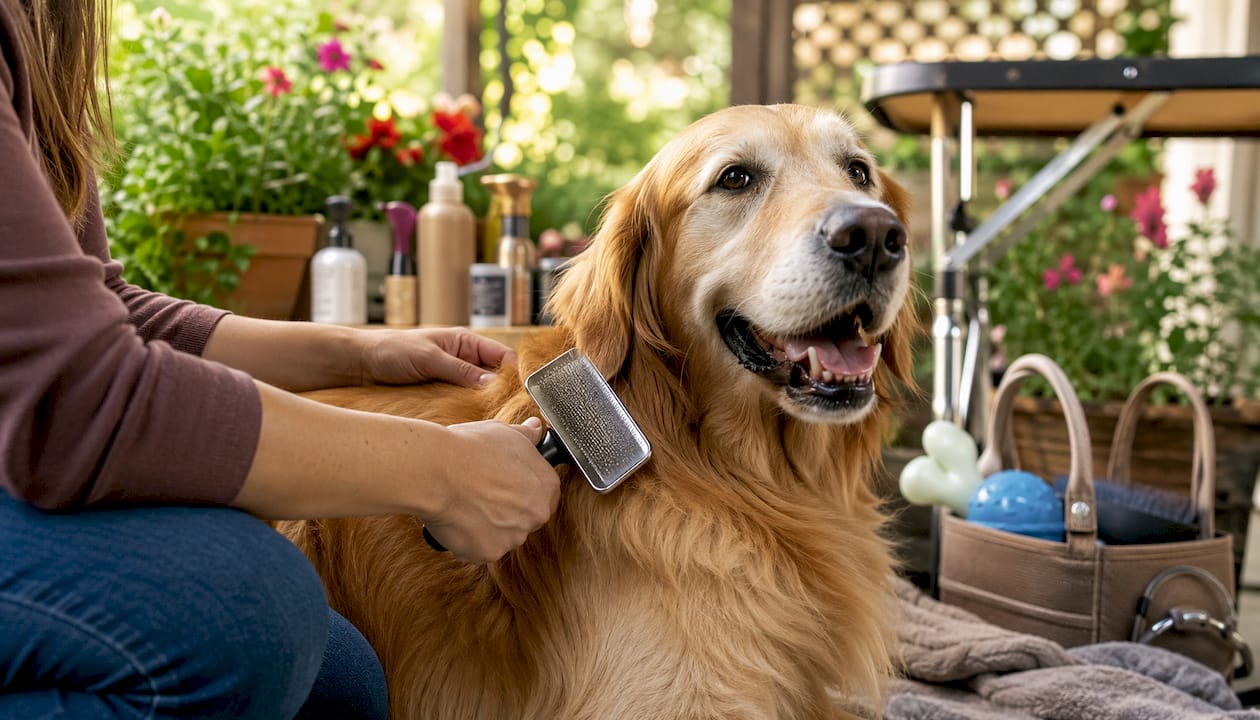
The job varies entirely by coat type. A slicker brush that works perfectly on a Golden Retriever will skip over a double-coated Husky’s undercoat. Match the tool to the coat, not to what looks professional. Nail clippers or a grinder, dog-specific shampoo, and a coat-appropriate brush cover most dogs. Regular grooming also catches skin issues, lumps, and parasites early — the health function is as real as the cosmetic one.
Travel and containment
Crates are the most functional training tool most owners own. The sizing rule is straightforward: the dog should be able to stand, turn around, and lie flat. Use divider panels for growing puppies rather than buying a new crate every few months. A crate that’s too large removes the den-like security that makes it effective for housetraining.
Car restraints and barriers serve a safety function that most owners treat as optional until an accident happens. A crash-tested restraint keeps the dog from becoming a projectile and keeps the driver focused on the road.
Mobility and health aids
Supplements, joint supports, and mobility aids are a growing category. Manufacturers are shifting toward easier-to-administer formats — liquid drops, jelly bars — because owner compliance is part of a product’s functional performance. A supplement your dog refuses to eat every third day isn’t delivering its health benefit. Ease of administration is a legitimate selection criterion, not a marketing gimmick.
What materials and construction actually tell you
Not all materials are equal, and the gap between a quality product and a cheap one usually shows up in the construction details, not the marketing copy.
Materials tiers to know:
- Natural rubber and food-grade silicone: best for chew toys and feeding accessories; non-toxic, durable, easy to clean
- PVC-coated webbing with rounded edges: reduces fur matting and hand irritation on leashes and harnesses; sharp webbing edges cause micro-abrasions over time
- Natural fibers (cotton, hemp): breathable for apparel and bandanas; check for colorfast dyes
- Bargain plastics: fine for short-lived accessories; avoid for anything load-bearing or chewed regularly
Construction signals worth checking:
- Hardware: cast metal or forged steel buckles outlast zinc-alloy equivalents under repeated stress
- Stitching: double-stitched seams at stress points (D-ring attachments, buckle loops) indicate structural intent
- Welded vs. sewn buckles: welded is stronger for load-bearing applications
- Seam finishes: raw edges fray; bound or folded edges last
Quality signals on product pages:
- Published materials list (not just “durable nylon”)
- Warranty or replacement policy
- Third-party testing or certifications where relevant
- Clear sizing charts with actual measurements, not just S/M/L
Monthly inspection checklist:
- Check all hardware for corrosion or deformation
- Run fingers along every seam for fraying or separation
- Inspect chew toys for cracks, exposed squeakers, or chunks missing
- Check collar and harness buckles for click-lock integrity
- Retire anything showing structural compromise
Dog accessory durability depends as much on ongoing inspection as on initial quality. A gear audit once a month catches failure modes that a purchase-day check will always miss.
How to choose: the hiring lens in five steps
The five-question framework cuts through marketing noise faster than any review:
- What job is this product hired to do? Write the sentence. “This harness is hired to prevent neck injury during walks with a 60-pound dog that pulls hard.”
- Does it fit? Measure neck circumference, chest girth, and back length before ordering. Never guess on sizing for load-bearing gear.
- What are the materials? If the product page doesn’t list them, that’s a red flag.
- What’s the safety record? Check the FDA’s pet product recall database and the CPSC for consumer product hazards.
- What happens if it fails? Is there a warranty? A return window? A replacement policy?
Sizing rules to measure before you buy:
- Neck: measure at the base, not the middle, for collar sizing
- Chest girth: the widest point behind the front legs for harness sizing
- Back length: collar of neck to base of tail for apparel
- Weight: always cross-reference with the manufacturer’s weight chart
The 3-3-3 rule is worth knowing before you invest heavily in gear for a new dog: expect 3 days to decompress, 3 weeks to settle into routine, and 3 months to fully bond. Delay nonessential purchases until the 3-week mark when behavior patterns become readable. A dog that seems anxious on day 2 may be completely calm by week 4, which changes the entire gear list.
Cost-per-year thinking: premium gear pays off for daily-use and safety-critical items like harnesses and beds. Budget tiers work fine for consumables and growth-phase gear that will be outgrown anyway. A $90 harness used daily for three years costs $30 a year. A $20 harness replaced every six months costs $40 a year and fits worse.
Red flags to walk away from:
- Chew toys that pass the thumbnail test (no dent = too hard)
- No materials list on the product page
- No warranty, return policy, or customer support contact
- Safety claims with no certification or testing reference
U.S. safety and regulation: what’s covered and what isn’t
The regulation gap: Pet food has FDA and AAFCO oversight. Most dog toys and gear have no dedicated pre-market safety authority — there is no equivalent body that tests a chew toy before it reaches store shelves. The owner is the final gatekeeper.
This isn’t a minor footnote. It means a toy can be marketed as “safe” and “non-toxic” with no independent verification required. The CPSC handles consumer product hazards broadly, but pet-specific gear falls into a regulatory gap that puts the burden of materials checks, recall lookups, and construction inspection squarely on you.
Practical owner responsibilities:
- Check the FDA’s pet food and product recall page before buying new food or treats
- Search the CPSC database for any consumer product safety notices on gear
- Inspect all new items on receipt before the first use
- Run supervised debut sessions: watch the first 15–20 minutes of use with any new toy or gear
- Conduct monthly gear audits (see the inspection checklist above)
Recall lookup, step by step:
- Go to fda.gov and search “pet food recalls” for food and treat products
- Search recalls.gov for broader consumer product safety notices
- Check the manufacturer’s website for voluntary recalls or safety notices
- Set a Google Alert for the brand name + “recall” to catch future notices
The quality signals in dog accessories — published materials lists, warranties, and transparent return policies — exist partly because the regulatory framework doesn’t require them. Brands that publish them anyway are signaling something real about their standards.
How functional priorities shift by dog type and situation
| Scenario | Top Functional Priorities | Key Feature Types |
|---|---|---|
| Puppy (under 6 months) | Containment, ID, safe chewing | Correctly sized crate with divider, breakaway collar + ID tag, soft natural rubber chew toys |
| Adolescent large breed | Control, durability, enrichment | Front-clip harness, indestructible toys, puzzle feeders to burn mental energy |
| Senior dog (joint issues) | Comfort, mobility, low-impact enrichment | Orthopedic bed, non-slip surfaces, gentle puzzle toys, joint supplements in easy formats |
| Anxious dog | Comfort, enrichment, containment | Covered crate, treat dispensers, calming bed with raised sides, consistent gear set |
| Working or sport dog | Control, safety, durability | Fitted sport harness, reflective leash, durable gear rated for repeated stress |
| Multi-dog household | Resource management, individual ID, safety | Separate feeding stations, individual ID tags, enough enrichment items to prevent guarding |
Puppies need containment and safe chewing above everything else. A crate sized with a divider panel handles housetraining and provides a secure den without requiring a new purchase every two months. For seniors, the shift is toward low-impact comfort: orthopedic foam, non-slip bowl mats, and ramps instead of stairs.
Anxious dogs benefit most from consistent, predictable gear. Changing equipment frequently adds stress. Pick a harness, a leash, and a bed that fit well, and keep them. Treat dispensers give anxious dogs a productive focus during alone time, which is why enrichment ranks so high in that scenario.
Multi-dog households need to think about resource guarding from the start. Separate feeding stations and enough enrichment items to go around aren’t optional extras — they’re conflict prevention. Setting up a home training space with clear zones for each dog reduces competition and makes training more consistent.
How Americanbarkbliss selects products
Americanbarkbliss evaluates every product against a functional checklist before it appears on the site. The process starts with the job test: does this product solve a clear, specific problem for a dog? If the answer isn’t obvious from the product specs, it doesn’t make the cut.
The in-house selection checklist:
- Job test: clear functional role with measurable performance criteria
- Sizing: published size charts with actual measurements, not just label sizes
- Materials transparency: full materials list available, no vague descriptors
- Construction quality: hardware, stitching, and seam inspection against category standards
- Warranty and returns: clear policy that gives owners recourse if the product fails
- Third-party testing: preferred where available, noted where absent
The catalog focuses on American-made goods because domestic manufacturing standards and supply-chain transparency are easier to verify. That’s a practical quality signal, not just a marketing position. When a product is sourced domestically, tracing materials and holding manufacturers accountable is a shorter path.
For fit questions specific to a product, Americanbarkbliss’s customer support team can help. The harness fit guide and comfort in harness design articles on the site walk through measurement and adjustment in detail. Editorial content and product pages are kept separate: the guides exist to help owners make better decisions, not to push specific SKUs.
A cohesive product ecosystem also matters practically. Owners who buy matched functional collections — a harness, leash, and collar set that fit and work together — report fewer fit problems and higher satisfaction than those who mix unrelated products from different brands.
Key Takeaways
Function determines whether a dog supply actually solves its intended job — safety, control, comfort, health, enrichment, training, or containment — and every purchase decision should start with naming that job explicitly.
| Point | Details |
|---|---|
| Name the job first | Write one sentence defining what the product is hired to do before evaluating any other feature. |
| Measure before you buy | Check neck, chest girth, back length, and weight against the manufacturer’s size chart — never guess on load-bearing gear. |
| Run the thumbnail test | Press your thumbnail into any chew toy; no dent means the material is too hard and risks tooth damage. |
| Audit gear monthly | Inspect seams, hardware, and chew toys every month; retire anything showing fraying, cracks, or buckle failure. |
| Americanbarkbliss selection | Americanbarkbliss applies a job-test checklist covering materials transparency, sizing, construction, and warranty before listing any product. |
The part most owners get wrong
The conventional wisdom in pet retail is that more choice is better. It isn’t. The owners who end up with a closet full of unused gear almost always skipped the job sentence. They bought the cute bandana set before they knew whether their dog tolerated anything around its neck. They bought the indestructible toy before they knew whether their dog was actually a chewer.
The 3-3-3 rule exists for a reason. A dog that’s been in your home for 72 hours is still in survival mode — you genuinely don’t know what gear they need yet. The impulse to buy everything on day one is understandable, but it’s expensive and often counterproductive. Start with the essentials: food, a properly fitted harness and leash, a correctly sized crate, and an ID tag. Add everything else after three weeks, when you actually know your dog.
The other common mistake is treating safety-critical gear the same as consumables. A $15 harness from an unknown brand with no materials list and no return policy is a gamble on your dog’s safety, not a bargain. Save money on toys (they get destroyed anyway) and spend it where the stakes are real. That’s the function-first approach in practice.
Americanbarkbliss: shop functional, American-made dog supplies
You’ve just worked through a complete framework for evaluating dog supplies by function. Americanbarkbliss is where that framework meets a curated product lineup — every item selected against the job-test checklist described above, made in the USA, with published materials and clear return policies.
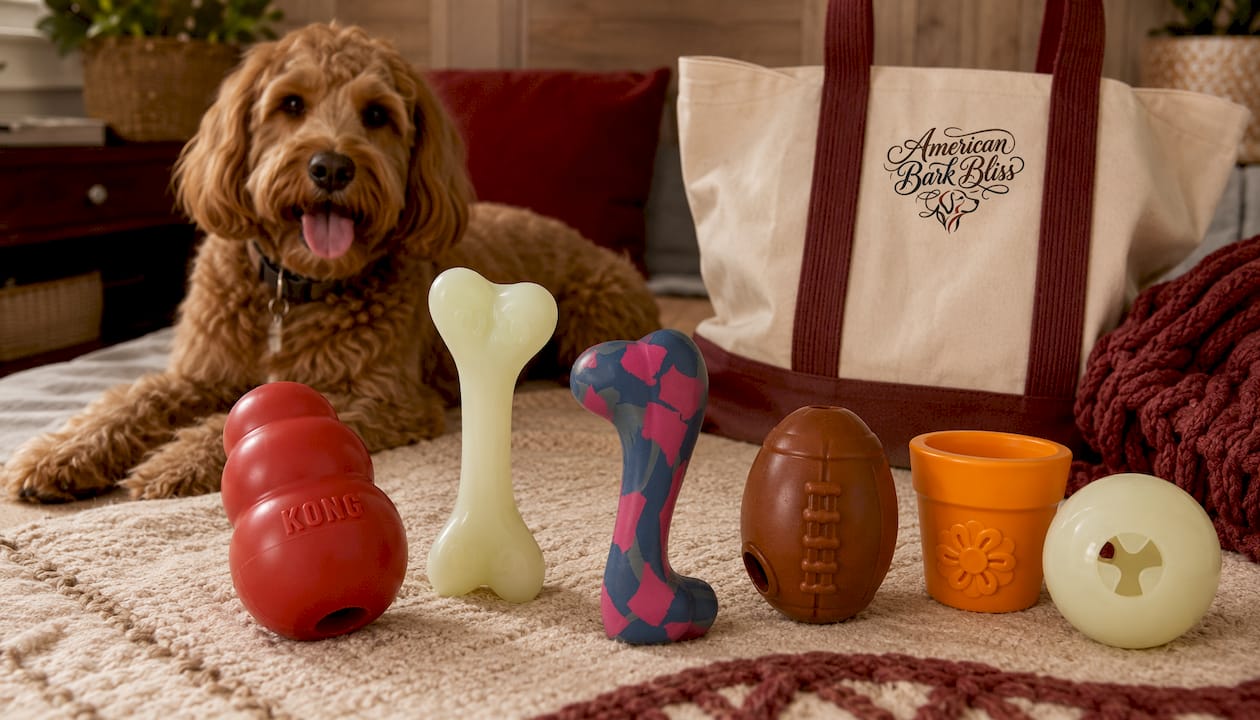
Three categories worth starting with: treat dispensers for enrichment and anxiety management, a natural rubber chew toy that passes the thumbnail test and handles daily chewing safely, and a classic durable toy for everyday interactive play. Each one maps directly to a functional role covered in this guide. Browse the full collection at Americanbarkbliss and use the buying framework from this article to find what your dog actually needs.
Useful sources and where to check recalls
Government and regulatory resources:
- FDA pet food recalls: fda.gov — search “pet food recalls” for current notices on food and treats
- CPSC consumer product safety: cpsc.gov — broader consumer product hazard notices that may cover gear
- AAFCO nutritional standards: aafco.org — explains minimum nutritional requirements for pet food labeling
Americanbarkbliss guides:
- Types of dog accessories: style, safety and function — function vs. fashion trade-offs
- Adjustable pet harness: safety, fit and comfort guide — detailed fitting instructions
- The role of design in dog collars — collar design trade-offs explained
Partner training resources:
- Dog training tools for home use — practical guide to training gear and techniques
For product-specific fit questions or warranty details, contact Americanbarkbliss customer support directly through the site.
FAQ
What does “function-first” mean when buying dog supplies?
It means identifying the specific job a product must do before evaluating any other feature. A harness hired to prevent neck injury needs a different spec than one hired to redirect pulling.
What is the 3-3-3 rule for dogs?
The 3-3-3 rule describes a new dog’s adjustment timeline: 3 days to decompress, 3 weeks to settle into routine, 3 months to fully bond. Delay nonessential gear purchases until the 3-week mark when behavior patterns are readable.
How do I know if a chew toy is safe for my dog’s teeth?
Use the thumbnail test: press your thumbnail firmly into the toy’s surface. If you can’t make a dent, the material is likely too hard and risks cracking a tooth. Natural rubber typically passes; nylon and antler often don’t.
Can dogs tell the difference between toys by what they do?
Research suggests dogs do categorize objects by function and sensory properties rather than appearance alone. A dog that fetches will often select a ball-shaped object even when it looks different from their usual toy, responding to shape and texture cues tied to the activity.
Are dog toys and gear regulated for safety in the U.S.?
Pet food falls under FDA and AAFCO oversight, but most dog toys and gear have no dedicated pre-market safety authority. Owners are responsible for checking materials, inspecting construction, and monitoring recall databases before and after purchase.
Leave a comment