

Measure First: Puppy Collar Size, Two Finger Fit & 1–2 Week Checks
Measure your puppy’s neck circumference high up, near where a collar naturally sits, then add room for two fingers to slide underneath comfortably. That measurement, not your puppy’s expected adult size, tells you which collar to buy. Choose an adjustable collar sized to fit now, recheck the fit every week or two during growth spurts, and for breeds prone to tracheal problems, save the collar for ID tags and use a harness for actual walking.
TL;DR:
- Most puppies need an adjustable collar with a range that matches their current measurement plus two fingers, and rechecking every one to two weeks is essential during rapid growth.
- Breeds prone to tracheal issues, such as Yorkies and Chihuahuas, should use harnesses for walks and keep collars for ID tags to prevent respiratory strain.
- Collars measuring 6-12 inches suit toy and small breed puppies, while larger sizes up to 20 inches are suitable for bigger breeds and adult dogs, with careful attention to adjustment range.
- Measuring a wiggly puppy is easiest after activity or a nap, using treats or assistance, and verifying the fit with a two-finger rule to prevent slipping or discomfort.
- Replacing or adjusting collars promptly when fit becomes loose or worn out helps prevent escape hazards and skin irritation during rapid puppy growth.
Table of Contents
- How to Measure Your Puppy for the Right Collar Size
- Measuring a Wiggly Puppy Without Losing Your Mind
- Collar or Harness: Which Does Your Puppy Actually Need?
- How Often to Re-Measure as Your Puppy Grows
- Quick Fit and Safety Checklist
- Why Trust This Sizing Advice
- Puppy Collar Size: Measure First, Buy Second
- Puppy Collars Built for the Growth Stage
- Sources
- FAQ
How to Measure Your Puppy for the Right Collar Size
Grab a soft fabric tape measure or a piece of string and a ruler. Wrap it around your puppy’s neck about two inches behind the ears, right where a collar would rest during a walk. That’s higher than most people think to measure, and it matters. Measuring too low, near the shoulders, gives you a number that’s too big for the actual fit point.
Pull the tape snug but not tight, then slide two fingers underneath it. That’s the two-finger rule, and it’s the industry standard for a reason: tight enough that the collar won’t slip over the head, loose enough that it doesn’t press on the windpipe. If you’re using string, mark where it overlaps, lay it flat against a ruler, and add roughly one to two inches to that raw measurement to account for the two-finger gap, depending on your puppy’s size.
Once you have a number, match it against a size chart. Collar sizing isn’t perfectly standardized across brands, but most follow a similar pattern:
| Size | Neck circumference | Typical strap width | Puppy type |
|---|---|---|---|
| XXS | 6–8 inches | 3/8 inch | Toy breeds, tiny puppies |
| XS | 8–12 inches | 5/8 inch | Small breed puppies |
| S | 10–14 inches | 3/4 inch | Small to medium puppies |
| M | 14–20 inches | 1 inch | Medium breed puppies |
| L | 16–20 inches | 1.5 inches | Large breed puppies |
| XL | 24–28 inches | 1.5–2 inches | Giant breed puppies |
These bands come from PetSmart’s published collar sizing chart, and they overlap on purpose. A puppy at 14 inches could reasonably wear an S or an M, so let the two-finger test break the tie, not the chart alone.
A few things to keep in mind while you shop:
- Narrower straps (3/8 to 5/8 inch) suit puppies under 15 pounds; wider straps can rub or feel heavy on a small neck.
- An adjustable collar with at least 4 to 6 inches of range gives you room to size up without buying new hardware every month, as explained in this practical guide on dog travel containment collars.
- Chain or prong-style collars fit differently than flat nylon collars and usually need extra length. Most puppy owners should skip these entirely.
Measuring a Wiggly Puppy Without Losing Your Mind
Puppies do not hold still for tape measures, so plan around that instead of fighting it.
- Measure right after a play session or short walk, when your puppy is tired and less likely to squirm.
- Have a second person hold treats at nose level while you wrap the tape, or use your body to gently pin your puppy against your legs.
- Work in short bursts. Two or three ten-second attempts beat one long struggle.
- If your puppy already has a collar, take it off and lay it flat. Measure from the buckle to the hole currently in use, then add the width of the overlap. That gives you the puppy’s actual current fit, which is often more reliable than a live measurement on a wiggling body.
When your number lands between two sizes, size down toward the smaller option if its adjustment range can still stretch to your measurement. A collar that’s secure today beats one that’s roomy for a size your puppy hasn’t grown into yet.
Pro Tip: Measure in the evening after a full day of activity and food. Puppies can look and feel slightly different in girth after meals, and evening measurements tend to reflect a more “average” neck size than a first-thing-in-the-morning check.
Collar or Harness: Which Does Your Puppy Actually Need?
A collar works fine for most puppies as an everyday ID holder and for short, calm leash walks around the yard. That’s its job. Where things get more specific is leash training on real walks, especially with breeds built with narrower necks or airways.
VCA Animal Hospitals recommends harnesses over collars for breeds prone to tracheal issues, since a puppy that pulls or lunges against a collar puts direct pressure on the throat. Pugs, Yorkies, Chihuahuas, and other small or short-nosed breeds tend to fall into this category, though any enthusiastic puppy on a leash can strain against a collar hard enough to matter.
A practical split works for nearly every household:
- Keep a properly fitted collar on at all times for ID tags and quick grabs.
- Switch to a soft, padded harness for actual leash walks, training sessions, or car rides.
- For trachea-sensitive breeds, treat the harness as the default and the collar as backup.
This isn’t an either/or decision. Most puppies end up wearing both, just for different jobs. A collar built with comfort in mind still matters even when a harness is doing the walking work, since the collar is what holds the rabies tag and ID at 2 a.m. when it counts most.
How Often to Re-Measure as Your Puppy Grows
Puppies can outgrow a well-fitted collar in about two weeks during peak growth phases, which is faster than most new owners expect. That’s not a guess. It’s why breeders and trainers push re-measuring so hard in the first few months.
- Check the fit every one to two weeks until your puppy hits roughly six months old.
- After six months, growth slows for most breeds, so monthly checks are usually enough.
- Prioritize the collar that fits securely right now over one bought with adult size in mind. A collar that’s too loose can slip over the head; one bought “for later” often sits that loose in the meantime.
- Replace the collar when the buckle or D-ring shows wear, or when you’ve run out of adjustment holes and the smallest setting is still loose.
An adjustable collar with a generous range buys you time between replacements, but it doesn’t buy you a pass on checking the fit. Adjustment range and correct sizing are two different things, and confusing them is how collars end up loose right when a puppy is most likely to bolt.
Quick Fit and Safety Checklist
Run this check anytime you put a collar back on after a bath, a swim, or a growth spurt you suspect happened overnight.
- Slide two fingers flat underneath the collar. If they slide in with room to spare, tighten it. If they can’t fit at all, loosen it.
- Watch for a collar riding low on the neck or spinning loosely. Both mean it’s too big.
- Check for redness, rubbing, or thinning fur where the collar sits. That’s an early sign it’s too tight or made from stiff material.
- Confirm the buckle and D-ring sit flat and haven’t cracked or loosened.
- Dry a wet collar fully before the next wear. Damp nylon holds bacteria and can irritate skin over time.
Puppies grow in bursts. Skipping the two-finger check for even a week during a growth spurt is often enough for a snug collar to turn loose and risky.
Why Trust This Sizing Advice
Christopher writes the Dog Collar Fitting Guide and other educational content at Americanbarkbliss, built around the same measure-first approach covered here. Americanbarkbliss designs its collars in the USA with adjustability and comfort as starting points, not afterthoughts, so the sizing advice above lines up directly with how its products are built and sold.
Puppy Collar Size: Measure First, Buy Second
Most collar problems trace back to one habit: people buy for the dog they imagine having in six months instead of the puppy standing in front of them. That instinct is understandable. Nobody wants to buy three collars in a single season. But a collar sized for a projected adult neck is a collar that can slip off a puppy’s head today, and a slipped collar is how puppies get loose near roads.
The conventional advice to “size up for growth” isn’t wrong, exactly. It’s incomplete. Sizing up only makes sense within a collar’s actual adjustment range, checked against your puppy’s current measurement, not a guess about next season. If a collar’s smallest setting is already loose on your puppy, it’s the wrong collar, no matter how much bigger your puppy will eventually get.
What actually works is boring and repetitive: measure, check two fingers, recheck in a week. That habit does more for safety than any specific brand or material choice ever will.
— Christopher
Puppy Collars Built for the Growth Stage
If you’ve just measured your puppy and landed somewhere in that medium range, the 1.5" Wide Lighthouse Nylon Dog Collar gives you an adjustable fit with room to grow without the collar feeling stiff or heavy on a young neck.
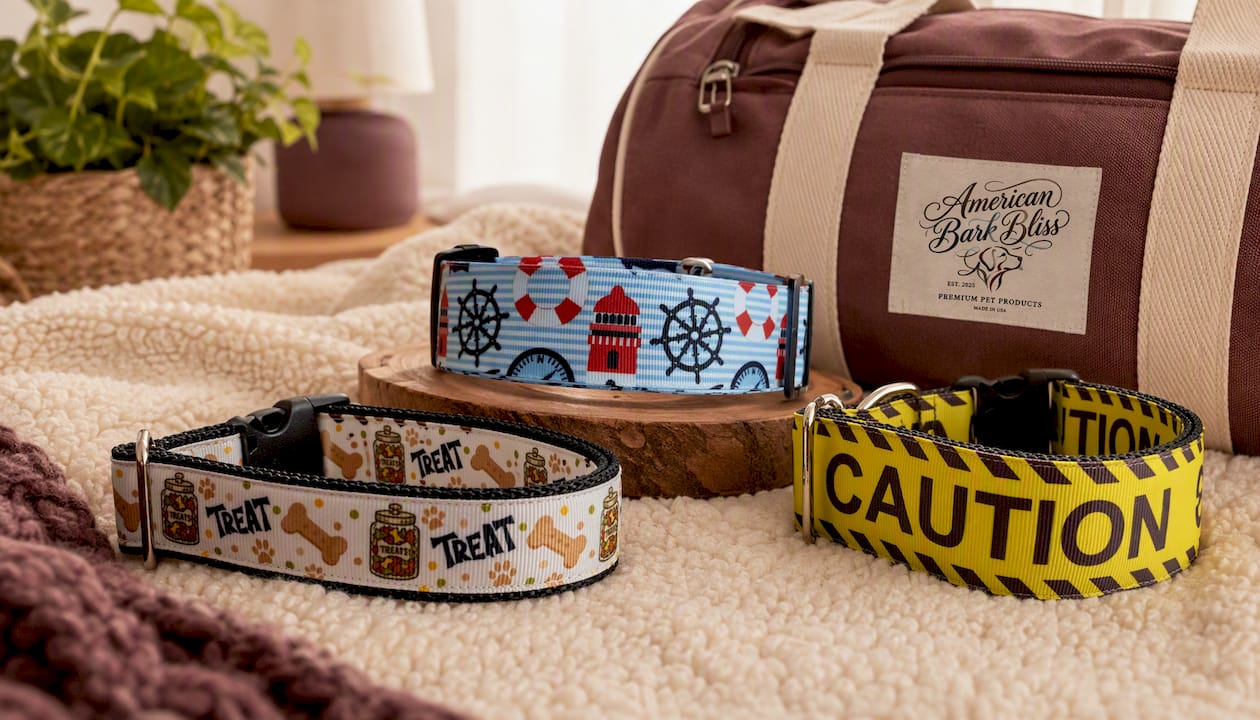
For smaller puppies or breeds still building up their neck size, the Treat Nylon Dog Collar is soft and lightweight enough for daily wear without chafing. If you want a collar that keeps your puppy visible on evening walks or at a busy dog park, the 1.5" Wide Caution Nylon Dog Collar adds high-visibility styling while keeping the same adjustable, quick-release build.
All three are made in the USA with adjustable hardware, so you’re not locked into a single size as your puppy grows. Measure your puppy’s neck first, using the two-finger rule from the sizing chart above, then match that number against each collar’s adjustment range before you buy. Check the current sizing details on each product page, and pick the one whose range actually covers your puppy’s measurement today, not just the size you expect to need later.
FAQ
Can an 8-week-old puppy wear a collar?
Yes. An 8-week-old puppy can wear a properly fitted, lightweight collar for ID purposes, though many owners wait until basic leash training starts to introduce it for walking. Start with short, supervised sessions so the puppy gets used to the feeling gradually.
What size collar fits a 10-week-old puppy?
There’s no single answer, since size depends on breed rather than age. Measure the neck circumference directly using a tape or string, then match that number to a size chart, since a 10 week old toy breed and a 10 week old large breed puppy can differ by 10 inches or more.
What size collar should I use for an 8-week-old Lab puppy?
Most 8 week old Labrador puppies measure somewhere in the 8 to 12 inch neck range, which typically fits an XS or S adjustable collar, but you should still measure directly since individual puppies vary. Choose a collar with enough adjustment range to grow with a Lab’s fast growth curve over the following months.
What size dog fits a 20-inch collar?
A 20-inch collar setting typically fits a medium to large adult dog with a neck circumference in that 16 to 20 inch range, per PetSmart’s sizing chart. For a growing puppy, a 20-inch collar is usually too large unless it’s an adjustable collar with a wide range meant to fit down to a smaller current size, so check the minimum adjustment setting before buying one for a young puppy.
Leave a comment