

4 Night Walking Dog Safety Essentials for US Owners: Visibility First
Night walking dog safety comes down to four things: a fitted harness and standard leash for control, layered visibility (an active light plus retroreflective gear), a familiar well-lit route, and a charged phone with a flashlight in your pocket. Back that up with basic emergency know-how for wildlife or bite exposure. Guidance from the American Veterinary Medical Association, NHTSA, and a Cochrane review on visibility aids all point the same direction: gear helps, but route and control decide the outcome.
TL;DR:
- Visibility gear should include both a collar-mounted light for the dog and a headlamp for the owner to maximize detection and recognition by drivers.
- Use a sturdy harness with reflective striping on multiple sides and ensure all lights and batteries are functioning properly before every walk.
- Stick to familiar, well-lit routes and cross only at lit intersections to minimize the risk of accidents during nighttime walks.
- Shorten the leash and redirect attention immediately if your dog fixes on a distraction or encounters wildlife, and contact your veterinarian if bitten or exposed to wild animals.
- Prepare a night walk checklist that includes a charged phone, active lights, proper gear, reflective accessories, waste bags, and basic first aid supplies.
Table of Contents
- Layered Visibility: Why One Light Isn’t Enough
- Which Leash and Harness Setup Works Best at Night?
- Choosing a Safer Route and Time for Night Walks
- What to Do During a Wildlife Encounter or Bite
- Your Night Walk Departure Checklist
- Conditioning Your Dog and Watching for Warning Signs
- Personal Safety and Self-Defense Tips for Dog Walkers at Night
- How to Stay Alert and Aware of Surroundings During Night Walks
- Communication Devices and Emergency Contacts to Carry
- Training Commands Your Dog Needs to Know in the Dark
- Dressing for the Weather on Night Walks
- An Editor’s Take on Night Walk Safety Gear
- Shine Bright: Gear Built for the Layered Visibility Rule
- Sources
- FAQ
Layered Visibility: Why One Light Isn’t Enough
Layered visibility means combining an active light source with retroreflective material, and the research is clear that pairing beats picking just one. A Cochrane review of pedestrian and cyclist visibility interventions found that lamps, flashing lights, and retroreflective materials improve how quickly drivers detect and recognize a person on the road. Retroreflective fabric only works when a light source hits it. Under a streetlamp, that’s fine. On a quiet residential street with gaps between poles, it’s nearly useless without your own light.
That’s why the smartest setup puts light in two places: on your dog and on you. A collar-mounted LED or clip-on light on the dog helps a driver judge exactly where the animal is relative to you, since a moving light low to the ground reads very differently than a shape at hip height. Reflective harnesses and leashes add a second layer that catches headlights even when the battery-powered light isn’t facing the right direction.

For your own light, a headlamp beats a handheld flashlight for most walks because it frees your hands for leash control and keeps the beam pointed wherever you look. Save the handheld flashlight for spot-checking dark patches of yard or brush before your dog goes near them.
A few placement rules make a real difference:
- Put a steady or slow-pulse light on your dog’s collar or harness, not a rapid strobe that can be disorienting to drivers or cyclists.
- Angle your headlamp down and away from oncoming traffic so you’re not blinding drivers at intersections.
- Choose reflective gear with striping on multiple sides, not just the front, since most vehicles approach from behind or the side.
- Replace batteries before they die mid-walk. A light that’s dim is barely better than no light at all.
Statistic Callout: The same Cochrane review found that visibility aids increase how well drivers detect and recognize pedestrians, but the trials reviewed didn’t prove a reduction in actual collisions or injuries. Gear improves your odds. It doesn’t replace good route choices or attentive handling.
Pro Tip: Test every light and reflective piece in your driveway at dusk before your first real night walk. A dead battery or a harness-mounted light that spins out of view is a lot easier to fix at home than three blocks from your house.
Related reading: reflective dog walking gear breaks down specific product types, and what reflective dog gear actually does explains the mechanics in more depth.
Which Leash and Harness Setup Works Best at Night?
A standard, sturdy leash and a well-fitted harness are the safest combination for nighttime walks, and retractable leashes should stay home after dark. The AVMA’s walking guidance is direct on this point: keep your dog leashed, use a properly fitted harness or collar, and skip retractable leads at night because the thin cord is hard for drivers and cyclists to see and gives you far less immediate control if your dog lunges.
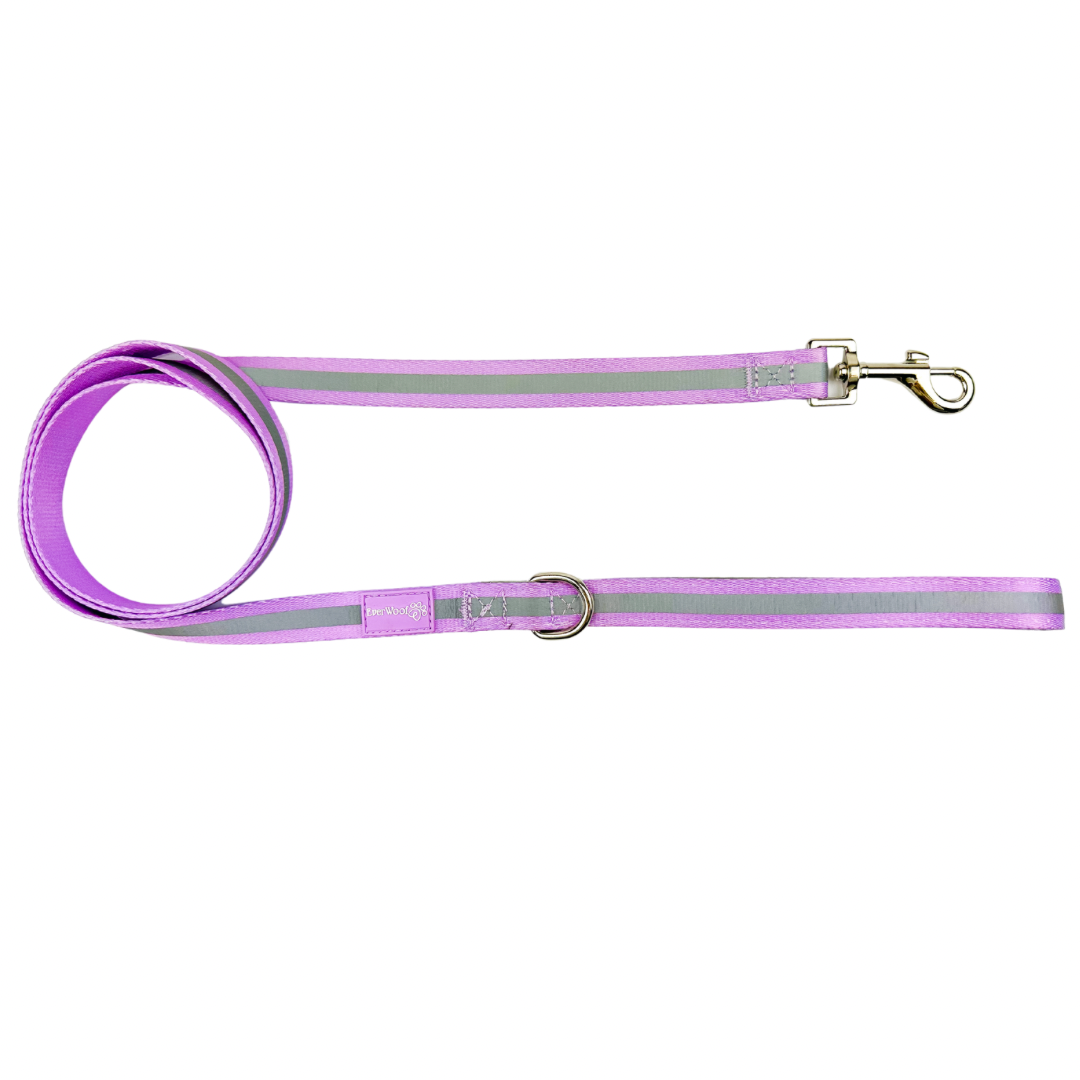
A harness distributes pressure across the chest and shoulders, which matters if your dog pulls toward a rustling bush or a jogger who appears suddenly out of the dark. A collar works fine for dogs with solid leash manners and no history of pulling, but a harness is the safer default when visibility is low and reaction time is short.
Before you leave the house, run through a quick mechanical check:
- Confirm the harness buckles are fully clicked and the fit hasn’t loosened since your last walk.
- Check that the ID tag is legible and securely attached to the collar.
- Test that any light clips or battery compartments on collar or harness lights are snapped shut, not just resting in place.
- Give the leash clip a firm tug to make sure it’s locked onto the harness ring, not half-latched.
If your dog suddenly fixes on something in the dark, shorten the leash immediately by gathering slack into your hand rather than letting the dog run the line out. Step slightly to the side so you’re not directly between your dog and whatever it’s pulling toward, and use a firm, calm voice cue to redirect attention back to you.
Pro Tip: Practice the “shorten and redirect” move in daylight with a low-stakes distraction, like a squirrel across the street, so your hands know what to do before it matters in the dark.
Choosing a Safer Route and Time for Night Walks
Stick to routes you already know, on lit sidewalks and main streets, and skip unlit midblock crossings or isolated trails once the sun goes down. Familiarity matters because you already know where the curb dips, where a fence juts into the sidewalk, and where the streetlight burned out last winter.
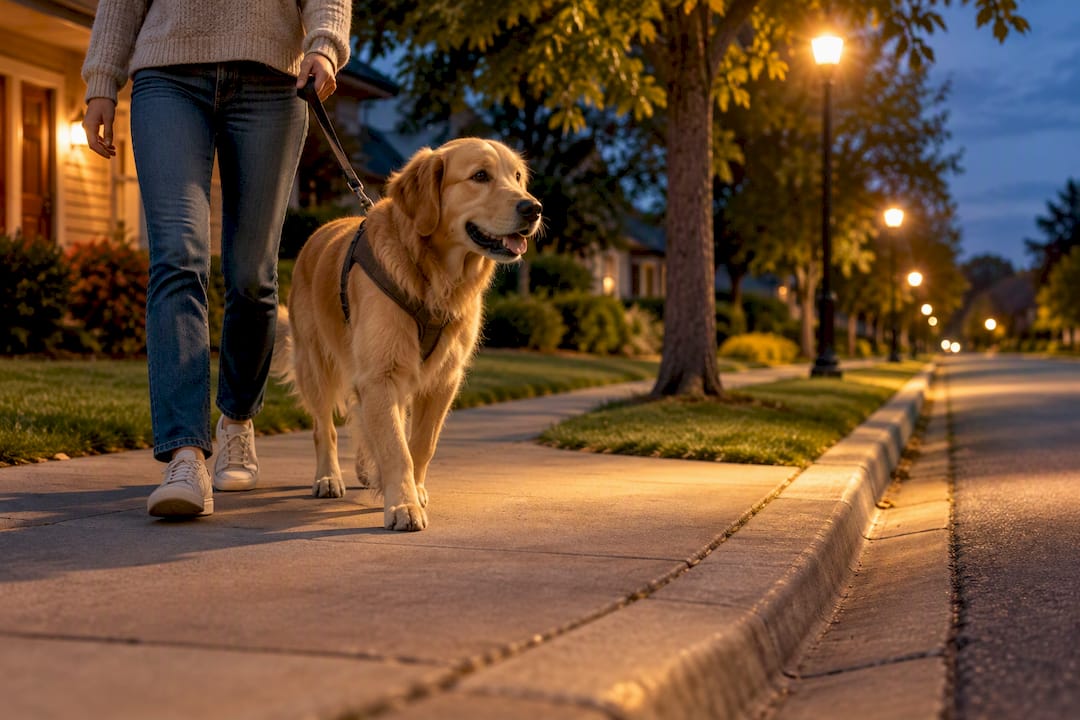
NHTSA’s most recent pedestrian crash data is a useful planning tool here: a majority of pedestrian fatalities occur in the dark, with crash counts climbing in the evening and late-evening hours. That doesn’t mean don’t walk at night. It means treat the 6 p.m. to midnight window with extra caution, especially near roads without dedicated crosswalks.
Lighting quality on a route matters as much as whether streetlights exist at all. A Michigan Department of Transportation study on crosswalk lighting found many serious nighttime pedestrian crashes happen at spots with low illuminance even where streetlights are technically present. A few practical habits follow directly from that:
- Walk a new route in daylight first to spot uneven pavement, blind driveways, or gaps in lighting.
- Favor continuously lit stretches over routes with long dark gaps between poles.
- Cross at marked, lit intersections instead of cutting across midblock, even if it adds a few minutes.
- Have a backup route ready for nights when a construction closure or a burned-out streetlight changes the lighting on your usual path.
What to Do During a Wildlife Encounter or Bite
If a raccoon, skunk, coyote, or other wild animal appears, shorten your dog’s leash immediately, step between the animal and your dog if you can do it safely, and back away toward a lit, populated area without running or shouting. Sudden movement or noise can escalate a standoff that would otherwise resolve on its own.
Here’s the sequence to follow if contact happens:
- Separate your dog from the animal as calmly as possible, using the shortened leash to pull back rather than lunging forward yourself.
- Check your dog for visible wounds or saliva contact once you’re both clear of the animal.
- Contact your veterinarian promptly, since the CDC recommends prompt reporting and veterinary consultation after potential rabies exposure, and rabies risk is time-sensitive.
- Report the encounter to local animal control or public health, especially if the wild animal behaved erratically or the encounter involved a bite.
A bat, raccoon, skunk, or fox that seems unusually aggressive, disoriented, or active in daylight hours it normally avoids can be a rabies warning sign. Don’t approach it, don’t let your dog approach it, and report it to animal control rather than assuming it’s just a bold neighborhood visitor.
Call 911 only for an active, ongoing threat, like an aggressive loose dog charging at you or your pet. For everything after the fact, animal control and your veterinarian are the right first calls.
Your Night Walk Departure Checklist
A short pre-walk routine catches most of the avoidable failures before they happen. Run through it at the door every time, not just for new routes.
For any walk, pack:
- A fully charged phone
- A flashlight or headlamp
- A standard (non-retractable) leash
- A properly fitted harness or collar with a legible ID tag
- An active light for your dog, plus reflective gear
- Waste bags
- A few basic first-aid items, since the AVMA recommends carrying a small first-aid kit for outdoor walks
For longer or more remote walks, add water, a fuller first-aid kit, and a spare light or battery in case your primary one dies far from home.
| Walk type | Core gear | Add if remote or long duration |
|---|---|---|
| short neighborhood loop | Phone, light, leash, harness, ID, waste bags | Not usually needed |
| long or trail walk | All core gear above | Water, backup light/battery, fuller first-aid kit |
The dog walking safety guide covers additional prep steps if you’re building this into a nightly habit.
Conditioning Your Dog and Watching for Warning Signs
Build up to longer or later walks gradually rather than jumping straight into a 45-minute night route your dog has never done. Short, repeated walks at dusk let your dog adjust to unfamiliar sounds and shadows before you add distance or darkness.
Watch for these signs during the walk, since the AVMA flags them as reasons to shorten the outing or call your veterinarian:
- Sudden lameness or favoring a paw
- Heavy panting or labored breathing beyond what the pace should cause
- Disorientation, unusual hesitation, or refusing to continue
- Excessive pulling toward or away from something you can’t identify in the dark
After you’re home, check paws for cuts, embedded debris, or salt and ice damage, and run a tick check along the ears, neck, and legs. Frequent post-walk checks catch small injuries before they become vet visits.
Personal Safety and Self-Defense Tips for Dog Walkers at Night
Your dog’s safety and your own are the same problem after dark. A few habits reduce personal risk without turning every walk into a tactical exercise.
Carry a personal alarm or whistle clipped somewhere you can reach it in one motion, not buried in a jacket pocket. Walk facing traffic on roads without sidewalks so you can see approaching vehicles rather than being surprised from behind. Vary your route and timing occasionally if you walk the same loop every night. Predictability is convenient for you and also convenient for anyone paying attention to patterns.
If you carry pepper spray or a similar deterrent, practice drawing and using it in daylight so it’s not the first time you’ve handled it under stress. Keep one hand free of leash tangles at all times. If your dog is on a shortened leash and something concerning approaches, a free hand lets you react instead of fumbling with slack.
Trust your instincts over politeness. If a street feels wrong, cross to the other side or turn back toward home rather than talking yourself out of the discomfort. Walking with a friend or a walking group a couple of nights a week, even if you usually go alone, adds a real layer of deterrence that gear alone can’t provide.
Stay off headphones in both ears. One ear free, or none at all, keeps your hearing available for footsteps, engines, or a dog barking a block away, which is often your first warning before you see anything.
How to Stay Alert and Aware of Surroundings During Night Walks
Situational awareness at night is a skill you build through habit, not a one-time decision to “pay more attention.” The biggest failure point is phone use. Checking messages while walking narrows your field of view and delays your reaction time exactly when you need it most.
Scan in a rhythm rather than staring straight ahead the whole walk. Glance across the street, check what’s behind parked cars, and look toward alley entrances or dark yards as you pass them. This takes seconds and becomes automatic after a few walks.
Notice sound layers, not just sights. A car slowing down behind you, a gate creaking open, or another dog’s bark changing pitch are often the first signals something’s shifted, well before you can see the cause. Your dog is picking up on scent and sound cues constantly. A sudden ear perk or stiffened posture is worth pausing for, even if you can’t yet tell what triggered it.
Keep a mental note of well-lit “safe points” along your route, like a 24-hour store, a lit porch, or a busy corner, so you always know your nearest option if you need to change direction quickly. Walking the same route repeatedly actually helps here, since you build a mental map of where those points are without having to think about it.
Finally, resist the urge to zone out just because the walk feels routine. Most of the time nothing happens, which is exactly why attention slips. The habit of scanning costs you nothing and pays off on the one night it matters.
Communication Devices and Emergency Contacts to Carry
A charged phone is the baseline, but a few additions make it more useful in an actual emergency. Save “ICE” (In Case of Emergency) contacts directly on your lock screen so anyone who finds you can reach someone without unlocking your phone. Most smartphones let you set this up through the built-in emergency or medical ID feature.
Keep your veterinarian’s number and the nearest 24-hour emergency animal hospital saved as a favorite, not just searchable. If your dog is bitten or injured, you don’t want to be searching for a phone number while also managing a frightened animal.
Consider a small personal locator device or a smartwatch with SOS calling if you frequently walk remote trails or areas with weak cell coverage. These cost more than a phone alone, but they close the gap in the specific situations where a phone is least reliable.
Share your route and expected return time with someone at home before you leave, especially for longer or less familiar walks. It costs ten seconds and means someone notices if you’re overdue.
Program local animal control and non-emergency police lines into your contacts ahead of time rather than searching for them mid-encounter. Reserve 911 for immediate, active threats. Everything else, from a loose aggressive dog that’s since wandered off to a wildlife sighting worth reporting, goes to animal control or your local police non-emergency line.
Training Commands Your Dog Needs to Know in the Dark
A dog that responds reliably to voice commands in daylight can lose that reliability at night, when visual cues you didn’t realize you were using disappear along with the light. Retraining or reinforcing a handful of commands specifically for low-visibility conditions closes that gap.
Focus on four commands: “come,” “leave it,” “stay,” and a strong “watch me” or name-recognition cue that redirects attention back to you instantly. Practice each one in dim lighting on purpose, not just in bright daylight, since dogs generalize cues to context more than owners expect. A “sit” that’s flawless in your living room can fall apart on an unfamiliar dark sidewalk if it’s never been practiced there.
Voice tone matters more at night because your dog can’t read your body language or facial expression as easily. A firm, distinct tone for “leave it” or “come” should sound different from your everyday conversational voice, so it cuts through distraction even in the dark.
Short, frequent practice sessions beat occasional long ones. Five minutes of recall practice in your backyard at dusk, three times a week, builds more reliable low-light responses than one long weekly session. For dogs that struggle with leash manners specifically, a structured program like this force-free loose leash walking guide offers a step-by-step approach that pairs well with night-specific command work.
Treat training as a layer on top of gear and route planning, not a replacement for either. A well-trained dog still needs a leash, a harness, and a lit path. Training just means fewer surprises when something unexpected crosses your path.
Dressing for the Weather on Night Walks
Cold, wet, or windy conditions change what “safe” looks like on a night walk, for both of you. Layering matters more after dark because you can’t rely on daylight warmth to compensate for a light jacket, and reduced visibility already narrows your margin for error if weather forces you to rush.
In cold months, dress in layers that still let your reflective gear show, since a heavy coat can cover a reflective harness stripe you’re counting on for visibility. Choose an outer layer with its own reflective elements or wear a high-visibility vest over your jacket if your walking gear gets buried underneath winter clothing.
Check the ground conditions as much as the temperature. Wet leaves, ice patches, and standing water are harder to spot in low light and become genuine slip hazards. A headlamp angled slightly downward helps you catch these before you step in them.
For your dog, cold pavement, road salt, and ice can affect paws just as much as they affect your footing. Booties or paw balm help on salted sidewalks, and shorter walks in extreme cold protect against frostbite risk on exposed paw pads and ear tips.
In hot weather, night walks are often the safer choice for avoiding heat, but don’t let the darkness distract from checking pavement temperature, which can stay warm well after sunset. Rain adds its own visibility problem: water on reflective material can actually reduce its effectiveness temporarily, so an active light becomes even more important on wet nights than dry ones.
An Editor’s Take on Night Walk Safety Gear
, and. The gap I keep noticing in advice on this topic is that gear reviews and safety checklists rarely talk to each other. A guide will rank the brightest collar light on the market without mentioning that a bright strobe on a small dog can actually startle drivers instead of helping them, and it will cover leash law without ever mentioning that retroreflective material is dead weight without a light source nearby.
The visibility research backs a more layered, less flashy approach: pair an active light with retroreflective fabric, keep your dog on a standard leash instead of a retractable one, and treat route familiarity as safety gear in its own right. [brand_signal] and [internal_data] shape how Americanbarkbliss picks materials and fit for its own leash and harness lines, and you can find more of that thinking on the brand’s blog. None of this requires expensive gear. It requires the right combination, tested once in your driveway before you rely on it three blocks from home.
— Christopher
Shine Bright: Gear Built for the Layered Visibility Rule
This brand offers products designed as a matched reflective set, made in the USA, so the visibility on a dog’s harness lines up with the visibility on the leash in your hand instead of competing patterns that confuse drivers at a glance.
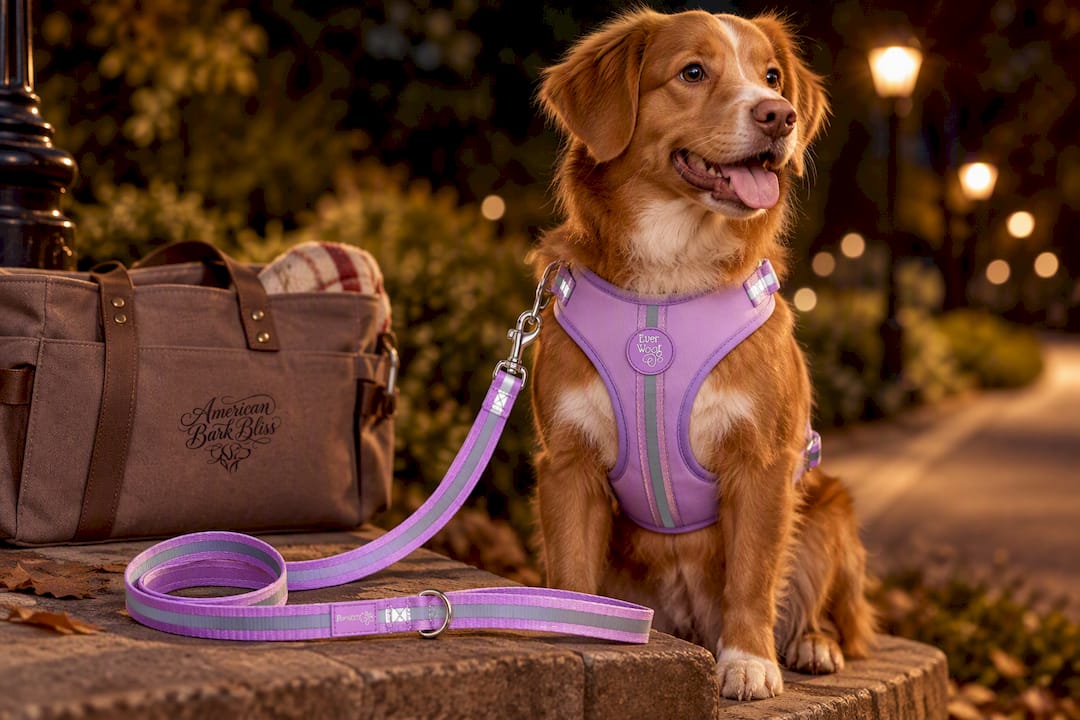
The harness uses an adjustable, one-piece fit that addresses the control half of the equation this article keeps coming back to: a harness that’s snug and correctly sized does more for handling a sudden pull than any amount of reflective tape. Pair the Shine Bright leash with the Shine Bright adjustable harness for a straightforward neighborhood loop or a longer evening route, and check the fit against your dog’s measurements before your first night walk. Browse the Americanbarkbliss shop for the full range of American-made walking gear, including collars and travel accessories, to round out your kit.
Sources
- Walking or running with your dog | American Veterinary Medical Association
- Interventions for increasing pedestrian and cyclist visibility for the prevention of death and injuries (Cochrane review)
- Protecting public health from rabies | CDC
- Pedestrians: 2024 Data, Traffic Safety Facts | NHTSA
- Examination of lighting practices at crosswalk corridors (MDOT report)
FAQ
Is It Safe to Walk My Dog at Night?
Yes, walking your dog at night is safe when you use a fitted harness, a standard leash, layered visibility gear, and stick to familiar, well-lit routes. The main added risk comes from reduced visibility to drivers, which is why pairing an active light with retroreflective material matters more after dark than during the day.
What Is the Best Safety Gear for Walking Dogs at Night?
The best setup combines an active light (a collar LED or clip-on light) on your dog, a headlamp or flashlight for yourself, and retroreflective material on the harness and leash. A standard, non-retractable leash and a properly fitted harness round out the essential kit, matching what a reflective leash and adjustable harness like Americanbarkbliss’s Shine Bright set are designed to provide.
Is It Safe to Walk at Night in General, With or Without a Dog?
Night walking carries more risk than daytime walking mainly because of reduced visibility to drivers, and a majority of pedestrian fatalities occur in the dark. Sticking to lit, familiar routes and avoiding the highest-traffic evening hours when possible lowers that risk substantially.
What Is the “5 Second Rule” for Walking Dogs?
The “5 second rule” commonly refers to checking pavement temperature by pressing your hand against it briefly. If it’s too hot or too cold for your hand to tolerate, it’s unsafe for your dog’s paws too. This applies to hot summer nights when pavement retains heat and to icy or salted winter sidewalks.
How Often Should I Replace or Charge My Dog’s Night Walking Lights?
Check battery levels before every walk rather than waiting for a light to fail mid-route, since a dead light at night is one of the most common avoidable gear failures. Rechargeable options should go on the charger as part of your regular pre-walk routine, especially if you walk nightly.
Leave a comment