

Leash Lengths for Training That Actually Work: 4ft, 6ft, 15–30ft
For most training tasks, three lengths cover it: a 4-foot leash for tight control in crowded or high-risk spots, a standard 6-foot leash for everyday walks and basic obedience work, and a 15 to 30+ foot long line for recall practice and off-leash skill building. Attach long lines to a back-clip harness, not a collar, and keep sessions to 10 to 15 minutes. Reliable recall usually takes weeks of daily practice, not one lucky afternoon at the park; for practical training consistency and recall-building guidance, see our dog training at home resource.
TL;DR:
- Long lines for recall training should start around 15 to 30 feet and extend up to 50 feet for reliable off-leash responses in open areas.
- Training with long lines requires proper handling, including gathering slack in loops and avoiding slack dragging on the ground to prevent tangles and hazards.
- Choosing the correct leash length depends on the dog’s size, temperament, environment, and training goal, with shorter leashes for control and longer ones for distance work.
- For long-line sessions, attach the leash to a back-clip harness instead of a collar to reduce neck injury risk during sudden pulls or stops.
- Owners should maintain a toolkit of three leashes: a 4-foot for control, a 6-foot for daily walks, and a long line for distance training, along with durable gear for safe and effective routines.
Table of Contents
- Choosing the Right Leash Length for Training by Activity
- How to Choose Leash Length for Your Dog
- Harness vs. Collar and Which Materials Actually Hold Up
- Managing Long Lines Without Tangles or Accidents
- What Trainers See Go Wrong With Leash Length
- Why Americanbarkbliss Builds Around a Leash Toolkit, Not One Leash
- Gear That Actually Supports Your Training Routine
- Sources
- FAQ
Choosing the Right Leash Length for Training by Activity
The leash length for training isn’t one-size-fits-all. It changes with the task, the environment, and how much freedom your dog has actually earned. Trainers generally work with three categories, and each solves a different problem.
Short leashes (3 to 4 feet) exist for moments that demand tight control. Think puppies still learning boundaries, strong pullers who lean into every distraction, or reactive dogs navigating a crowded sidewalk. A short lead keeps your dog’s head close enough to redirect attention fast, which matters more than comfort when you’re managing a dog that lunges at joggers or other dogs.
The standard 6-foot leash is the workhorse. It’s the most common all-purpose length for a reason: six feet gives a dog enough room to sniff, circle, and walk slightly ahead or behind without losing your ability to correct drift. Loose-leash walking, basic obedience drills, and general neighborhood walks all live here. If you own exactly one leash, this is it.
Long lines (8 to 50 feet) are built for distance work. Early recall training often starts at 5 to 10 meters, roughly 15 to 30 feet, in a low-distraction field or fenced area. As your dog’s response improves, you stretch that distance out, sometimes to 50 feet in wide-open spaces. This is where “come” actually gets tested against real temptation instead of a hallway.
Matching length to activity looks like this in practice:
- Puppy leash training or crowded sidewalks: 4-foot leash
- Daily walks and loose-leash manners: 6-foot leash
- Recall drills in a park or field: 15 to 30-foot long line
- Advanced off-leash prep with a reliable dog: 30 to 50-foot long line
- Hiking on open trails: 6-foot leash or a shorter long line, depending on trail traffic
How to Choose Leash Length for Your Dog
Picking the right leash length for training comes down to four factors, and skipping any one of them tends to backfire.
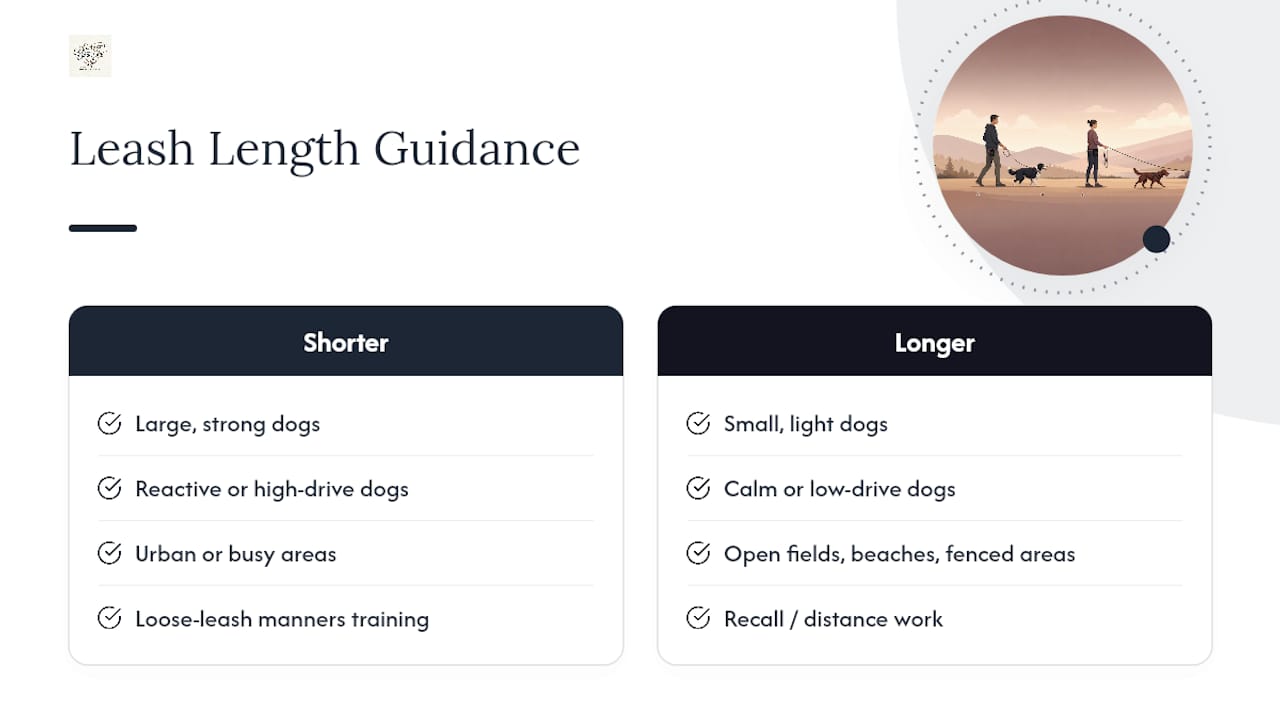
Size and strength. A 90-pound Rottweiler pulling at full force needs a shorter leash and sturdier webbing than a 12-pound terrier. Length matters, but so does whether the leash and your hands can handle the force behind it.
Temperament and drive. Reactive or high-drive dogs generally do better starting on shorter leads. A dog that explodes at every squirrel doesn’t need 30 feet of rope to test that impulse. Build calm behavior close in first, then extend distance as a reward for improvement, not a starting point.
Environment. Tight urban blocks and busy trailheads call for short leashes. Open fields, empty beaches, and fenced training areas are where long lines actually make sense. Using a 40-foot line on a crowded sidewalk isn’t training, it’s a liability.
Training goal. Recall work needs distance. Loose-leash manners need proximity. Be honest about which one you’re actually working on today, because those two goals pull in opposite directions.
Pro Tip: If you’re not confident you can gather and control a long line without dropping slack, start shorter. A 15-foot line you manage well beats a 50-foot line that tangles around your ankles.
Harness vs. Collar and Which Materials Actually Hold Up
Where you clip the leash matters as much as its length. For any long-line work, attach the line to a back-clip harness rather than a collar to reduce the risk of neck injury if your dog hits the end of the line at a run. A collar can work fine for short leashes on a calm walker, but sudden long-line stops put a lot of force on the neck.
Material choice matters too, especially for long lines that see fast, hard pulls:
- Avoid thin rope for strong pullers. Rope can cause serious rope burn to your hands when a dog bolts.
- Biothane resists mud, water, and odor, and it’s easy to grip even when wet.
- Flat-braided nylon is durable and widely available in long-line lengths.
- Quality leather works well for shorter leashes where hand comfort over years of daily walks matters more than water resistance.
Check hardware regularly. A rusted clasp or a stiff swivel is exactly the kind of failure point that shows up at the worst possible moment. For deeper material comparisons, our nylon vs. leather leash guide breaks down the tradeoffs, and our harness vs. collar walking guide covers fit specifics.
Managing Long Lines Without Tangles or Accidents
Long lines reward good handling and punish sloppy handling almost immediately. Here’s how to run one safely:
- Gather slack in loops, not coils. Hold the excess line in your palm in a loose figure-eight pattern so you can release it smoothly instead of it snagging on itself.
- Keep slack off the ground. A trailing line on the ground is a trip hazard for you and a snag risk around trees, fence posts, and other people’s legs.
- Scan the environment before you extend distance. Trees, staircases, other dogs, and wildlife all turn a 30-foot line into a problem fast if you’re not watching.
- Never leave a drag line on an unsupervised dog. Indoor drag lines are useful for interrupting behaviors like door-dashing, but they need to come off the moment you’re not actively watching.
- Keep sessions short. Ten to 15 minutes of focused recall work beats an hour of distracted wandering.
Basic recall reliability typically shows up within 6 to 8 weeks of daily practice, according to the AKC. High-distraction reliability, the kind that holds up around other dogs or squirrels, takes longer: 8 to 12 weeks for handler-oriented breeds, and 4 to 6 months for independent or high-drive breeds. That timeline isn’t a failure if you’re on week five and still working through distractions. It’s normal.
What Trainers See Go Wrong With Leash Length
The most common mistake isn’t picking the wrong length, it’s picking a length the handler can’t actually manage. A 50-foot long line in the hands of someone who’s never gathered slack before turns into a tangled mess within minutes, and that frustration gets transferred straight to the dog.
Other recurring errors show up just as often:
- Letting slack drag on the ground instead of gathering it, which invites trips and snags.
- Running long-line work off a collar instead of a harness, risking a hard jolt to the neck.
- Choosing rope-style leads for strong pullers, which can cause real rope burn during a sudden lunge.
Fixes are straightforward. Practice gathering and releasing slack in your backyard before you take a long line into an open field. Increase distance in stages rather than jumping straight to 50 feet. And if you’re working with a strong dog on a long line, switch to a harness and a flat nylon or biothane line built for grip. If you want product-specific guidance, our guide to choosing dog leashes walks through what to look for by dog size and pulling strength.
Pro Tip: Practice your slack-gathering technique with a 15-foot line indoors before ever attaching it to your dog outside. Muscle memory here prevents nine out of ten tangling problems.
Why Americanbarkbliss Builds Around a Leash Toolkit, Not One Leash
Most owners don’t need one perfect leash. They need three: something short for control, something standard for daily walks, and something long for recall. That’s the framework Americanbarkbliss designs around, and it shapes which materials make the cut. Rope gets skipped in favor of flat-braided nylon and biothane because those hold up to sudden pulls without tearing up your hands.
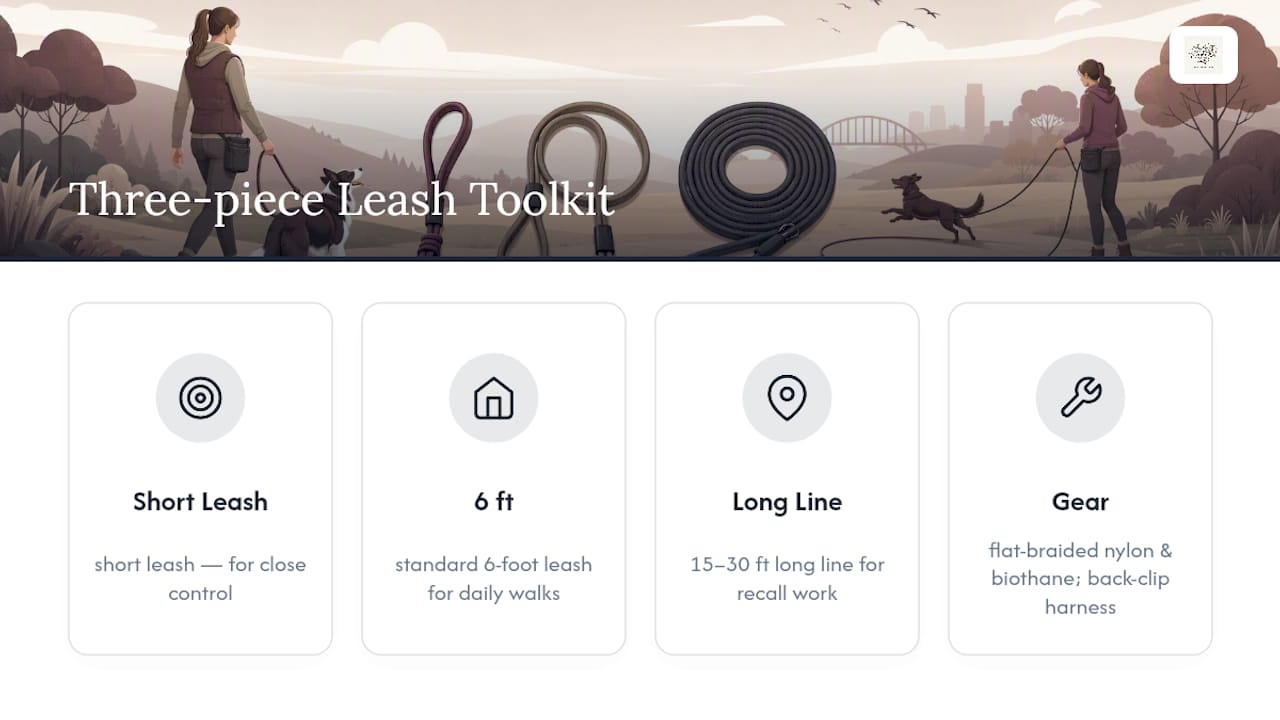
The harness question comes up constantly, and the answer stays consistent: for any long-line work, a back-clip harness protects the neck in a way a collar simply can’t. If you’re only going to buy one piece of gear this year, make it a well-fitted harness rated for your dog’s size and pulling strength.
Owners who keep a short leash, a standard 6-footer, and a long line on hand tend to solve more training problems with less frustration than owners chasing a single “perfect” leash. Our guide to what leash length is best breaks this toolkit approach down further for puppies specifically.
— Christopher
Gear That Actually Supports Your Training Routine
Beyond the leash itself, the right accessories make daily training sessions easier to run and easier to stick with. Americanbarkbliss builds American-made gear designed for exactly this kind of daily use, not just occasional walks.

A durable foldable storage bin keeps leashes, long lines, and training rewards organized between sessions instead of tangled in a drawer. If you’re running reward-based recall drills, a high-value toy makes a real difference. The tennis ball variety pack gives you squeaker and treat-fill options that hold a dog’s attention across a 30-foot recall practice better than a dry command alone. And for handlers who want a way to carry treats, water, and gear on longer training walks, the Original Doggy Bag backpack keeps everything within reach.
Building a proper leash toolkit starts with the right supporting gear. Browse the full collection at Americanbarkbliss and put together what your training routine actually needs.
Sources
- Long vs. short dog leashes: how to choose — Orvis News
- Selecting the correct leash length for your various leash training exercises — Whole Dog Journal
- Harness vs. collar for dogs — East Coast Dog Training
FAQ
What is the 3-3-3 rule for dog training?
The 3-3-3 rule is a general guideline for newly adopted dogs: roughly 3 days to decompress, 3 weeks to settle into routine, and 3 months to feel fully at home. It’s a settling timeline, not a leash-length rule, but it helps explain why early leash sessions should stay short and low-pressure.
What is the 7-7-7 rule for dogs?
The puppy socialization checklist some trainers use encourages exposure to different surfaces, sounds, people, and environments in structured, low-stress doses. Definitions vary by trainer, so treat it as a general framework rather than a fixed standard.
Is a 4-foot or 6-foot leash better?
Neither is universally better. A 4-foot leash gives tighter control for crowded areas and strong pullers, while a 6-foot leash offers more room for sniffing and socialization on standard walks. Most owners benefit from owning both.
What leash does Cesar Millan use for training?
Cesar Millan is closely associated with standard flat leashes, generally in the 4 to 6-foot range, paired with calm, structured leash-handling technique rather than any single branded product. The technique matters more than the specific leash.
How long should a long line be for recall training?
Most trainers start recall work at 5 to 10 meters, roughly 15 to 30 feet, then extend the distance as reliability improves, sometimes up to 50 feet in open spaces.
Leave a comment