

How to Price Premium Dog Goods for Maximum Profit
TL;DR:
- Pricing premium dog goods requires accurate cost calculation and channel-specific margins to ensure profitability.
- Consumer perception, often influenced by packaging and product storytelling, significantly impacts what can be charged.
Pricing premium dog goods is defined as setting price points that reflect true product costs, perceived consumer value, and channel-specific margin requirements. Get it wrong and you either leave money on the table or price yourself out of the market entirely. The real benefits of premium dog products justify higher prices only when your pricing structure supports them. This guide covers the formulas, margin targets, and consumer psychology you need to price high-end dog products with confidence.
How to price premium dog goods: start with your full cost base
Every pricing decision starts with a complete picture of what a product actually costs to make and deliver. Most sellers underestimate this number, which is why so many premium dog goods businesses run thin margins despite strong sales.
The core cost components for any premium dog product include:
- Raw materials and ingredients: Fresh meat, organic components, or specialty fabrics. Ingredient transparency and fresh meat inclusion above 30–50% define modern consumer perceptions of premium pet food. That standard sets a cost floor you cannot ignore.
- Packaging: Boxes, pouches, labels, and inserts. Premium packaging costs more than standard options, and that cost must be built into your base price before any markup.
- Labor: Small-batch production typically runs $12–$20 per hour in labor costs. Track every hour spent on production, not just materials.
- Overhead: Electricity, facility costs, equipment depreciation, and insurance. These are real costs that erode margin when left out of the calculation.
- Marketing and customer acquisition: Paid ads, influencer fees, and email platform costs all belong in your cost model.
The beginner formula for small-batch premium dog goods is straightforward: (Ingredient Cost + Packaging Cost) × 2 or 3. The multiplier covers labor, overhead, and profit. Use a multiplier of 2 for wholesale and 3 for direct-to-consumer retail.
Pro Tip: Track overhead as a percentage of your total monthly production cost. Divide fixed monthly costs by units produced to get a per-unit overhead figure. Add it to every product’s cost base before applying any markup.

Bundle pricing also improves your margin math. Selling a grooming kit as a bundle at a slight discount versus individual items increases average order value while keeping your per-unit cost stable.
What margin targets should you set by sales channel?
Channel selection determines how much of your retail price you actually keep. Brands should target a 45–60% gross product margin for paid acquisition and shipping, with a 35–48% contribution margin after fulfillment costs. Those numbers are the benchmark for a financially healthy premium dog goods business.
The channel you sell through changes your net margin dramatically. Here is how the math breaks down:
| Sales channel | % of MSRP received | Gross margin target | Notes |
|---|---|---|---|
| Direct-to-consumer (DTC) | 100% | 45–60% | Full price control, highest margin potential |
| Large retailers | 45–60% | 20–30% net | Retailer takes 40–55% of MSRP |
| Distributors | 25–35% | 10–18% net | Deepest discount, lowest margin |
Selling DTC allows full MSRP receipt, while selling to retailers yields 45–60% and distributors only 25–35% of MSRP net. That gap is not a minor adjustment. It is the difference between a profitable product and one that loses money at scale.
The practical implication is that your retail price must be set high enough to remain viable across all channels you plan to use. If your DTC price is $30 and a distributor takes 70%, you net $9. That $9 must cover your full cost of goods and still leave margin. Model this before you launch, not after.
Pro Tip: Build a simple spreadsheet with your product cost, MSRP, and a column for each channel’s net percentage. Run the numbers before committing to any wholesale or distribution deal. A product that works at DTC may be structurally unprofitable through a distributor.
Does consumer psychology affect what you can charge?
Value-based pricing is the practice of setting prices based on what the customer believes the product is worth, not just what it costs to make. For premium dog goods, perceived value is the most powerful pricing lever available.
Packaging is the fastest way to shift perceived value. Premium packaging with quiet aesthetics like matte black and embossed gold enables pricing at 2–3x higher price points than standard packaging. The packaging signals lifestyle, not just function. A treat in a kraft paper bag with a hand-stamped label reads as artisan. The same treat in a matte black pouch with gold foil reads as luxury. The product is identical. The price tolerance is not.
Key value signals that support higher pricing include:
- Ingredient transparency: Named proteins, single-source ingredients, and clear country-of-origin labeling. Shoppers at Americanbarkbliss can see exactly what goes into products like freeze-dried raw beef patties, which builds the trust that justifies premium prices.
- Product story: Origin, maker credentials, and manufacturing standards. American-made goods carry a built-in quality narrative that resonates with dog owners who prioritize American dog products.
- Category positioning: Specialized premium dog goods can command 3–5x markup over standard products when unique value is clearly communicated. Orthopedic beds and certified training tools sit at the high end of this range.
Price elasticity is low for premium dog foods and supplements but higher for impulse items like toys. That distinction matters for how you price each category. A premium orthopedic bed buyer researches before purchasing and is less sensitive to a $20 price difference. A toy buyer at checkout is more likely to respond to charm pricing, such as $14.99 versus $15.
Pro Tip: Use your product story and quality cues to justify price before the customer reaches the cart. A product page that explains sourcing, manufacturing, and benefits reduces price resistance more effectively than any discount.
Step-by-step guide to setting and adjusting your prices
Pricing is not a one-time decision. It is a process you revisit as costs change, channels evolve, and your customer base grows.
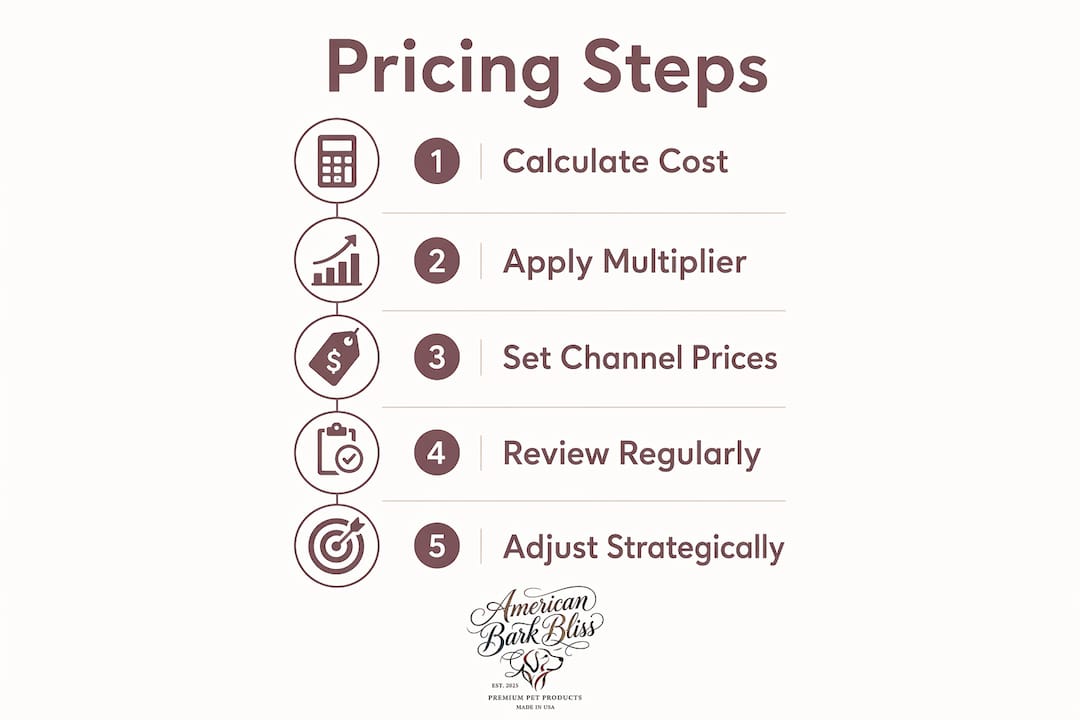
Step 1: Calculate your total landed cost. Add raw materials, packaging, labor, and a per-unit overhead allocation. This is your cost floor. Never price below it.
Step 2: Apply the right multiplier. Use the (Ingredient Cost + Packaging Cost) × 2 formula for wholesale and × 3 for DTC retail. For specialty items like orthopedic beds or training tools, a 3–5x multiplier is defensible when value is clearly communicated.
Step 3: Set channel-specific price points. Your DTC price is your MSRP. Work backward from that number to confirm viability at each channel. If the distributor math does not work, either raise your MSRP or decline that channel.
Step 4: Test with bundles and subscriptions. Autoship programs providing 5–10% discount build predictable demand with higher customer lifetime value than one-time discounting. A subscription buyer is worth more over 12 months than a discount buyer who churns after one purchase.
Step 5: Avoid these common pricing mistakes:
- Discounting to chase volume. Discounting undermines structural category advantages. Build retention through bundles and autoship instead.
- Setting prices without modeling channel impact. A price that works DTC may fail through retail.
- Ignoring break-even thresholds. Know exactly how many units you must sell at each price point to cover fixed costs.
Step 6: Raise prices strategically. Introduce a premium tier with enhanced packaging or added features rather than raising prices on existing SKUs. Customers accept new tiers more readily than price increases on familiar products. A 10–15% website price premium offset by better bundles and subscription benefits is a proven approach for high-end dog accessories.
Key Takeaways
Pricing premium dog goods profitably requires combining accurate cost accounting, channel-specific margin modeling, and value-based positioning to protect margins at every stage of the sales process.
| Point | Details |
|---|---|
| Know your full cost base | Include labor, overhead, and packaging before applying any markup multiplier. |
| Target 45–60% gross margin | This is the industry benchmark for DTC premium dog goods with paid acquisition. |
| Model every sales channel | Retailers net you 45–60% of MSRP; distributors net only 25–35%. Price accordingly. |
| Use packaging as a pricing lever | Matte black and embossed gold packaging supports 2–3x higher price points. |
| Build retention, not discounts | Autoship at 5–10% off outperforms volume discounting for long-term profitability. |
Why I think most premium dog brands price themselves into a corner
I have worked with enough pet product businesses to see the same mistake repeat itself. A founder builds a genuinely excellent product, prices it based on what feels fair, and then wonders why margins collapse the moment they add a retail partner or run a promotion.
The problem is almost never the product. It is the pricing architecture. Most brands set a DTC price first and then try to make retail work around it. That is backward. You need to model the worst-case channel scenario first, which is the distributor margin, and then build your MSRP from there. If the product cannot survive a distributor relationship at a healthy margin, it either needs a higher MSRP or a different channel strategy.
The second mistake I see constantly is treating packaging as a cost to minimize rather than a pricing asset. Premium branding is psychological. Subtle, elegant packaging signals lifestyle and commands higher price tolerance. A $3 packaging upgrade that allows you to charge $8 more is not an expense. It is your highest-return investment.
My honest advice: stop discounting to win customers and start building subscription and bundle structures that reward loyalty. The dog owners who spend the most are not looking for the cheapest option. They are looking for the brand they can trust. Price like that brand, and then deliver on it every time.
— Christopher
Premium dog goods worth every penny at Americanbarkbliss
Americanbarkbliss puts the pricing principles in this article into practice across its full catalog of American-made dog products. Every product reflects the cost of quality ingredients, thoughtful design, and domestic manufacturing.
The Americana Chicken Chips for Dogs show exactly what ingredient transparency and USA sourcing look like at the product level. For durable play, the Stars and Stripes rubber dog toy from USA-K9 delivers the kind of quality that justifies a premium price point. Americanbarkbliss also offers grooming kits and apparel that bundle well for higher average order values. Browse the full catalog to see premium pricing done right.
FAQ
What is the standard markup for premium dog goods?
The standard beginner formula is (Ingredient Cost + Packaging Cost) × 2 for wholesale and × 3 for direct-to-consumer retail. Specialty items like orthopedic beds can support a 3–5x markup when unique value is clearly communicated.
What gross margin should a premium dog goods brand target?
Brands should target a 45–60% gross product margin for DTC sales with paid acquisition and shipping. Contribution margin after fulfillment should reach 35–48%.
How does selling through retailers affect my pricing?
Selling to large retailers typically yields 45–60% of your MSRP, while distributors return only 25–35%. Your retail price must be set high enough to remain profitable at the lowest channel margin you plan to use.
Does packaging really affect how much I can charge?
Premium packaging with quiet aesthetics like matte black and embossed gold supports pricing at 2–3x higher price points than standard packaging. Packaging signals perceived quality before the customer ever opens the product.
Are subscription discounts better than one-time promotions?
Autoship programs offering 5–10% off build predictable demand and higher customer lifetime value than volume discounting. One-time discounts attract price-sensitive buyers; subscriptions build loyal, high-value customers.
Leave a comment