

Durable Dog Toys for Heavy Chewers: 2026 Picks
Table of Contents
- Why Heavy Chewers Destroy Ordinary Toys
- What to Look for in Durable Dog Toys for Heavy Chewers
- Nylon vs. Rubber: Which Material Wins for Heavy Chewers?
- Top Picks Built for Power Chewers
- How to Choose Safe Dog Toys That Match Your Dog's Style
- The Case for Non-Toxic Dog Chew Toys
- When to Replace a Chew Toy: Wear and Tear Warning Signs
- Final Verdict: Matching the Right Toy to Your Chewer
- Frequently Asked Questions
Last Updated: September 8, 2026
When a determined chewer meets an ordinary plush toy, the toy rarely survives the afternoon. The market for durable dog toys for heavy chewers has grown precisely because this problem is so common, yet most products still fail under serious jaw pressure. In this guide from American Bark Bliss, we break down what actually holds up, which materials matter, and how to match a toy to your dog's chewing style.
A determined dog applies hundreds of pounds of pressure per square inch, and many toys simply aren't engineered for that reality. Below, we evaluate durability claims, which materials withstand real punishment, and the products that have earned their reputation.
Why Heavy Chewers Destroy Ordinary Toys
Most standard toys are designed for average chewers, not determined ones. Plush toys fail at the seams, thin rubber tears under puncture pressure, and hollow vinyl cracks along stress points. An aggressive chewer targets weak seams, squeakers, and thin walls.
Manufacturers prioritize softness and squeak appeal over structural integrity, so toys that feel great in your hand often lack the material density needed to survive a power chewer's jaws.
What to Look for in Durable Dog Toys for Heavy Chewers
Durable dog toys share several non-negotiable traits. Material density ranks first: high-density nylon and thick natural rubber resist puncture and tearing far better than soft plastics. Construction matters equally, with solid, single-piece designs outperforming assembled toys with glued or stitched components.
Size-appropriate selection is another critical factor: a toy that is too small becomes a choking hazard, while an oversized toy may be difficult to grip. Look for toys marketed for power chewers, check the toughness rating if one exists, and supervise the first few play sessions.
Nylon vs. Rubber: Which Material Wins for Heavy Chewers?
The nylon-versus-rubber debate is the most important buying decision for owners of power chewers. To choose correctly, you need to understand how each material behaves under stress, how it interacts with dental health, and what safety testing actually verifies.
The Mechanics of Nylon
Nylon toys are engineering thermoplastics whose durability comes from molecular weight and density. Industrial-grade nylon, such as that used in BULLYMAKE toys, resists deformation under concentrated bite force, with the manufacturer rating its toys up to 3,500 PSI, exceeding the measured bite force of most domestic dogs (200 to 450 PSI depending on breed and measurement method) (peer-reviewed research).
The critical trade-off is abrasiveness: nylon is harder than tooth enamel, so persistent gnawing can wear enamel over time. Veterinary dental specialists advise against nylon for dogs with existing enamel fractures, exposed dentin, or gingival recession. For healthy adult dogs, nylon suits short, supervised sessions but should not be the only toy in rotation.
Nylon is inherently inert, so manufacturers often add food-grade flavorings to maintain interest, though these can trigger sensitivities in some dogs. If your dog loses interest after a few days, the flavoring has likely worn off, not the toy's structural integrity.
The Mechanics of Natural Rubber
Natural rubber, tapped from rubber trees, offers a different failure mode: instead of resisting force with hardness, it absorbs and distributes energy through elasticity, making it gentler on teeth and gums while still resisting puncture. The KONG Extreme uses a proprietary ultra-durable rubber compound denser than standard latex rubber, which is why it outlasts generic rubber toys.
Rubber fails through surface abrasion and eventual tearing, not cracking or splintering, a safety advantage, since it sheds small pieces rather than sharp shards. However, rubber can harbor bacteria in surface grooves over time, especially if not cleaned regularly.
Chemical Safety: What Testing Actually Covers
The term "non-toxic" is not regulated in the pet toy industry. Claims like "BPA-free" or "phthalate-free" mean the manufacturer tested for those specific compounds, not that the material is free of all harmful substances. The FDA does not pre-approve pet toys; they fall into a regulatory gray area.
Look for third-party testing. Reputable manufacturers like Goughnuts and KONG publish their protocols: Goughnuts tests for heavy metals, phthalates, and BPA, and KONG states its rubber compounds are food-grade and free of BPA, lead, and phthalates. If a manufacturer cannot provide documentation of third-party testing, treat durability claims with skepticism.
Matching Material to Chewing Style
A practical framework for choosing between nylon and rubber:
| Chewing Behavior | Recommended Material | Why |
|---|---|---|
| Persistent gnawing in one spot | Nylon | Hardness resists focused pressure |
| Shaking, tossing, and thrashing | Natural rubber | Elasticity absorbs impact without cracking |
| Treat-motivated chewing | Natural rubber (stuffable) | Hollow designs allow food-based engagement |
| Dogs with dental sensitivity | Natural rubber (soft-density) | Softer surface reduces enamel wear |
| Extreme chewers that destroy rubber | Nylon (with supervision) | Highest resistance to puncture |
The Hidden Risk of "Indestructible" Claims
No toy is indestructible; the term is marketing, not engineering. Every material has a fatigue limit, surface cracking or chipping for nylon, thinning or tearing for rubber. The most dangerous toys appear intact but have internal structural damage, which is why the Goughnuts safety indicator layer is a meaningful innovation.
For maximum safety, rotate between a nylon toy and a rubber toy. This prevents overuse of either material, reduces monotony, and allows you to inspect each toy during its off-cycle. A rotation of two or three high-quality toys will outlast a single toy used exclusively.
Top Picks Built for Power Chewers
Goughnuts MAXX Ring: Safety-First Design
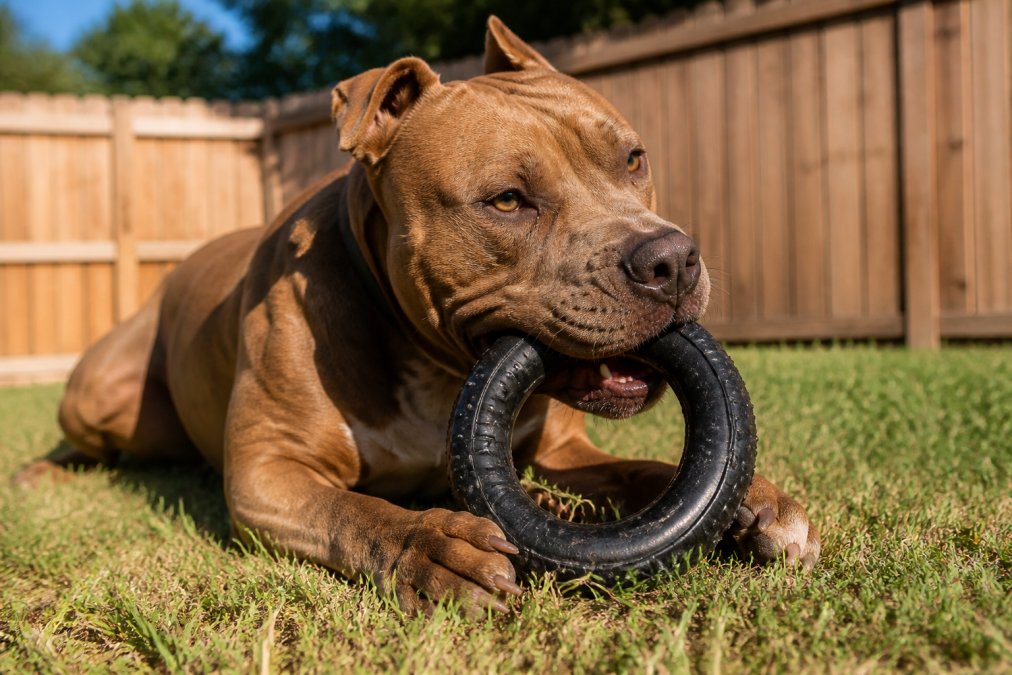
Engineered by mechanical engineers, the Goughnuts MAXX Ring stands out for its patented safety indicator layer: a red inner layer that becomes visible only when the outer material is compromised, signaling replacement is needed before a choking hazard develops. At roughly $20.95, it costs more than standard rubber toys, but the built-in warning system and extreme resilience justify the premium.
KONG Extreme: The Versatile Classic
The KONG Extreme rebuilds the classic shape with an ultra-strong black rubber formula designed to resist puncture. Its dual function satisfies the urge to chew while providing mental stimulation through treat stuffing, and the hollow center allows you to freeze peanut butter or kibble inside for extended solo play. At approximately $13.45, it is the most affordable option among heavy-duty picks while remaining one of the most versatile.
BULLYMAKE Nylon Toys: Built for Maximum Bite Force
BULLYMAKE engineers its toys for the most extreme cases, claiming resistance to up to 3,500 PSI of bite pressure. Constructed from industrial-strength nylon, these toys are designed for aggressive chewers that have destroyed everything else, with various shapes and a subscription model for fresh toys. The primary limitation is hardness: dogs with sensitive gums or dental issues may find the material too abrasive.
How to Choose Safe Dog Toys That Match Your Dog's Style
Most buying guides treat "heavy chewer" as a single category, but chewing behavior varies dramatically by breed, jaw morphology, and individual temperament. Understanding these differences is the difference between a toy that lasts months and one that fails in an afternoon.
Breed-Specific Jaw Strength and Chewing Profiles
Bite force is not uniform across breeds, though breed standards provide useful baselines for jaw structure and chewing persistence.
Bully breeds (American Pit Bull Terriers, American Staffordshire Terriers, Bulldogs): These breeds have broad, powerful jaws with a bite force often cited in the 300-450 PSI range. They are persistent gnawers that target a single point, and their high prey drive makes toys with appendages or squeakers targets for dismantling. Solid rubber rings (like Goughnuts MAXX) or dense nylon bones work best.
German Shepherds and Belgian Malinois: These working breeds have strong jaws and a tearing instinct, often preferring to grip and pull rather than gnaw in place. Their chewing is frequently tied to anxiety or boredom, so treat-stuffable KONGs that provide mental engagement are more effective than passive chew toys.
Labrador Retrievers and Golden Retrievers: These breeds have "soft mouths" bred for retrieving, but they are persistent chewers, especially in adolescence. They tend to carry and shake toys rather than gnaw in one spot, so the toy must withstand impact and flexing, not just puncture. Flexible natural rubber is ideal.
Terriers (Jack Russell, Rat Terrier, Border Terrier): These small but intense chewers have strong jaws relative to their size and a relentless prey drive. They are shredders that methodically dismantle plush toys to reach a squeaker, so they need toys with no seams, no stuffing, and no squeakers. Small-diameter rubber toys that fit their jaw size are essential.
Sighthounds (Greyhounds, Whippets): These breeds have narrow jaws and generally lack the jaw strength of bully breeds. Standard durable rubber toys are usually sufficient; the bigger risk is boredom, not destruction.
Age and Dental Health Adjustments
Age changes chewing behavior and dental tolerance. Puppies under one year have developing teeth and jaws, and hard nylon can cause microfractures in developing enamel, so use softer rubber designed for teething. Adult dogs from one to six years have peak jaw strength and can handle maximum-durability materials. Senior dogs often have dental disease or weakened enamel, so consult your veterinarian before introducing any new hard toy.
The 15-Minute Rule for New Toys
When introducing any new toy to a heavy chewer, follow the 15-minute rule: allow supervised play for 15 minutes, then remove and inspect the toy thoroughly for surface abrasion, loose fibers, or any change in shape. If it shows significant wear, it will not survive long-term use; if minimal, gradually increase playtime while continuing to inspect after each session.
Behavioral Red Flags Beyond Toy Choice
If your dog destroys every toy regardless of material, the issue may not be the toy. Compulsive chewing that persists despite adequate exercise and enrichment can indicate separation anxiety, obsessive-compulsive disorder, or chronic stress. Consult a veterinary behaviorist if destructive chewing is accompanied by pacing, excessive drooling, or self-harm.
A Decision Framework for Your Dog
Use this checklist when evaluating any toy for your heavy chewer:
- Measure the toy against your dog's jaw width. The toy should be wider than the distance between the canine teeth when the mouth is closed.
- Test the material with your thumbnail. If you can dent it with moderate pressure, your dog's teeth will puncture it.
- Check for appendages. Any part that extends beyond the main body is a potential grip point for tearing.
- Verify the manufacturer's testing claims. Look for third-party certification or published safety data.
- Match the toy to the behavior, not the breed label. A German Shepherd that gnaws in place needs a different toy than one that shakes and tears.
American Bark Bliss curates its selection with these distinctions in mind, handpicking each item for durability, safety, and design. Every product in the catalog is American-made and vetted to meet the demands of real-world chewing, giving owners confidence that their purchase will not end up in pieces within a week. Shop American Bark Bliss today!
The Case for Non-Toxic Dog Chew Toys
Non-toxic dog chew toys are a safety necessity. Dogs explore toys with their mouths, and low-quality materials can contain harmful chemicals that leach out during chewing. Look for toys made from food-grade materials, natural rubber, or nylon free from phthalates, BPA, and other plasticizers commonly found in cheaper imports.
Material transparency is a growing concern among pet owners, and reputable manufacturers now publish their material sourcing and safety testing protocols. The American Veterinary Medical Association's guidance on pet toy safety emphasizes choosing toys appropriate for your dog's size and chewing habits to prevent both ingestion hazards and dental damage. When in doubt, contact the manufacturer directly about their testing standards rather than assuming a product is safe based on packaging claims.
When to Replace a Chew Toy: Wear and Tear Warning Signs
Even the most durable dog toys have a finite lifespan, and knowing when to retire one prevents dangerous accidents. Inspect toys at least once a week for heavy chewers, looking for cracks, chunks missing, or visible inner layers. For toys with safety indicators like the Goughnuts MAXX Ring, replacement is clearly signaled by the red layer showing through.
A practical replacement cycle depends on usage intensity: an aggressive chewer that plays daily may need new toys every few weeks, while a moderate chewer might keep a toy functional for months. The key is proactive inspection rather than waiting for visible failure. When a toy develops sharp edges or begins to shed pieces, it has become a hazard.
| Chewing Intensity | Inspection Frequency | Typical Replacement Cycle |
|---|---|---|
| Light | Monthly | 6-12 months |
| Moderate | Every 2 weeks | 2-4 months |
| Heavy | Weekly | 2-6 weeks |
| Extreme | Daily | 1-3 weeks |
Final Verdict: Matching the Right Toy to Your Chewer
The search for durable dog toys for heavy chewers comes down to matching material science with your dog's specific behavior. For most owners, the KONG Extreme offers the best balance of durability, versatility, and price. If safety monitoring is your top priority, the Goughnuts MAXX Ring's indicator system provides unmatched peace of mind. For the most extreme chewers, BULLYMAKE's nylon construction represents the final line of defense.
Starting your search with American-made products adds another layer of confidence. Domestic manufacturing typically means stricter quality control and more transparent material sourcing, which is why American Bark Bliss focuses exclusively on American-crafted gear. As noted in the FDA's guidance on animal product safety, knowing where and how a product is made informs your ability to assess its safety. The upfront cost of a quality toy is almost always lower than the cumulative expense of replacing cheap ones, and your dog gets the benefit of a toy that actually holds up.
Frequently Asked Questions
What is the toughest dog toy for aggressive chewers?
For extreme bite force, high-density nylon toys like BULLYMAKE are engineered to withstand up to 3,500 PSI. Rubber options like the Goughnuts MAXX Ring are also top contenders and include a red safety indicator layer that appears when the toy is compromised. The toughest choice depends on your dog's chewing style: nylon suits relentless gnawers, while thick rubber is better for dogs that like to tug and shake.
Are rubber or nylon toys better for heavy chewers?
Both materials have strengths. Nylon toys are extremely hard and long-lasting, ideal for dogs that sit and gnaw for hours, but they can be abrasive on sensitive gums. Natural rubber toys, like the KONG Extreme, offer more flexibility and are gentler on teeth, making them a safer choice for many dogs. Consider your dog's preference and watch how they chew to decide which material suits them best.
What is the best toy for a dog that destroys everything?
Start with toys that have a toughness guarantee or safety indicator. The Goughnuts MAXX Ring is a strong option because its red inner layer tells you when to stop using it. The KONG Extreme is another favorite for its puncture-resistant rubber and treat-stuffing capability. Always supervise the first few play sessions to confirm your dog cannot bite off and swallow pieces.
How do I know when to throw away a durable dog toy?
Check toys before each use. Replace them when you see deep punctures, pieces of rubber or nylon that can be bitten off, or any cracks that expose the inner material. For toys with a safety indicator, like the Goughnuts MAXX Ring, discard it as soon as the red layer becomes visible. A good rule of thumb is to replace heavily used toys every few weeks to prevent choking hazards.
Finding the right toy for a power chewer takes patience, but the payoff is a happier dog and fewer wasted dollars. At American Bark Bliss, we handpick every product for durability, safety, and design, so you can shop with confidence knowing each toy has passed our standards. Explore our collection of American-made chew toys and give your dog something that will actually last. Get started with American Bark Bliss and find the perfect match for your heavy chewer today.
Leave a comment