

Dry Horse Hoof: Summer Care Guide for Owners
TL;DR:
- Treat dry horse hooves by cleaning gently, applying a lanolin-based conditioner, and consulting a farrier if cracks worsen. Avoid long soaks and petroleum sealants, and focus on consistent nutrition, trimming, and controlled moisture exposure for optimal recovery. Proper care takes months to over a year, depending on the severity and underlying causes.
If your horse has a dry or crumbly hoof right now, here is what to do first: pick the hoof clean, apply a lanolin-based conditioner to the outer wall and coronary band, and call your farrier if you see deep cracks, lameness, or any foul odor. Do not reach for a bucket and soak the foot. That instinct, however logical it feels, can make things worse.
Do now:
- Pick out debris gently with a hoof pick, working heel to toe
- Photograph all four hooves from the front, side, and sole before any treatment
- Apply a lanolin-based or quality commercial hoof conditioner to the outer wall only
- Contact your farrier if cracks extend into the white line, if the horse is lame, or if you smell anything off
Avoid now:
- Long soaking sessions (more than a few minutes) on hooves that have adapted to dry conditions
- Petroleum-based sealants that trap surface moisture without adding hydration
- Applying any oil or wax to the sole or frog
- Waiting more than a day or two to call a professional when lameness is present
Recovery takes time. Superficial dryness can improve in weeks with consistent care, but full hoof wall regrowth from the coronary band to the toe typically takes several months to over a year.
Table of Contents
- What does a dry horse hoof actually look like?
- Why do hooves get dry and crumbly in the first place?
- Safe immediate treatments: what to apply and what to skip
- How diet and supplements support hoof repair
- When should you call a farrier or veterinarian?
- Daily and seasonal routines that prevent recurrence
- How long does recovery actually take?
- Key Takeaways
- The moisture balance mistake most owners make
- American-made pet care tools from Americanbarkbliss
- FAQ
- Research and further reading
What does a dry horse hoof actually look like?
Knowing the difference between cosmetic dryness and structural damage changes how urgently you act. A hoof that looks a little dull after a dry week is not the same as one with vertical cracks running toward the coronary band.
Visual signs to check:
- Dull, chalky wall surface with no natural sheen
- Vertical cracks (grass cracks from the ground up, or sand cracks from the coronary band down)
- Chipped or crumbling toe
- Horizontal rings or concentric lines of delamination on the wall
- White line widening or separation at the toe or quarters
- Flaking layers peeling away from the outer wall
Tactile signs:
- Wall feels brittle and flakes off under light thumb pressure
- Reduced nail retention if the horse is shod (clinches loosen faster than normal)
- Hoof feels warm to the touch, which can signal inflammation below the surface
Behavioral clues:
- Shortened stride on hard or rocky ground
- Reluctance to bear full weight on one foot
- Sensitivity when you pick the hoof or tap the wall
Behavioral signals matter most. A horse that shortens its stride on gravel but moves freely on soft footing is telling you the hoof wall is compromised enough to cause discomfort. University of Minnesota Extension recommends monitoring hoof condition as part of every routine care visit, precisely because early changes are easy to miss.
Pro Tip: Take photos from four angles: front of the hoof, lateral (side) view, heel view, and sole. Send these to your farrier before the appointment. A farrier who can see the crack pattern and wall condition in advance arrives with the right tools and materials.
Why do hooves get dry and crumbly in the first place?
The short answer is that dry hooves rarely have a single cause. Environment, nutrition, management, and genetics all contribute, and they often stack on top of each other during summer.
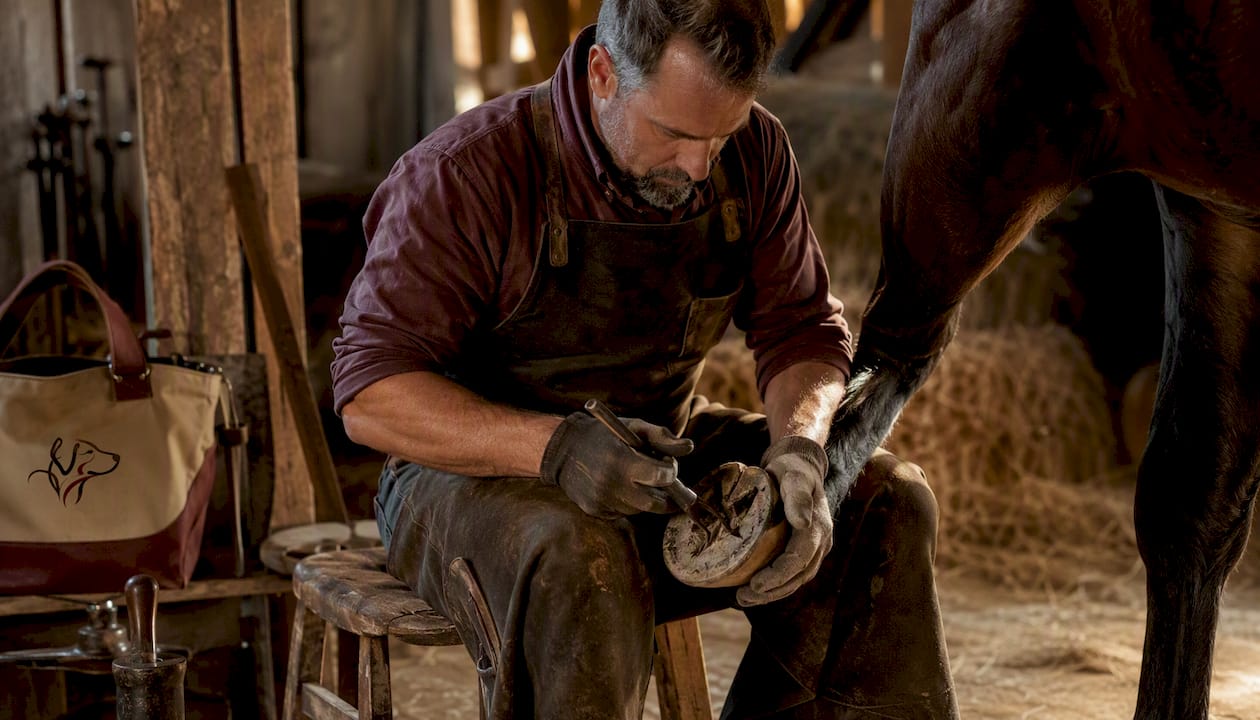
Environmental causes are the most common trigger in arid climates. Prolonged dry weather pulls moisture from the outer horn layers, leaving the wall brittle and prone to chipping. Hard, abrasive ground accelerates wear faster than the hoof can grow. Low humidity compounds both effects.
What surprises many owners is that repeated wet-dry cycles cause more structural damage than steady dryness alone. When water enters the hoof wall, it expands the keratin blocks and stretches the “cement” between them. Rapid drying then leaves gaps in that structure. Mud season, morning dew followed by afternoon sun, or daily hosing without thorough drying all create this cycle. The hoof wall weakens not from drought but from the swing between extremes.
Management factors that accelerate the problem:
- Trimming intervals stretched too long, allowing the toe to flare and crack
- Poor hoof balance that concentrates loading on one quarter
- Heavy work on asphalt or packed gravel without protective shoeing
- Standing in soiled stalls where ammonia from urine degrades horn quality
Nutritional deficits slow the rate at which new, healthy horn grows from the coronary band downward. The hoof wall is largely protein, and Kentucky Equine Research confirms that a positive energy balance and adequate nutrients directly accelerate hoof growth. Horses on poor-quality forage, those in heavy work without caloric support, or those with zinc, copper, or methionine shortfalls often show chronic wall quality problems regardless of how much conditioner you apply.
Genetics and age play a real role too. Some horses simply grow thinner, softer horn than others. Older horses and those on long-term medications that affect circulation may show reduced horn quality even with excellent management.
Safe immediate treatments: what to apply and what to skip
The goal in the first few days is to stabilize what you have, not to transform the hoof overnight. Work clean, work gently, and resist the urge to do too much at once.
Step-by-step protocol for superficial dryness
- Pick the hoof thoroughly and brush away loose debris with a stiff brush.
- Let the hoof dry completely if it is wet or muddy. Apply conditioner only to a clean, dry surface.
- Apply a lanolin-based conditioner or quality commercial hoof dressing to the outer wall and coronary band. Work it in with your fingers or a small brush.
- Repeat once daily during extreme dryness, or every other day during moderate conditions.
FarrierIQ specifically warns against petroleum-based sealants because they coat the surface without adding hydration, trapping whatever moisture state the hoof is already in. If the hoof is dry when you seal it, it stays dry underneath. Lanolin-based products and quality commercial conditioners work differently: they support the outer wall’s ability to regulate moisture exchange rather than blocking it entirely.
UC Davis Veterinary Medicine notes that a horse’s hoof gets its moisture primarily from the blood supply, and internal hoof moisture stays around 30% regardless of external environment. External conditioners therefore work best by protecting the outer wall from excessive evaporation, not by driving water into the hoof from outside.
For deep or bleeding cracks
Do not attempt to debride or clean out a deep crack yourself. Photograph it, cover it loosely with a clean bandage or duct tape pad to keep debris out, and call your farrier the same day. A crack that reaches the coronary band, bleeds, or shows any discharge needs professional evaluation before you apply anything.
What NOT to do:
- Soak the hoof repeatedly. Horse & Rider reports that soaking hooves adapted to dry conditions can create a breeding ground for bacteria in the frog and sulcus.
- Apply motor oil, cooking oil, or bacon grease. These are folk remedies with no evidence base and real contamination risk.
- Seal a hoof that is still wet from rain or hosing.
- Apply conditioner to the sole or frog, which need to stay relatively firm.
Pro Tip: Hoof packing (a clay or commercial packing material placed under a pad) can retain short-term moisture in the sole area when a farrier recommends it. This is a targeted tool, not a daily routine. Ask your farrier whether packing is appropriate for your horse’s specific situation before using it.
For controlled moisture, FarrierIQ recommends brief, early-morning wetting rather than long soaks. A wet sand patch or overflow trough where the horse can stand for a few minutes gives limited, natural moisture exposure without the bacterial risk of a prolonged soak. According to Pavo’s guidance, a hoof needs at least 15 minutes of contact to absorb surface moisture, so very brief hosing has minimal effect either way.
How diet and supplements support hoof repair
No conditioner applied to the outside of the hoof can compensate for a nutritional deficit on the inside. Hoof wall is built from the coronary band down, one millimeter at a time, from whatever the horse’s body has available.
The foundation: adequate calories and high-quality protein. A horse in negative energy balance will prioritize vital organ function over hoof horn production. Before adding any supplement, confirm the horse is eating enough forage and that the base diet is balanced.
Biotin is the most studied hoof supplement. Research supports a daily dose in the range of 15–20 mg for horses showing poor hoof quality, though your veterinarian or an equine nutritionist can advise on the right amount for your horse’s size and condition. Biotin works by supporting keratin synthesis, the protein structure that gives the hoof wall its strength.
Supporting nutrients to consider:
- Zinc and copper in correct ratios (excess zinc without adequate copper can create imbalances)
- Methionine, a sulfur-containing amino acid that contributes to keratin cross-linking
- Lysine, often the first limiting amino acid in forage-based diets
Timeline reality check: Expect measurable improvement in hoof wall quality within 3–6 months of consistent supplementation and management. Full regrowth of a damaged wall from coronary band to toe takes several months to over a year, depending on the horse’s growth rate.
Coordinate any supplement plan with your farrier’s trimming schedule. New horn growing from the coronary band needs to be protected as it grows down. A farrier who knows you are supplementing can adjust trim angles and shoeing choices to support that new growth rather than inadvertently stressing it.
Photo checkpoints to track progress:
- Week 1: baseline photos of all four hooves
- Month 3: look for a visible band of stronger, smoother horn at the coronary band
- Month 6: the new horn should be roughly halfway down the wall
- Month 9–12: full wall replacement in most horses
When should you call a farrier or veterinarian?
Some hoof problems are owner-manageable with good daily care. Others need a professional within 24 hours. Knowing which is which prevents a manageable crack from becoming a career-ending injury.
Call your farrier the same day if you see:
- Any lameness, even mild
- A crack that reaches or originates at the coronary band
- Bleeding from the hoof wall or white line
- Heat concentrated in one hoof (compare all four)
- Foul odor suggesting thrush or white line disease
- A shoe that has shifted, sprung, or is missing
Call your veterinarian (not just the farrier) if you observe:
- Lameness that does not improve after the farrier visit
- Digital pulse that is bounding or noticeably stronger than normal
- Swelling above the coronary band
- Signs of systemic illness alongside hoof changes
- Suspected laminitis (reluctance to move, rocking back onto heels, heat in multiple hooves)
Farrier interventions for dry or cracked hooves typically include rebalancing the trim, removing delaminated wall, applying a hoof hardener, and choosing appropriate shoeing. For severe cracks, a farrier may use a glue-on shoe or apply a crack repair composite to stabilize the wall while new horn grows.
Veterinary interventions can include radiographs to rule out laminitis or pedal bone rotation, regional antibiotic treatment for deep infections, and in rare cases, surgical referral for white line disease that has tracked deep into the foot.
Pro Tip: When you call, have this information ready: when you first noticed the problem, any recent environmental changes (new pasture, drought, flooding), current supplements and feed, shoeing history, and the photos you took. A farrier or vet who gets this context before arriving can diagnose faster and bring the right materials.
Daily and seasonal routines that prevent recurrence
Prevention during dry seasons costs far less time and money than treating a cracked hoof. These habits, done consistently, keep the wall resilient through summer.
Trimming and shoeing schedule:
- In arid climates, consider shortening the trim interval to every 5 weeks rather than the standard 6–8. Shorter intervals prevent the toe from flaring and cracking before the farrier arrives.
- Ask your farrier about appropriate shoeing for dry weather and hard footing, which may include pads or a different shoe profile.
Footing and turnout management:
- Water a small patch of sand or dirt in the paddock each morning. Horses will stand in it naturally, getting brief, controlled moisture exposure without prolonged soaking.
- Avoid turnout patterns that cycle the horse through wet mud and then dry hard ground in the same day. That swing is more damaging than either condition alone, as the American Farriers Journal documents.
- Overflow troughs positioned where horses naturally congregate give passive moisture access without owner effort.
Stable management:
- Keep bedding dry and deep enough to cushion hard flooring.
- Remove soiled bedding daily. Ammonia from urine degrades horn quality over time.
- Avoid rubber mats that trap moisture underneath without drainage.
Owner daily routine:
- Pick all four hooves twice daily during extreme dry spells.
- Apply conditioner to the outer wall weekly, or more often during peak summer heat.
- Check clinches and shoe fit between farrier visits. A risen clinch or shifted shoe changes hoof loading and accelerates cracking.
FarrierIQ notes that hoof cracks tend to increase during the driest summer months in arid regions, which means summer is exactly when the routine matters most. Build it into your morning feed check so it becomes automatic rather than reactive.
Pro Tip: Keep a simple hoof log: date, condition notes, conditioner applied, and any changes in footing or weather. After one season, patterns become obvious. You will know exactly which month your horse’s hooves need extra attention and can schedule the farrier proactively.
For seasonal pet care adjustments applicable across species, consistent monitoring and environment management are the common thread.
How long does recovery actually take?
Set your expectations before you start treatment, not after three weeks of frustration.
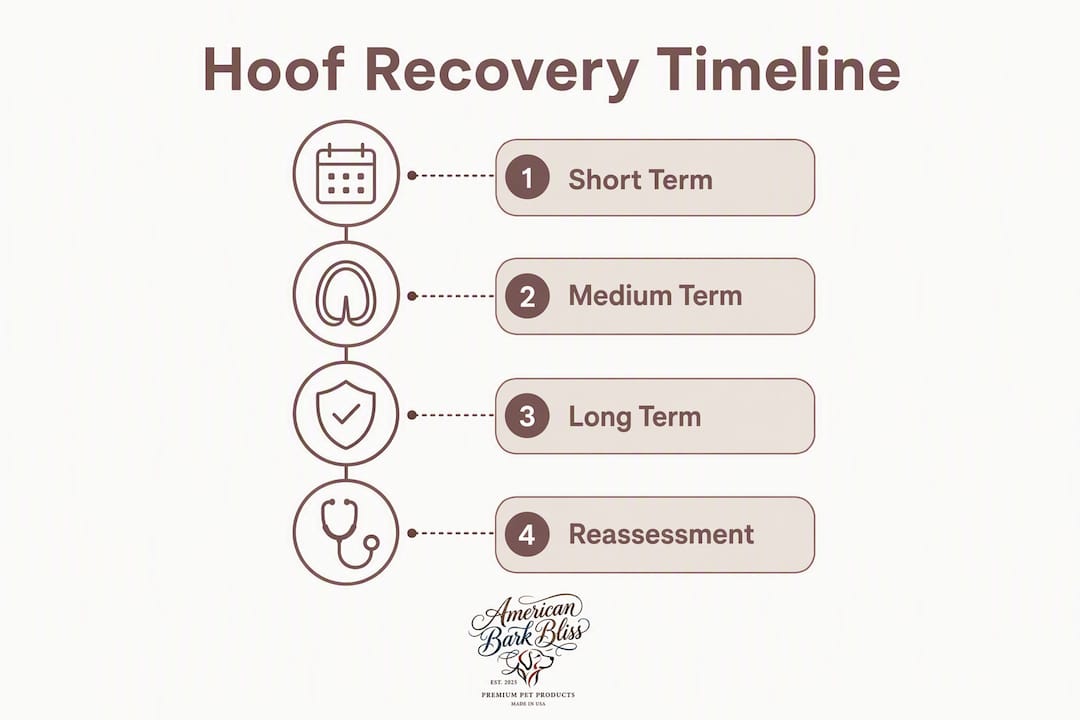
Short term (days to 2 weeks): With consistent picking, controlled moisture, and appropriate conditioner, you can reduce debris accumulation, lower infection risk in existing cracks, and stop the wall from getting worse. You will not see new healthy horn yet. This phase is about stabilization.
Medium term (3–6 months): This is when supplementation and consistent trimming start to show results. A band of stronger, smoother horn becomes visible at the coronary band. Flaking decreases. The horse may move more comfortably on hard ground. Photos taken at month 3 versus week 1 will show a clear difference if the protocol is working.
Long term (9–12+ months): Full wall replacement for a severely damaged hoof. The coronary band grows new horn at roughly 1 cm per month in a healthy horse, so a full-length wall (approximately 7–9 cm from coronary band to toe) takes most of a year to replace completely. Horses with slower growth rates, older horses, or those with systemic health issues may take longer.
When to reassess with your farrier: if you see no improvement at the coronary band by month 3, something in the protocol needs to change. Either the nutrition is still inadequate, the trimming interval is too long, or there is an underlying health issue worth investigating.
Key Takeaways
Consistent moisture balance, the right conditioner, and a coordinated farrier schedule are the three factors that determine whether a dry hoof recovers in months or drags on for a year.
| Point | Details |
|---|---|
| Stabilize first | Clean the hoof, apply lanolin-based conditioner to the outer wall, and photograph before any other treatment. |
| Skip the soak | Soaking dry-adapted hooves can invite bacterial growth; brief, controlled moisture exposure is safer. |
| Supplement with patience | Biotin and supporting nutrients improve horn quality in 3–6 months; full wall regrowth takes 9–12+ months. |
| Escalate on lameness | Call your farrier the same day you notice any lameness, heat, foul odor, or cracks at the coronary band. |
| Americanbarkbliss tools | The Pet Grooming Gloves and THE TOOL KIT give owners practical handling and care tools for daily hoof maintenance. |
The moisture balance mistake most owners make
The conventional wisdom on dry hooves is that they need water. Grab a bucket, soak the foot, problem solved. That logic is intuitive and almost entirely wrong.
The hoof’s internal moisture comes from the horse’s blood supply, not from what you apply externally. UC Davis research puts internal hoof moisture at around 30% regardless of environmental conditions. What external treatments actually do is influence the outer wall’s ability to hold onto what it already has. A good conditioner slows evaporation. A petroleum sealant locks in whatever state the hoof is in when you apply it. A prolonged soak temporarily swells the outer horn, then leaves it more vulnerable to rapid drying afterward.
The owners who get the best results are the ones who treat hoof care the way a farrier does: consistent, moderate, and targeted. They condition the wall weekly, keep the trimming schedule tight, and address nutrition as seriously as they address topical care. They do not panic-soak after a dry week and then ignore the hoof for another month.
The other thing worth saying plainly: if your horse is lame, no conditioner or supplement is going to fix that. Lameness is a professional call, every time. The farrier and veterinarian are not a last resort after you have tried everything else. They are the first call when the horse is telling you something hurts.
American-made pet care tools from Americanbarkbliss
Horse owners who handle hoof care themselves know the value of having the right tools within reach. Americanbarkbliss carries American-made grooming and handling supplies that belong in any tack room.

The Pet Grooming Gloves are designed for dogs, cats, rabbits, and horses, giving you a secure, tactile grip during hoof handling and cleaning. Pair them with THE TOOL KIT for a practical set of owner-level care supplies that covers daily maintenance between farrier visits. Both are USA-made and built for owners who take their animals’ care seriously. For dogs in your household, the Country Living All-in-One 3-Piece Dog Grooming Kit and the Americana Chicken Chips for Dogs round out a complete care routine. Browse the full range at Americanbarkbliss and find what fits your barn and your budget.
FAQ
How do you treat a dry horse hoof at home?
Clean the hoof thoroughly, let it dry, and apply a lanolin-based conditioner to the outer wall and coronary band daily during dry periods. Avoid petroleum-based sealants and prolonged soaking, and call your farrier if cracks deepen or lameness appears.
How do you add moisture to horse hooves safely?
Brief, controlled moisture exposure works better than soaking: a wet sand patch in the paddock or a short early-morning hosing session gives the hoof limited contact without the bacterial risks of a long soak. Apply conditioner to a clean, dry wall afterward to slow evaporation.
Can a horse recover from a cracked hoof?
Yes, most horses recover fully with consistent care. Superficial cracks stabilize within weeks, but full wall regrowth from the coronary band to the toe takes 9–12 months or longer depending on the horse’s growth rate and the severity of the damage.
Can dry hooves cause lameness?
Yes. Severe dryness that leads to deep cracks, white line separation, or compromised sole integrity can cause significant lameness. Any horse showing shortened stride, reluctance to bear weight, or heat in the hoof should be evaluated by a farrier or veterinarian the same day.
Research and further reading
These sources informed this guide and are worth sharing directly with your farrier or veterinarian when discussing treatment options.
- Horse Hoof Care 101 | University of Kentucky Extension: A solid starting point for owners new to hoof care fundamentals; share with a new farrier to establish baseline expectations.
- Caring for Your Horse’s Hooves | University of Minnesota Extension: Covers trimming schedules, moisturizer use, and seasonal adjustments. Useful for discussing routine care frequency with your farrier.
- 10 Things You Might Not Know About Horse Hooves | UC Davis Vet Med: The source for understanding internal hoof moisture and why external soaking has limits. Show this to anyone who insists on prolonged soaking.
- Summer Horse Hoof Care: Dry Ground, Brittle Hooves | FarrierIQ: Practical product guidance and seasonal management tips from a farrier-focused publication.
- Hooves: Too Wet? Too Dry? | American Farriers Journal: The best explanation of how wet-dry cycles damage horn structure at the molecular level.
- Dry Hooves Soaked? | Horse & Rider: Addresses the soaking debate directly and explains the bacterial risk in the frog and sulcus.
- Horses with Dry, Chipped Hooves: Management Tips | Kentucky Equine Research: Covers the nutritional side of hoof quality, including protein, energy balance, and supplement timing.
- 4 Horse Hoof Hardening Tips | The Horse: Veterinarian-reviewed tips on hardening and protecting hooves through seasonal transitions.
- Tips for Horses with Dry Hooves | Pavo: Practical application timing for conditioners and the 15-minute absorption guideline.
- Pet Care Step by Step: A Practical Owner’s Guide | Americanbarkbliss: A broader owner care checklist covering routine maintenance across species, including handling tools and daily care habits.
Leave a comment