

Power Steering and Hands Free Control with a Double Ended Dog Leash
A double-ended dog leash gives you two points of contact for steering, braking, and hands-free wear, but it works best on dogs that already walk politely on a loose leash. Use it for training aids, tandem walking, and tethering, not as a fix for a dog that pulls or reacts to triggers. Proper harness attachment and basic leash manners come first.
TL;DR:
- Double-ended leashes are best for dogs that already walk calmly on a loose leash and are not suitable for reactive or pulling dogs.
- Proper attachment involves using a front-clip harness for steering and a back clip for stable braking to maximize control and safety.
- Tandem walking with two dogs on one leash requires both dogs to have good leash manners, similar energy levels, and no reactivity issues.
- Hardware checks before each walk are essential to prevent line twist, hardware failure, or injury due to wear on swivel hooks.
- The leash length and configuration should match the activity, with shorter lengths for crowded areas, medium for regular walks, and longer for open spaces or tethering.
Table of Contents
- What Is a Double Ended Dog Leash Used For?
- How Do You Attach a Double Ended Leash Correctly?
- How Do You Steer and Brake With a Double Ended Leash?
- Can You Walk Two Dogs on One Leash?
- What Are the Safety Limits of a Double Ended Leash?
- What Leash Lengths and Configurations Work Best?
- Which American Bark Bliss Leash Fits Your Situation?
- Training First, Equipment Second
- Ready to Set Up Your Double-Clip Walking System?
- Where to Learn More About Leash Safety and Training
- Sources
- FAQ
What Is a Double Ended Dog Leash Used For?
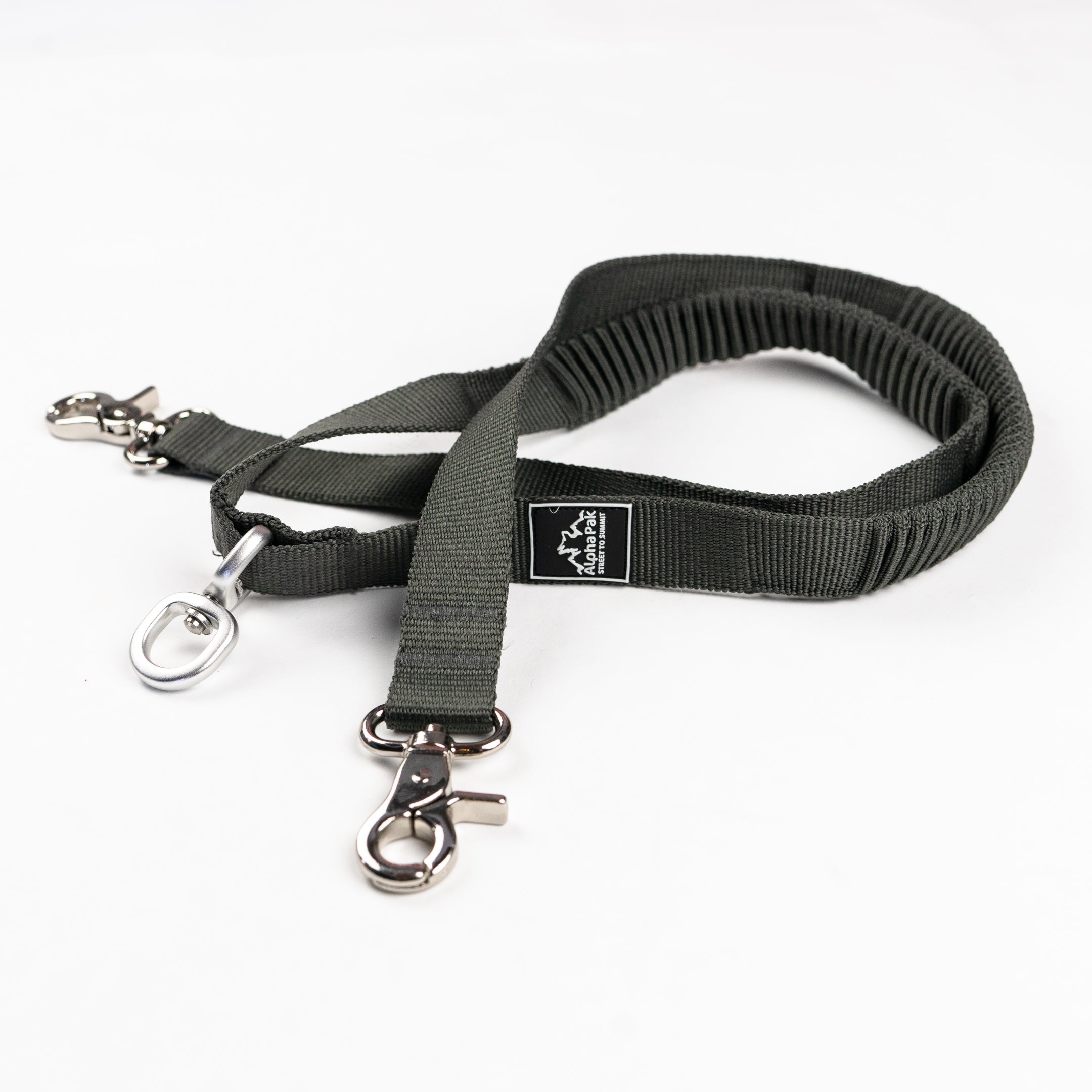
A double-ended leash has a clip on each end, plus a series of metal rings running along its length. That hardware turns one leash into several tools, depending on which rings you clip and where you attach each end.
The core idea is control from two directions instead of one. Clip both ends to the same dog’s harness (one at the chest, one at the back), and you get steering plus braking in a single lead. Clip each end to a different dog and you’ve got a tandem walking setup. Loop it around your waist and you’ve got hands-free wear for jogging or chores that need two free hands.
Common everyday uses include:
- Training aid for teaching loose-leash walking and turns
- Short-term extra control near traffic, wildlife, or other dogs
- Walking two compatible dogs on one leash
- Tethering to a bench or post during a quick stop
- Hands-free wear around the waist or across the body
It differs from a coupler, which is built specifically to split one leash into two dog attachments and usually can’t convert to hands-free wear. It also differs from a slip lead, which tightens around the neck and offers no front-clip steering option. A dual-purpose leash sits in between: more flexible than a single-clip leash, more versatile than a coupler.
How Do You Attach a Double Ended Leash Correctly?
Where you clip each end matters more than the leash itself. A front-clip harness attachment gives you steering leverage: when your dog pulls, the clip sits at the chest and redirects the dog’s shoulders back toward you instead of letting the pull carry forward. A back-clip attachment, by contrast, is comfortable for well-mannered walking but does little to stop forward momentum.
Combining both, front clip on one end, back clip on the other, is what makes the “power steering” technique work. You get gentle steering from the front and stable braking from the back, in one lead.
Rules worth following:
- Use a front-clip harness for dogs still learning loose-leash manners
- Reserve collar attachment for well-trained dogs with no neck sensitivity
- Avoid headcollars unless a trainer has shown you correct fit, since a sudden lunge against a headcollar can strain the neck
- Match hardware strength to your dog’s size and pulling force
- Choose swivel hooks over fixed rings to prevent line twist and tangling
A properly fitted harness also reduces the neck pressure that comes from a sudden stop, especially useful for dogs still building leash manners.
Pro Tip: Check both clips before every walk, not just at the start of the season. Swivel hooks wear at the pivot point, and a stiff swivel defeats the whole purpose of tangle-free steering.
How Do You Steer and Brake With a Double Ended Leash?
Power steering means using the front clip to rotate your dog’s shoulders while the back clip absorbs forward pull. Think of it like a boat’s rudder up front and an anchor line in back. Neither hand does all the work alone.
Here’s a sequence worth practicing in a quiet space before you try it on a busy sidewalk:
- Clip the front end to your dog’s chest ring and hold it slightly slack in your left hand.
- Clip the back end to the rear harness ring and hold it in your right hand with a bit more tension.
- When your dog starts to drift or pull, apply light pressure on the front clip to redirect the shoulders.
- As the dog turns back toward you, release front tension and reward with a treat or verbal marker.
- Repeat in short five-minute sessions, gradually adding distractions.
Timing is everything. Pull too late and you’re fighting momentum instead of guiding it. Pull too early and the dog never learns to self-correct. A cue word like “close” said right before you apply front pressure helps your dog anticipate the redirect instead of getting surprised by it.
Reward slack-leash behavior every single time, even for half a second of loose line. That’s the behavior you’re actually training. The leash hardware just buys you the moment to mark it.
Pro Tip: Practice hand switching in your living room first. Fumbling which hand holds which clip mid-walk is the most common reason handlers give up on the technique after one try.
Can You Walk Two Dogs on One Leash?
Yes, but only when both dogs meet a specific set of conditions. According to the AKC, a double-ended leash for two dogs works only when both walk politely on a loose leash already, share a similar pace, and have no history of reactivity or aggression toward other dogs or people.
Run through this checklist before you try it:
- Both dogs walk without pulling on individual leashes first
- Similar stride length and energy level (a sprinter paired with a stroller creates constant tension)
- No resource guarding or leash reactivity between the pair
- You clip one dog to each end, keeping lengths balanced so neither dog gets slack the other doesn’t
Skip tandem walking if either dog is still learning leash manners, is reactive to other dogs, or has noticeably higher energy than its partner. Trainers recommend individual walks for training sessions and save the shared leash for dogs that have already mastered the basics separately. Mixing a trained dog with an untrained one on the same leash usually teaches the trained dog bad habits faster than it teaches the untrained one good ones.
What Are the Safety Limits of a Double Ended Leash?
A double-ended leash is not a cure for pulling or reactivity, and treating it like one puts you at risk. The AKC’s guidance is blunt on this point: trainers recommend mastering loose-leash walking individually before introducing a dual-clip lead, because the hardware amplifies whatever habits are already there, good or bad.
The most common mistakes:
- Clipping both ends to a collar instead of a harness, risking neck strain on any sudden pull
- Relying on the leash to manage a reactive dog instead of addressing the reactivity directly
- Using mismatched lengths that let one dog surge ahead of the other
- Skipping a strength check on clips and rings before a walk with a strong puller
Handler risk is real too. Two leash points means two directions a dog can pull you off balance, especially on ice, gravel, or crowded sidewalks. If your dog pulls hard enough that you’re bracing rather than guiding, a double-ended leash won’t solve that. A no-pull harness paired with reward-based training addresses the root behavior more directly, and Kiblco’s rundown of no-pull harnesses is worth a look if pulling is your main issue. For dogs with a bite history or serious reactivity, working with a professional trainer beats any leash configuration.
What Leash Lengths and Configurations Work Best?
The ring positions along a double-ended leash let you reconfigure it on the fly instead of carrying three separate leashes. Most models run close to 2 meters, or about 79 inches, with reinforced clips and swivels built to resist tangling.
- Short configuration (clip to a middle ring): tight, close-quarters control near traffic or crowds
- Medium configuration: standard walking length for open sidewalks and parks
- Long configuration (both ends extended): open-field freedom or light training distance
- Tethering: clip one end to a fixed post for a coffee stop, but never leave your dog unattended even briefly
- Hands-free wear: loop around your waist for jogging, or cross-body for carrying groceries with a leashed dog in tow
Elastic leashes absorb the jolt of a sudden lunge better than static webbing, which matters most for running or jogging setups. Static leashes give more precise control for close training work where you want to feel every shift in your dog’s weight.
Which American Bark Bliss Leash Fits Your Situation?
Matching the leash to the job matters more than picking the fanciest option on the shelf. Here’s how three American Bark Bliss products line up with the uses covered above.
- Hands-free running: the Multifunctional Handsfree Bungee Dog Leash uses bungee stretch to absorb shock during jogs, reducing the jerk on your arm and your dog’s shoulders.
Check the weight rating on any product page before buying for a large or strong-pulling breed, and pair whichever leash you choose with a properly fitted harness rather than a collar. All three come with standard return options.
Training First, Equipment Second
The leash you buy will never do the training for you. It buys you leverage and a moment to mark good behavior, nothing more. I’d rather see a dog owner nail loose-leash basics on a plain leash before reaching for a double-ended one, because gear layered on top of untrained habits just amplifies the habits.
Keep individual walks in the rotation even after your dogs handle tandem walking well. American Bark Bliss builds gear around that training-first mindset, favoring hardware that supports good habits instead of masking bad ones.
— Christopher
Ready to Set Up Your Double-Clip Walking System?
If you’re weighing a plain single leash against something more versatile, American Bark Bliss gives you a direct upgrade path built specifically for the uses covered here, not a generic leash stretched to fit multiple jobs.
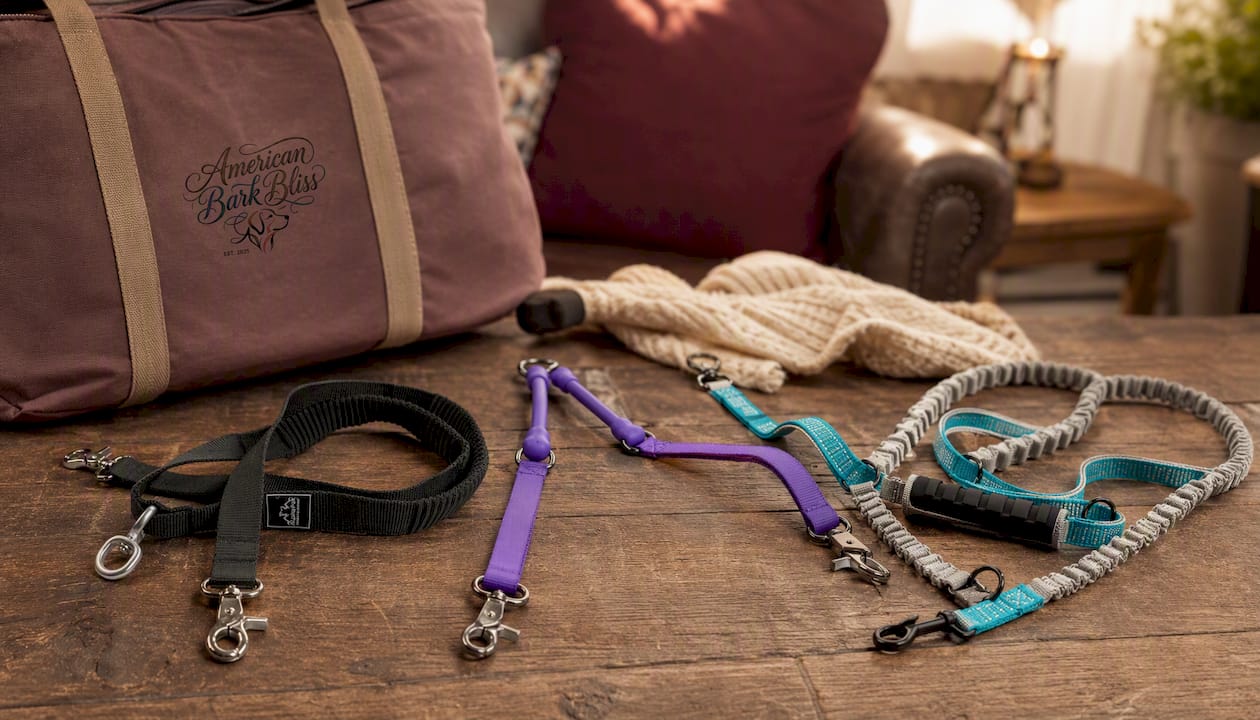
For tandem walks with two well-matched dogs, the CRAZYcoupl’r is purpose-built rather than a workaround. If you want the elastic give that softens sudden stops, the Teton elastic coupler handles that shock absorption directly. Runners and joggers who need both hands free should look at the handsfree bungee leash, which stretches with your stride instead of yanking your shoulder on every pull.
Match strength to your dog’s size before you buy, favor bungee construction if shock absorption matters for your routine, and always confirm the harness underneath fits snugly at the chest. Browse the full lineup of dog leashes and coupler options to find the setup that matches how you actually walk your dogs.
Where to Learn More About Leash Safety and Training
The AKC’s guide to double dog leashes covers trainer-backed compatibility rules in more depth. Kiblco’s no-pull harness roundup is a solid next stop if pulling is your main challenge. American Bark Bliss’s own dog walking safety guide rounds out the basics for everyday walks.
Sources
- Are Double Dog Leashes Suitable for Your Dog? Choosing a Double Leash — AKC
- Best No-Pull Dog Harnesses That Actually Work (2026) — Kiblco
FAQ
Are Double Leashes Good for Dogs?
Double-ended leashes work well for dogs that already walk politely on a loose leash and need extra steering or tandem-walking flexibility. They’re a poor fit for reactive dogs or dogs still learning basic leash manners, since the AKC recommends mastering individual walking first.
Does a Double-Ended Leash Stop a Dog From Pulling?
Not on its own. The front-clip attachment can redirect a pulling dog’s shoulders, but it works alongside training, not instead of it, and pairing it with reward-based loose-leash practice gets better long-term results than the hardware alone.
What Is a Dog Leash With Clips on Both Ends Called?
It’s called a double-ended leash or multiway leash, distinct from a coupler (built only for two dogs) and a slip lead (which tightens around the neck). The dual clips let one leash function as a steering aid, tether, or hands-free lead depending on how it’s attached.
What Words Do Dogs Respond to Best on Leash?
Short, consistent one-word cues work best, such as “close,” “heel,” or “wait,” paired with a marker word the moment your dog gives slack leash. Consistency in tone and timing matters more than the specific word you pick.
Does American Bark Bliss Sell a Leash for Walking Two Dogs?
Yes. The CRAZYcoupl’r is built specifically for walking two dogs on one leash, and the Teton elastic coupler offers a shock-absorbing alternative for the same use.
Leave a comment