

Dog Toy Rotation: How Often to Swap Toys for a Happier Dog
Dog toy rotation means keeping only a portion of your dog’s toys accessible at any time while the rest stay stored away, then swapping them on a schedule. Start with 3 to 5 toys out at once, pull from a total collection of 8 to 12, and swap every 5 to 7 days. The payoff: a dog who treats a two-week-old tennis ball like a brand-new find, because it disappeared long enough to feel unfamiliar again.
TL;DR:
- Dogs benefit most from rotating 3 to 5 toys every week to maintain novelty and prevent habituation, using a collection of 8 to 12 toys.
- Toy types should include comfort, durability, puzzles, tug, and fetch items, tailored to a dog’s specific habits and jaw size.
- Store toys out of sight in appropriate containers and clean them regularly to ensure safety and prolong their lifespan.
- Adjust rotation frequency based on the dog’s energy level, with high-drive breeds needing more frequent swaps and senior dogs less so.
- Using durable, American-made toys helps ensure they survive repeated rotations and stay safe during active play.
Table of Contents
- Why Dog Toy Rotation Works
- How to Set Up a Dog Toy Rotation Schedule
- Choosing the Right Toys for Rotation
- Storing and Cleaning Rotated Toys
- Fixing a Rotation That Isn’t Working
- A Sample 30-Day Toy Rotation Plan
- Why American Bark Bliss Builds for Rotation
- Build Your Rotation With American Bark Bliss
- Sources
- FAQ
Why Dog Toy Rotation Works
Dogs habituate to constant stimuli almost as fast as people do. Leave ten toys scattered across the living room floor and your dog’s brain quietly files most of them under “furniture” within days. Pull a toy out of sight for a week and reintroduce it, and the scent, texture, and squeak all register as new information again. That’s the entire mechanism behind rotation: it isn’t about owning more toys, it’s about managing exposure.
The behavioral payoff shows up fast. Owners who rotate typically see longer, more focused play sessions, less pestering for attention, and fewer chewed shoes or table legs, since a bored dog redirects that energy somewhere. Puppies and adolescent dogs benefit the most because their novelty threshold resets quickly. Senior dogs still benefit, just on a slower cycle.
- Restores novelty without buying new toys
- Increases independent play time
- Reduces destructive chewing tied to boredom
- Makes cleanup and floor management simpler
Enrichment tools do more than pass time. Research summarized by canine enrichment groups suggests puzzle feeders and snuffle-style toys can reduce stress-related behaviors by up to 30 percent when used consistently, which is one reason puzzle toys deserve a permanent slot in any rotation set rather than a one-off purchase. Rotation on its own isn’t a substitute for interaction, though. Shelter guidance from PAWS stresses pairing toy swaps with short bursts of interactive play, since a rotated toy sitting on the floor still won’t burn off a dog’s need for people time.
How to Set Up a Dog Toy Rotation Schedule
You don’t need a spreadsheet for this, just a plan you can repeat without thinking.
- Count your total collection. Aim for a moderate number of toys as your working baseline, enough variety to build a few distinct sets without buying anything new.
- Split them into 2 to 3 sets. Each set should include a mix, not five squeaky balls and nothing else.
- Put 3 to 5 toys out at a time. That’s the sweet spot most trainers and vets recommend, according to Pawty’s rotation method, which also backs the 8 to 12 total range.
- Store the rest out of sight, not just out of reach. Scent memory matters, and a toy visible in a bin doesn’t feel truly “gone.”
- Swap every 5 to 7 days. wikiHow’s veterinary-reviewed guide recommends changing out 4 to 5 toys at a time on roughly a weekly cadence, inspecting each one as it comes back into rotation.
- Adjust for your dog’s energy. High-drive breeds may need more frequent swaps, while calmer or senior dogs might stay content with the same set longer; adjust based on your dog’s behavior.
- Reintroduce with a few minutes of hand play. Toss the toy, tug it gently, or hide a treat in it before walking away. That short burst of engagement is what actually sparks renewed interest.
Pro Tip: Keep one or two “jackpot” toys completely out of the regular rotation, reserved only for thunderstorms, vet visits, or nail trims. Because they never lose their rarity, they work as an emergency distraction when you need one most.
Before every swap, run a 30-second check: any exposed stuffing, cracked rubber, or a squeaker that’s gone quiet? Set it aside for repair or the trash rather than putting it back into circulation.
Choosing the Right Toys for Rotation
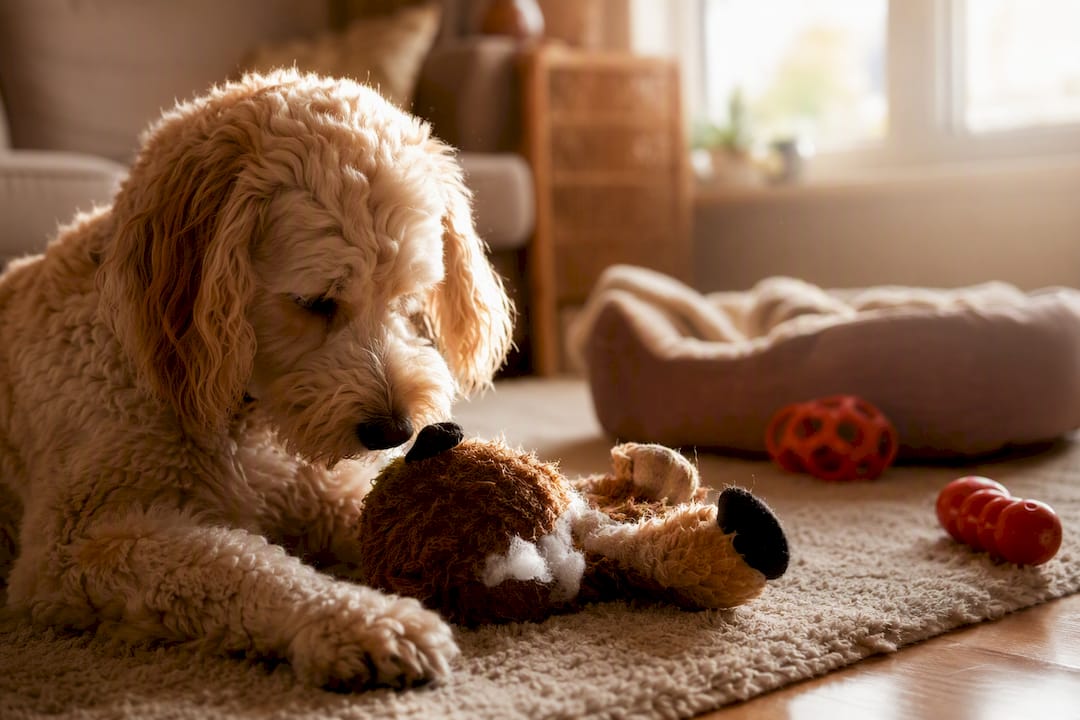
A good rotation isn’t just fewer toys out at once, it’s the right mix of toys doing different jobs. Most dogs benefit from a set that touches four or five categories rather than five variations on the same theme.
- Comfort/plush toys for downtime and settling, especially useful for anxious dogs or puppies still adjusting to a new home
- Durable chew toys for dogs who chew hard, ideally rubber or reinforced materials rather than anything with soft stuffing
- Puzzle or enrichment toys that hide treats and demand problem-solving, which is where a lot of the mental tiring-out actually happens
- Tug toys for dogs that love a shared, physical game with you
- Fetch toys like balls or flying discs for dogs with high retrieve drive
Match the mix to your dog’s temperament instead of buying one of everything. A committed chewer needs at least one heavy-duty rubber toy in every set, like a durable chew toy built for aggressive chewers, while a puzzle-solver who gets bored fast will get more mileage from rotating two or three different enrichment toys than five identical squeaky balls.
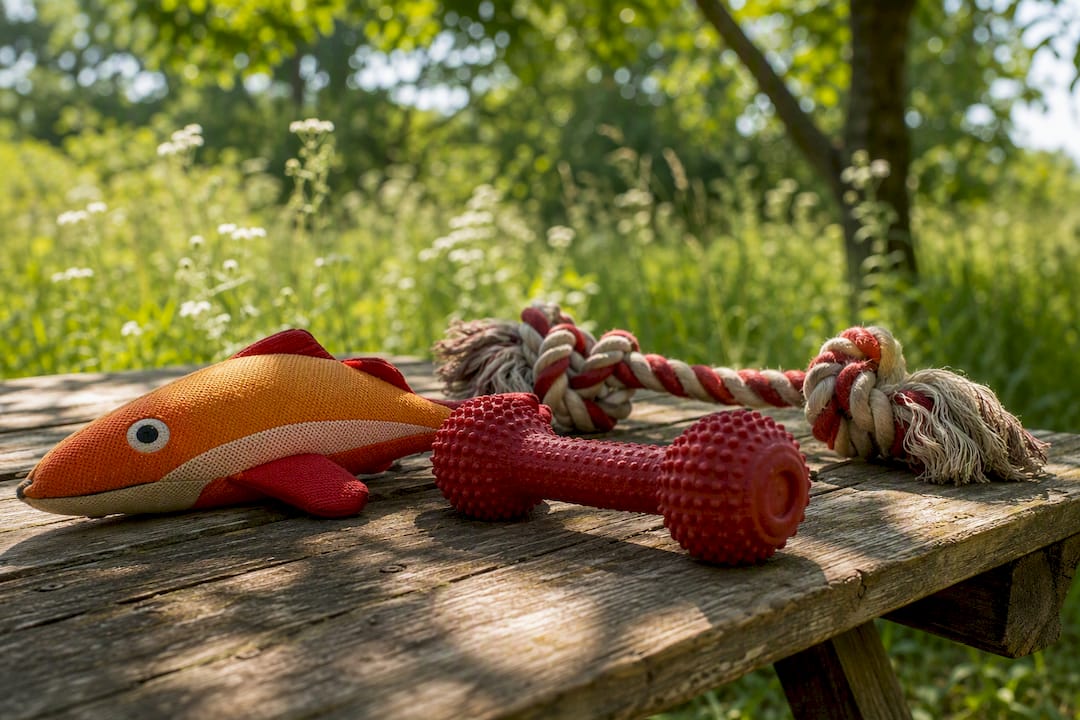
Size and material matter as much as category. Always match toy size to your dog’s jaw, check for squeakers that can be chewed loose, and remove rope toys once the fibers start fraying into strings your dog could swallow. Supervise any toy with a squeaker or stuffing until you know how your individual dog handles it, and check out more safe toy examples if you’re unsure what to avoid.
Storing and Cleaning Rotated Toys
Storage isn’t just tidiness, it changes how effective the rotation feels to your dog. The Spruce Pets recommends matching the storage type to the dog: a closed bin or lidded container for determined chewers who’ll otherwise raid the stash, a mesh bag for dogs who like to browse and pick their own toy, and a low, open bin for dogs who need visual access to stay calm about where their things went.
Cleaning depends on material. Rubber toys can go through a top rack dishwasher cycle or get scrubbed with soap and warm water. Rope toys can be soaked wet and microwaved briefly to kill bacteria, though you should let them cool fully before handing one back over. Plush toys are usually machine washable on a gentle cycle if the tag allows it, but always air dry rather than tumble dry to protect any internal squeaker.
- Closed bins for hard chewers determined to self-serve
- Mesh bags to keep scent separation between rotation sets
- Rubber toys: soap and water or dishwasher top rack
- Rope toys: wet, microwave briefly, cool before use
- Plush toys: gentle machine wash, air dry only
Run every toy through a quick safety check as it comes out of storage. Exposed stuffing, a squeaker rattling loose, or visible cracks in rubber are all reasons to retire a toy rather than reintroduce it, a habit wikiHow’s veterinary-reviewed guide treats as standard practice at every swap.
Fixing a Rotation That Isn’t Working
Sometimes a rotation stalls out, and the fix is usually smaller than owners expect.
- No renewed interest after a swap? Shorten your cycle to 3 to 4 days and reintroduce with hand play instead of just setting the toy down.
- One dog guarding a toy in a multi-dog home? Rotate toys per-dog rather than as a shared household set, and store each dog’s rotation separately.
- Obsessive fixation on a single toy? Pull it entirely for two weeks, not just out of the current set, then reintroduce it as a novelty.
- Chewing furniture despite rotation? The issue may be quantity of enrichment, not variety. Add a food-based puzzle toy rather than another chew.
If a puzzle toy gets solved in under a minute every time, it’s no longer doing enrichment work. Move up to a harder difficulty level rather than assuming rotation itself has stopped working.
A Sample 30-Day Toy Rotation Plan
Here’s a starter month you can copy without buying anything new, built around three sets pulled from a 10 to 12 toy collection.
- Days 1 to 7: Set A out (one chew, one puzzle, one plush, one fetch toy). Log any wear on day 7 during your swap check.
- Days 8 to 14: Swap to Set B. Reintroduce with 2 to 3 minutes of hand play before walking away.
- Days 15 to 21: Swap to Set C, your most novel combination, since interest tends to dip mid-month.
- Days 22 to 28: Rotate back to Set A. Most dogs treat it as new again after two full weeks away.
- Day 29 to 30: Inspect the entire collection, clean anything that needs it, and retire toys with visible damage before starting the cycle again.
For puppies, shorten every window to 3 to 5 days since novelty wears off faster during the teething months. Senior dogs can often stretch each phase to 10 days without losing engagement. In multi-dog households, run separate sets per dog to sidestep resource guarding and keep each dog’s pace independent of the others.
Why American Bark Bliss Builds for Rotation
Durable, American-made toys hold up to the wear a real rotation schedule puts them through, which is exactly why Americanbarkbliss designs enrichment pieces meant to survive dozens of swap cycles rather than one rough afternoon. This guide reflects that same practical thinking: fewer, better toys managed well beats a closet full of squeaky clutter nobody inspects.
— Christopher
Build Your Rotation With American Bark Bliss
A rotation plan only works if your toys can survive the cycle, and that’s where a lot of cheaper toys quietly fail after two or three washes. Americanbarkbliss carries the pieces built to actually last through weekly swaps: a USA-made rubber chew toy for dedicated chewers, a plush comfort toy to anchor your calm-down set, and a leather chew set for aggressive chewers if your dog goes through rubber fast.
For the storage side of the routine, a foldable fabric storage bin keeps your off-duty sets out of sight without taking over a closet shelf. Pair a chew toy with a bag of USA-made chicken chip treats for reintroduction days, since a little food incentive makes any “new” toy land even harder. Browse the full toy and enrichment collection to build your first three rotation sets this weekend.
Sources
The swap counts and cadence in this guide come from Pawty’s dog toy rotation method and the veterinary-reviewed steps at wikiHow Pet, both of which land on similar numbers independently. Storage guidance draws from The Spruce Pets, and the behavioral case for pairing rotation with active play comes from PAWS. For readers dealing with a dog on a limited-ingredient diet, this food allergy overview is worth a look before introducing treat-filled puzzle toys.
- Dog toys and how to use them - PAWS
- The dog toy rotation method — Pawty
- How to rotate your dog’s toys - wikiHow Pet
- Best dog toy storage - The Spruce Pets
FAQ
Is toy rotation actually beneficial?
Yes. It restores novelty to toys your dog has stopped noticing, which typically increases independent play time and reduces boredom-driven chewing.
At what age should you start toy rotation?
You can start as soon as a puppy has a small toy collection, usually around 8 to 10 weeks old, since puppies habituate to toys even faster than adult dogs.
How does the Montessori method of toy rotation work?
It borrows the idea of limiting accessible items at once so a child, or in this case a dog, engages more deeply with fewer choices rather than skimming past a pile of options.
What is the 10 toy rule?
There’s no single official rule, but many owners use it as shorthand for capping a total collection around 10 toys and cycling a smaller subset, close to the 8 to 12 total baseline most rotation guides recommend.
How many toys should a dog have out at once?
Most trainers and vets recommend 3 to 5 toys accessible at a time, drawn from a total collection of 8 to 12.
Leave a comment