

Dog Leash Types: 4 Fit Rules for Safer Walks
Add a hands-free leash for runs and a long line for recall training. According to the American Kennel Club, standard leashes are the safest default, and veterinary guidance from VCA warns against retractables in crowds, traffic, or training situations. Skip the gadget aisle until you’ve got the basics right.
TL;DR:
- Using a standard flat or rope leash is safest for everyday walks and training, especially in crowded or traffic-heavy areas.
- Retractable leashes are unsuitable in busy environments because they increase tangling risks and reduce quick control during emergencies.
- The durability of a leash depends more on hardware strength and hardware quality than strap material, so inspect clips and swivels regularly.
- Match the leash width and strength to your dog’s size and pulling force, with larger breeds requiring reinforced, double-stitched hardware for safety.
- Long lines and hands-free leashes work well for recall training and active outdoor exercises, but avoid retractables for high-risk, crowded situations.
Table of Contents
- Types of Dog Leashes: What Each One Does Best
- How Do You Match a Leash to Your Dog’s Size and Training Level?
- What Materials and Hardware Make a Leash Actually Durable?
- How Do You Keep a Leash Safe and Working Longer?
- What Do American Bark Bliss and Our Team Recommend?
- What Actually Matters More Than the Leash You Pick
- Quick Picks If You Want to Skip the Research
- Sources
- FAQ
Types of Dog Leashes: What Each One Does Best
Every leash on the market is a variation on a handful of core designs, and once you know what each one is built for, choosing gets a lot easier. The mistake most owners make isn’t picking a “bad” leash. It’s picking the right leash for the wrong situation, like using a retractable in a crowded farmers market or a slip lead for a daily stroll.
Standard flat leash (4 to 6 feet). This is the leash the AKC points to as the default for a reason. It’s usually nylon or leather, gives you consistent control, and works for basic obedience training, city sidewalks, and vet visits. The 6 foot length is the sweet spot for most walking situations because it lets your dog sniff and wander a little without losing your grip on the situation.
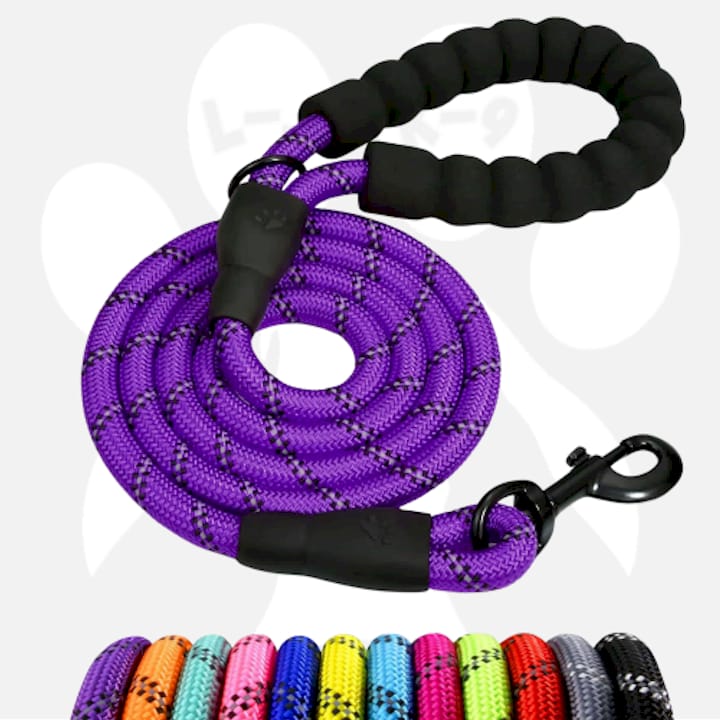
Rope leashes. Thick, braided rope leashes have gotten popular for a good reason: they’re comfortable on your hands even when a dog pulls, and the natural give in the weave absorbs some of the jolt. That shock absorption makes rope a smart pick for hiking trails where the terrain is uneven and sudden lunges are more common. The tradeoff is that rope can hold moisture and dirt more than a flat nylon strap, so it needs a bit more care after a muddy trail.
Retractable leashes. These extend and retract via a spring-loaded mechanical handle, typically stretching anywhere from 10 to 26 feet. They feel like freedom for the dog, but the thin cord, the locking mechanism, and the sudden unlocking snap are exactly why vets are cautious about them. Veterinary sources note that retractables increase tangling risk and reduce your ability to react fast, especially around traffic, bikes, or other dogs. They’re not useless. They’re just the wrong tool for busy environments.
Long lines. A long line looks similar to a retractable in purpose but works completely differently: it’s just a longer flat or rope leash, usually 10 to 30 feet or more, with no mechanical parts. Trainers reach for long lines during recall work because the dog gets real distance to explore while you still have a hand on a fixed length of material instead of a spring-loaded reel. If your goal is training a solid “come” command in an open field, a long line built for training does the job without the mechanical failure points a retractable carries.
Hands-free leashes. These clip around your waist or across your body, freeing both hands for running, hiking with poles, or simply carrying coffee. Reviewers consistently point to bungee-style hands-free designs as strong performers for active use because the elastic segment absorbs the jolt when a dog takes off after a squirrel.
Adjustable and coupler leashes. Adjustable leashes let you shorten or lengthen the working length with sliding hardware, useful if one leash needs to handle both a quick bathroom trip and a longer neighborhood walk. Coupler and double leashes split one handle into two lines, letting you walk two dogs at once, though this only works well when both dogs walk at a similar pace and don’t pull in opposite directions.
Slip leads and martingales. A slip lead is a single loop of rope or fabric that tightens around the neck when pulled, no separate collar needed. Shelters and veterinary clinics use them constantly because they’re fast to put on a nervous or unfamiliar dog. For daily walks, though, they’re a poor long-term choice. Preventive Vet notes that slip leads and martingale-style leads are meant for short-term control, not regular use, since repeated tightening around the neck can cause injury over time.
Chain leashes. Metal chain leashes exist mostly for dogs that chew through fabric and rope within a week. They’re heavy, loud, and not great on hands, but for a committed chewer, they solve a real problem nothing else does.
Bungee and shock-absorbing leashes. Built with an elastic middle section, these are aimed at active sports like canicross or jogging with a strong dog. The stretch reduces the jolt transferred to your shoulder when a dog surges forward, which matters more than people expect once you’ve felt what a 60 pound dog’s sudden lunge does to a rigid leash.
Here’s a quick rundown of where each type shines:
- Flat leash: everyday walks, vet visits, basic training
- Rope leash: hiking, dogs that pull, owners who want a comfortable grip
- Retractable: open, quiet spaces only, never crowds or traffic
- Long line: recall training, open fields, supervised off-leash practice
- Hands-free: running, hiking with poles, carrying gear
- Slip lead: vet clinics, shelters, brief handling, not daily walks
- Chain leash: dogs that chew through fabric
- Bungee leash: canicross, jogging, high-energy sport dogs
How Do You Match a Leash to Your Dog’s Size and Training Level?
Width and strength matter more than most owners realize. A leash rated for a 15 pound terrier won’t hold up to a 90 pound mastiff leaning into a squirrel sighting, and the hardware fails before the strap usually does.
- Small dogs (under 20 pounds): a 3/8 inch to 1/2 inch wide leash is usually plenty. Rope and thin nylon both work fine here.
- Medium dogs (20 to 50 pounds): look for 1/2 inch to 5/8 inch webbing or a medium-diameter rope leash with solid stitching at the handle.
- Large dogs (50 to 90 pounds): go with 3/4 inch to 1 inch flat leashes or thick rope, paired with heavy-duty hardware.
- Giant breeds (90 pounds and up): prioritize a leash explicitly rated for heavy pulling, often double-stitched with a reinforced clip, since a mismatched leash here is a genuine safety issue, not just a durability one.
If you’re still in the training phase, start with a standard 4 to 6 foot nylon or rope leash and skip the retractable entirely. It’s much easier to teach loose-leash walking and recall commands when the leash length is fixed and predictable. For city walking and traffic, a shorter grip, sometimes called a traffic handle, built closer to the clip gives you quick control at crosswalks or when another dog approaches unexpectedly. Runners and hikers do better with hands-free or bungee designs, while long lines are the better tool once you’re actively building recall in an open, safe area.
Leash choice also connects to harness choice. Front-clip harnesses reduce pulling and pair well with standard flat leashes for training. Back-clip harnesses suit calmer dogs on casual walks. No-pull harnesses work best paired with a shorter, fixed-length leash rather than anything retractable, since you want that extra steering control to actually register with the dog.
Pro Tip: If your dog pulls hard on a flat collar, switch to a harness before you switch leashes. A better leash won’t fix a pulling problem rooted in the collar attachment point.
What Materials and Hardware Make a Leash Actually Durable?
The strap is only half the story. Reviewers who test leashes for a living consistently point out that hardware, not material, is usually the first thing to fail, particularly the swivel and the bolt snap.
- Nylon: affordable, widely available, dries fast, but can cause rope burn if a dog lunges and the strap slides through your hand.
- Leather: ages well and softens over time, but needs occasional conditioning to avoid cracking.
- Rope: comfortable grip, good shock absorption, benefits from hand washing to keep the fibers flexible.
- Biothane: a coated webbing that resists mud and water, wipes clean in seconds, a strong pick for muddy trail walkers.
- Hemp: naturally durable and eco-friendly, though it can feel stiff until it breaks in.
- Chain: essentially indestructible against chewing, heavy and less comfortable to hold for long walks.
On clips, a bolt snap (the classic spring-loaded cylindrical clip) is generally stronger than a lightweight trigger snap, and a locking carabiner clip adds a manual lock step that a dog or a snag can’t accidentally pop open. Gear reviewers emphasize that a quality clasp and swivel raise leash reliability more than upgrading the strap material alone. If you walk at dawn or dusk, reflective stitching or a reflective overlay is worth the small upcharge. It’s one of the few features that adds real safety without adding bulk or weight.
How Do You Keep a Leash Safe and Working Longer?
Retractable leashes are the single biggest recurring safety complaint among trainers and vets, and the advice is consistent: avoid them around traffic, in crowded areas, during training, and around unfamiliar dogs. The thin cord and sudden-lock mechanism just don’t give you the split-second control those situations demand.
A quick monthly inspection catches most problems before they become an emergency:
- Check the bolt snap for stiffness, rust, or a loose spring action.
- Look at the swivel point for cracking or excess play.
- Run your fingers along the stitching near the handle and the clip for fraying.
- Inspect webbing or rope for thinning, discoloration, or brittle spots.
Cleaning depends on material. Nylon usually tolerates a machine wash on a gentle cycle, while leather needs conditioning rather than soaking, and rope leashes generally hold up better with hand washing and air drying instead of a dryer, which can stiffen the fibers. Replace a leash the moment you spot a fraying stitch line or a clip that doesn’t snap shut with a firm click.
In the car, a leash isn’t a restraint. Use a crash-tested harness or a dedicated seat belt tether designed for vehicle travel, not a walking leash looped through a seat belt buckle.
Pro Tip: Keep a spare leash in your car or bag. A leash failure at the wrong moment, near a road or another dog, is the scenario every one of these inspection habits is trying to prevent.
What Do American Bark Bliss and Our Team Recommend?
Christopher, who covers gear guides for the Americanbarkbliss blog, has spent a lot of time comparing leash construction across materials and use cases, from casual neighborhood loops to muddy trail miles. The recurring theme in that research: comfort and hardware quality matter as much as the label on the package.
Some manufacturers build their rope and flat leashes with quality control on stitching and clip hardware in mind, focusing on durability and reliability. For everyday walking, a well-made flat leash still gets the job done with the least fuss. For dogs that pull or for trail use, a rope leash’s grip and give tend to win out.
If you’re narrowing down length or material for your specific dog, the guide to choosing dog leashes breaks down sizing in more depth, and the guide to American-made leash materials explains what domestic manufacturing actually changes about durability.
What Actually Matters More Than the Leash You Pick
Most leash advice online focuses on brand and style, which misses the point. The leash that keeps your dog safest is the one whose width and clip strength actually match your dog’s size and pulling force, checked and re-checked every few months. A $60 leash with a corroded swivel is more dangerous than a $15 leash with solid hardware.
The conventional wisdom oversells retractables as “freedom” and undersells the basic flat leash as boring. It’s backwards. A 6 foot flat leash or a rope leash, held correctly, gives you faster reaction time than any retractable ever will, and reaction time is what actually prevents an incident. Long lines deserve more credit too. They do everything a retractable claims to do for training, without a locking mechanism that can snap or jam at the worst possible second.
If you take one thing from all this: inspect your hardware before you inspect your options. A cracked swivel on a premium leash is a bigger risk than a slightly wider strap on a cheap one.
— Christopher
Quick Picks If You Want to Skip the Research
If you’ve read this far and just want a straight answer, Americanbarkbliss makes three leashes that cover almost every scenario above.

- The Rope Leash is the pick for hiking, trail walks, and dogs that lean into their harness. The braided grip absorbs jolts better than flat nylon.
- The Premium Rope Leash steps up the finish and hardware for owners who want the same comfort with a more refined clip and stitching.
- The Classic Adventure Flat Dog Leash is the everyday choice: city walks, vet visits, basic training, the leash you reach for most days of the week.
Choosing between them comes down to your dog’s typical day. If most walks happen on pavement, the flat leash is simpler to clean and just as strong. If your weekends involve trails or a dog that pulls hard, the rope options earn their keep. And if you’re already stocking up on gear for active outings, a durable fetch and tug toy built for aggressive chewers are worth tossing in the bag alongside your leash.
Browse the full leash and collar collection to compare lengths, colors, and hardware side by side before you check out.
Sources
- Dog Leashes 101: These Leashes Were Made for Walking
- How to choose from these 7 common types of leashes and collars
- Dog leash safety: clip essential protection for your pet
FAQ
What is the best type of leash for my dog?
For most dogs, a 4 to 6 foot flat leash or a rope leash covers everyday walks and basic training best, according to the AKC. Match the width to your dog’s size and pulling strength rather than picking based on looks alone.
What kind of leash do vets recommend?
Veterinary guidance from VCA favors standard leashes or harnesses over retractable leashes for most situations, citing tangling risk and reduced handler control. Retractables are best reserved for open, quiet spaces, never crowds or traffic.
What is the 7-7-7 rule for dogs?
The 7-7-7 rule is a socialization guideline suggesting puppies experience 7 different environments, 7 types of people, and 7 new surfaces or experiences by a certain age. Definitions of the exact rule vary across sources, so treat it as a general socialization framework rather than a strict formula.
What words do dogs love to hear the most?
Dogs respond most strongly to a warm, upbeat tone paired with short, consistent words like their name, “good,” and cue words used during training and walks. The tone of your voice usually matters more to a dog than the specific word itself.
Leave a comment