

Fit First Dog Harness Types for Pullers, Small Breeds & Active Dogs
For dogs that pull, a front-clip or no-pull harness gives you the most control. For everyday walks, a Y-shaped or padded vest keeps a comfortable dog comfortable. Hikers and working dogs need a dual-clip or tactical harness built for load-bearing, and seniors or post-surgery dogs need a lift-and-support design. Whatever you pick, correct measurement matters more than brand name or price tag.
TL;DR:
- Proper harness measurement is critical, with two fingers of slack at the neck and chest for a secure and comfortable fit.
- Front-clip harnesses are most effective for dogs that pull, redirecting shoulder movement and reducing leverage for pulling.
- Dual-clip harnesses allow transitioning from front- to back-clip as a dog’s training progresses, supporting behavioral improvement.
- No-pull harnesses use chest pressure to discourage lunging, but training must accompany hardware use for best results.
- Material quality and hardware durability, especially metal components and reflective features, significantly influence harness longevity and safety.
Table of Contents
- What Are the Main Dog Harness Types?
- Front-Clip vs Back-Clip vs Dual-Clip: Which Gives You More Control?
- How Do No-Pull Harnesses and Head Halters Work?
- Which Materials and Hardware Actually Matter?
- How Do You Measure and Fit a Dog Harness Correctly?
- Which Harness Type Fits Your Dog’s Body and Behavior?
- What Do Vets Recommend, and How Do You Find Your Dog’s Fit?
- What Should You Prioritize When Picking a Harness?
- Find the Right Harness in the Americanbarkbliss Catalog
- Sources
- FAQ
What Are the Main Dog Harness Types?
Every harness style solves a different problem, and most owners only need one or two of them. Here’s the full lineup you’ll encounter shopping for dog harness types, with what each one actually does.
- Back-clip harness. Leash ring sits between the shoulder blades. Easy to put on, comfortable for calm walkers, but it gives a strong puller more leverage, not less.
- Front-clip harness. Ring sits on the chest. Best for dogs that pull, since it turns their shoulders back toward you instead of letting them drag forward.
- Dual-clip harness. Has both front and back rings. Flexible for training transitions and works with two-point leashes for extra stability.
- No-pull harness. Often front-clip with a tightening or looped-strap design over the chest. Built specifically to discourage pulling without choking.
- Y-shaped (Y-harness). Straps form a “Y” across the chest, leaving the shoulders completely free. Best for everyday walks and dogs with normal gait patterns.
- Step-in or over-the-head. Named for how you put it on. Step-ins are faster for wiggly dogs; over-the-head styles are more secure for escape artists.
- Head halter. Fits over the muzzle, not the body. Offers strong steering control but requires careful introduction.
- Tactical/utility harness. MOLLE webbing, handle on top, sometimes pouches. Built for working dogs and handlers who need to grab or guide quickly.
- Sled/weight-pull harness. Full-body design engineered to distribute pulling force evenly. Meant for dogs actually pulling weight, not casual walks.
- Rehabilitation/lift harness. Front, rear, or full-body support with handles, used to assist mobility in aging or recovering dogs.
- Soft-vest harness. Padded, mesh-lined, minimal hardware. Best for small breeds and dogs with sensitive skin.
Front-Clip vs Back-Clip vs Dual-Clip: Which Gives You More Control?
The clip location changes the physics of every pull. A front-clip harness redirects a dog’s momentum sideways, turning its shoulders back toward you the moment it lunges. That’s why training and veterinary resources point to front-clip attachments as the better tool for strong pullers. A back-clip harness, by contrast, sits closer to a dog’s center of mass. That position gives the dog more leverage to lean into the leash, which can make pulling worse rather than better.
Dual-clip harnesses solve the transition problem. Start on the front ring for control, then move to the back ring as leash manners improve. Many trainers and vets recommend exactly this progression, since it lets the harness evolve with the dog instead of forcing you to buy a second one.
- Strong or reactive pullers: front-clip or no-pull front-clip design.
- Calm, well-mannered walkers: back-clip for comfort and simplicity.
- Dogs mid-training: dual-clip, switching rings as behavior changes.
Pro Tip: If your dog suddenly starts pulling harder after switching to a back-clip harness, that’s not a training failure. It’s the hardware working against you. Switch the clip point before you switch tactics.
How Do No-Pull Harnesses and Head Halters Work?
No-pull harnesses use chest geometry, not force, to discourage lunging. Most route the leash through a front ring or a tightening loop across the sternum, so pressure spreads across the chest instead of concentrating on the throat. Pairing a no-pull design with basic leash training works better than hardware alone. Bought without any training, even the best no-pull harness just becomes a different way to pull.
Head halters work on a different principle entirely. They fit over the muzzle, so where the head goes, the body follows, similar to a horse halter. This gives strong steering control, especially for large or reactive dogs, but it demands a slow, reward-based introduction, since dogs often resist anything near their face at first.
- Small or brachycephalic dogs: skip head halters, favor a properly fitted no-pull harness.
- Large, powerful pullers: head halter or no-pull front-clip, always paired with training.
- Dogs with facial sensitivity or short muzzles: no-pull harness only.
Which Materials and Hardware Actually Matter?
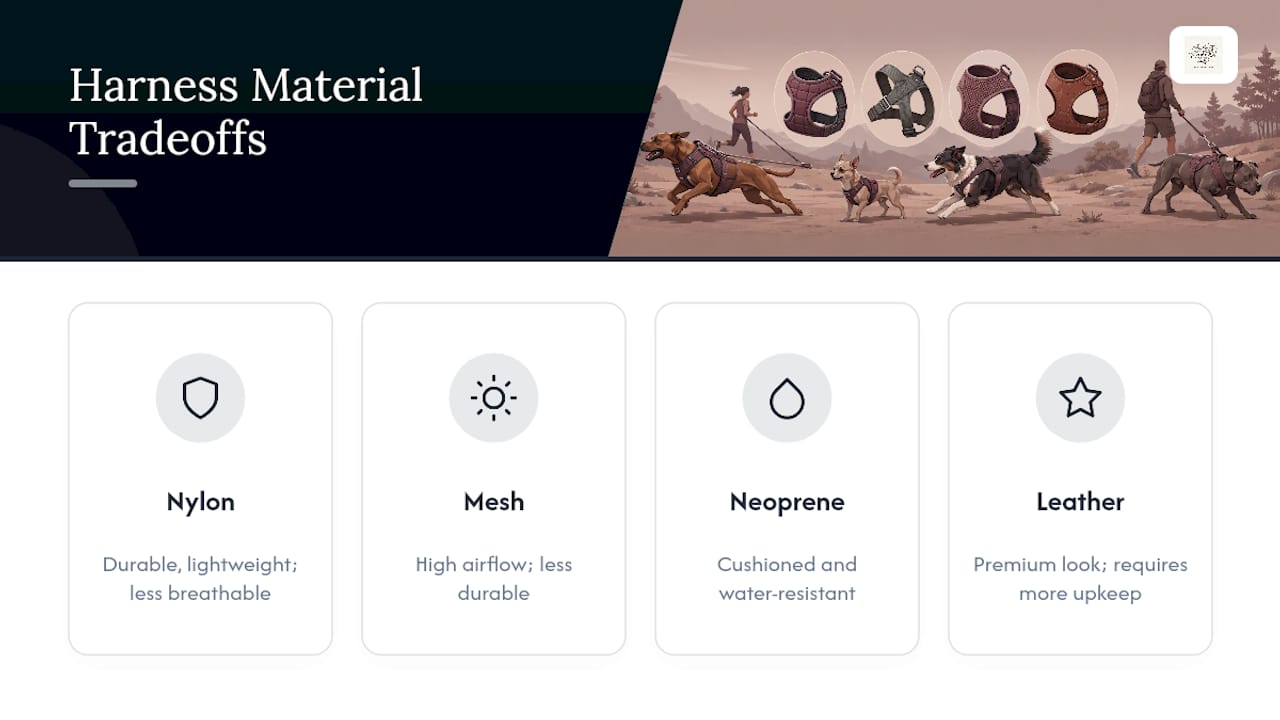
Nylon dominates the market for good reason. It’s durable, lightweight, and holds up to daily wear, though it doesn’t breathe as well as mesh in warm climates. Mesh trades some durability for airflow, a fair swap for short walks in hot weather but a weaker choice for dogs that dig, chew, or scramble through brush. Neoprene brings cushioning and water resistance, which makes it a strong pick for dogs that swim or hike near water. Leather shows up mostly in premium or fashion-forward designs, offering a broken-in feel over time but requiring more upkeep than synthetic materials.
Hardware quality matters just as much as fabric. Metal buckles and D-rings hold up under sustained pulling force far better than plastic clips, which can crack under stress from a determined 60-pound dog. Reflective piping isn’t a gimmick either. It’s a real visibility upgrade for dawn and dusk walks. If you’re using a harness in the car, look specifically for crash-tested or seat-belt-loop features. Not every harness on the market is built or rated for that job.
How Do You Measure and Fit a Dog Harness Correctly?
Getting the fit right solves more problems than switching styles ever will. Follow these steps before you buy or right after your harness arrives:
- Measure neck girth at the base of the neck, where a collar would normally sit.
- Measure chest girth at the widest part of the ribcage, just behind the front legs.
- Check the manufacturer’s size chart rather than guessing by breed. A “medium” varies wildly between brands.
- Apply the two-finger rule. You should be able to slide two fingers between the strap and your dog’s body, no more, no less.
- Check shoulder freedom on Y-shaped harnesses. The straps shouldn’t crowd the shoulder blades during a full stride.
- Inspect the armpit area for chafing after the first few walks. Redness there usually means the strap sits too far forward.
- Consider torso length for long-backed breeds like Dachshunds or Corgis. A harness that’s too short will ride up and choke; too long, and it slides side to side.
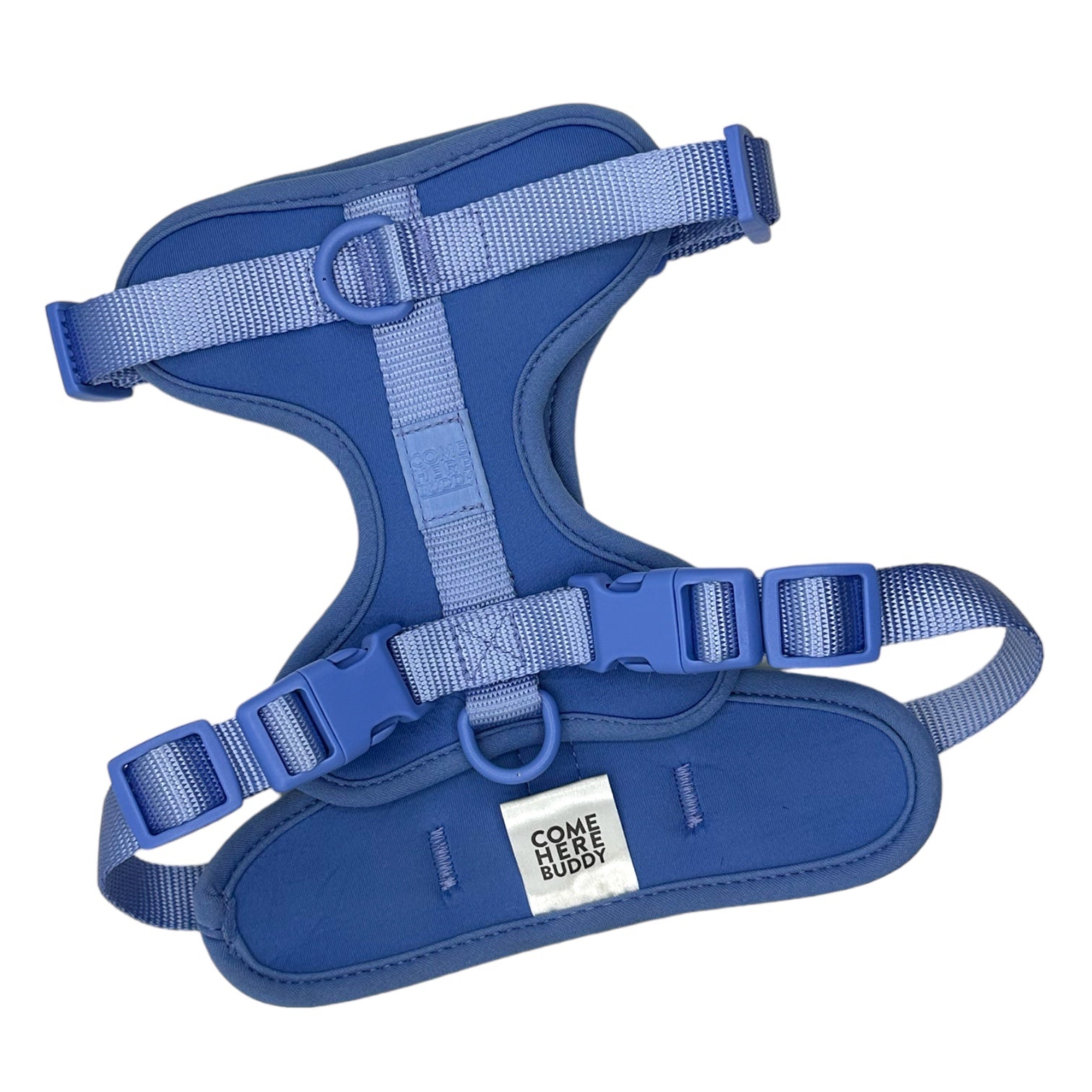
Getting this right isn’t a minor detail. AKC guidance is explicit that fit should allow two fingers of slack between the harness and your dog’s skin, no tighter and no looser, and that neck and chest measurements should drive your size choice, not the breed listed on the tag. If your dog can back out of the harness or the straps constantly twist, you’re one size too big or the wrong style entirely.
Americanbarkbliss’s own fit and safety guide walks through the same checklist with photos, which helps if you’re a visual learner working through this for the first time.
Which Harness Type Fits Your Dog’s Body and Behavior?
Matching style to dog isn’t guesswork once you know the profile. The right harness depends on pulling style, body shape, age, and activity level, not on what looks trendiest online.
- Strong pullers: front-clip or no-pull harness, paired with consistent leash training.
- Brachycephalic breeds (Bulldogs, French Bulldogs, Pugs): any well-fitted harness over a collar, avoiding designs that constrict the chest or restrict shoulder movement.
- Small breeds: soft-vest or step-in harness, lightweight and low-chafe.
- Deep-chested or broad-chested dogs: adjustable dual-strap designs that accommodate a wider girth without riding up.
- Long-backed breeds: harnesses with adjustable torso length, not a one-size chest strap.
- Seniors or dogs in recovery: rehabilitation or lift harness with a supportive handle.
- Hikers and adventure dogs: rugged nylon or tactical harness with a top handle and D-rings for gear.
- Working or service dogs: tactical/utility harness built for handler control and equipment attachment.
If your dog shows sudden resistance to a harness style that used to work fine, or pulling behavior that training alone isn’t fixing, that’s worth a conversation with a trainer or your veterinarian before you cycle through more products.
What Do Vets Recommend, and How Do You Find Your Dog’s Fit?
Veterinary guidance is consistent on one point: for brachycephalic breeds and dogs with any neck or tracheal sensitivity, harnesses are the medically preferred choice over collars, since they spread pressure across the chest instead of concentrating it on the throat. That doesn’t mean any harness will do. A poorly fitted one can still constrict the thoracic inlet or block shoulder movement, so fit still comes first even when you’ve picked the medically right category.
Americanbarkbliss carries a full harness selection built around that same fit-first philosophy, alongside a dedicated fitting walkthrough for owners measuring at home for the first time.
- Everyday Adventure Dog Harness: built for daily walks and light hiking, a solid pick for active dogs that need durability without bulk.
- Asanoha Harness: Y-shaped comfort with a distinct look, suited to dogs that walk well but still want shoulder freedom.
- Full harness category: covers everything from soft-vest to reinforced daily-wear styles for readers still narrowing down a profile.
Pair any of these with the comfort-focused breakdown Americanbarkbliss publishes on Y-harness versus chest-harness trade-offs if you’re stuck between two similar styles.
What Should You Prioritize When Picking a Harness?
Fit comes before everything else. A premium harness in the wrong size does less for your dog than a basic one measured correctly, and most of the “this harness doesn’t work” complaints trace back to sizing, not design. After fit, function: match the clip type and structure to your dog’s actual behavior, not the behavior you wish it had. Comfort and material sit third, because a padded harness on a dog that slips out of it does nothing but look nice in photos.
The industry oversells novelty styles more than it should. A dog that walks politely doesn’t need a tactical harness with six D-rings any more than a determined puller needs a soft mesh vest. Start with the job the harness needs to do, then work backward to the style.
— Christopher
Find the Right Harness in the Americanbarkbliss Catalog
Some harness lineups are built around one idea: the right fit matters more than the flashiest features, with sizing details provided for checking before purchase.
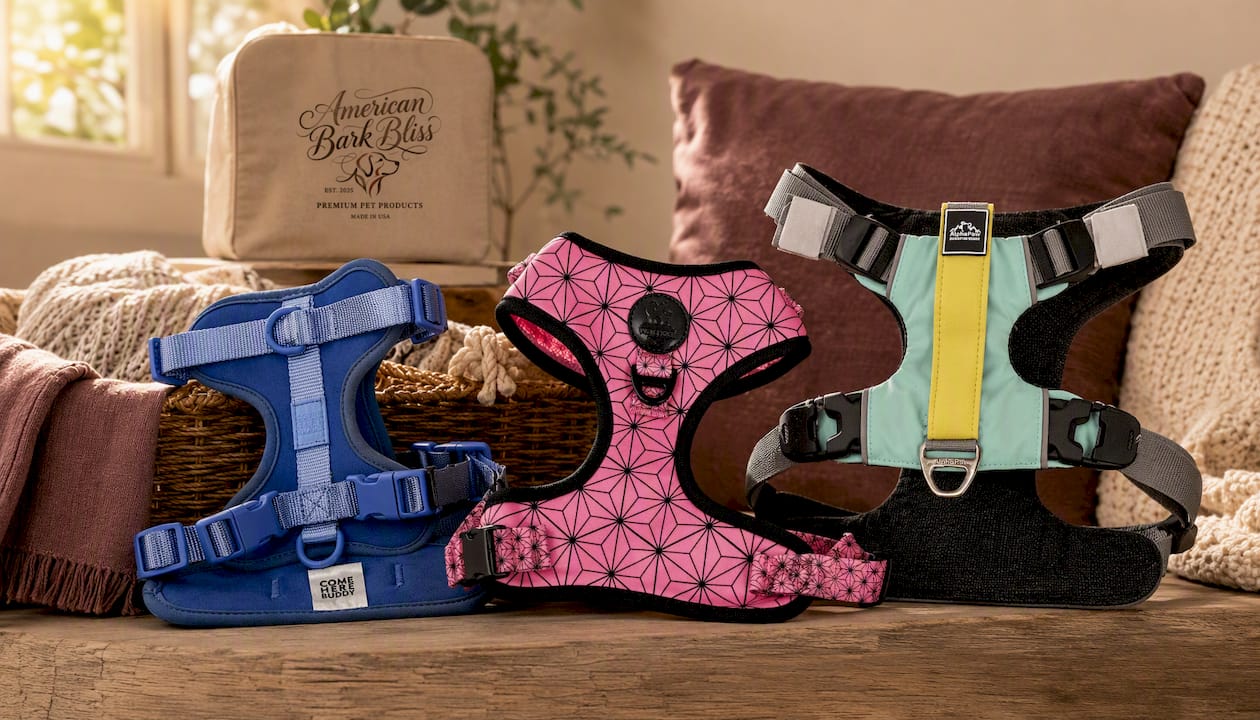
If you’ve read through the profiles above and landed on “everyday walker” or “light hiker,” the Everyday Adventure Dog Harness covers both without extra bulk. If your dog does fine on leash and you just want a comfortable Y-shaped fit with some style, the Asanoha Harness delivers shoulder freedom in a distinct pattern. Still narrowing down between clip types or body shapes? Browse the full harness collection and cross-check against the fit and safety checklist before you check out, since getting the measurements right the first time saves you a return and saves your dog an uncomfortable walk.
Sources
- Dog collars and harnesses — Tufts Veterinary School
- Choosing the right harness for your dog — AKC
- Get the best dog harness for your dog’s body type — PetMD
FAQ
What type of harness is best for dogs?
It depends on the dog: front-clip or no-pull for pullers, Y-shaped for comfortable everyday walkers, and tactical or dual-clip for hiking and working dogs. Correct sizing matters more than the style you choose.
Why are Y-shaped harnesses better?
Y-shaped harnesses leave the shoulder joints completely unrestricted, which supports a natural gait during daily walks. They’re generally the most comfortable option for dogs that already walk politely and don’t need pulling correction.
What is the best dog harness to prevent pulling?
A front-clip or no-pull harness works best for pulling, since it redirects a dog’s momentum back toward the handler instead of letting it lean forward into the leash. Pairing it with basic leash training speeds up results.
Which is better for pulling dogs, front-clip or back-clip harnesses?
Front-clip harnesses give you noticeably more control over pullers because the leash ring sits on the chest, turning the dog’s shoulders when it lunges. Back-clip harnesses sit near the dog’s center of mass, which can actually increase pulling leverage.
How do I know if my dog’s harness fits correctly?
You should be able to slide two fingers between the strap and your dog’s skin at both the neck and chest, with no rubbing at the armpits after a walk. If the harness twists, slides, or lets your dog back out, size down or switch styles.
Leave a comment