

American-Made vs Imported Pet Goods: What to Know
TL;DR:
- American-made pet goods are regulated for transparency and accountability, making them safer choices. Imported products often lack pre-market approval and can have less stringent quality controls, increasing risks. Pet owners should verify both manufacturing location and ingredient sourcing before buying to ensure quality and safety.
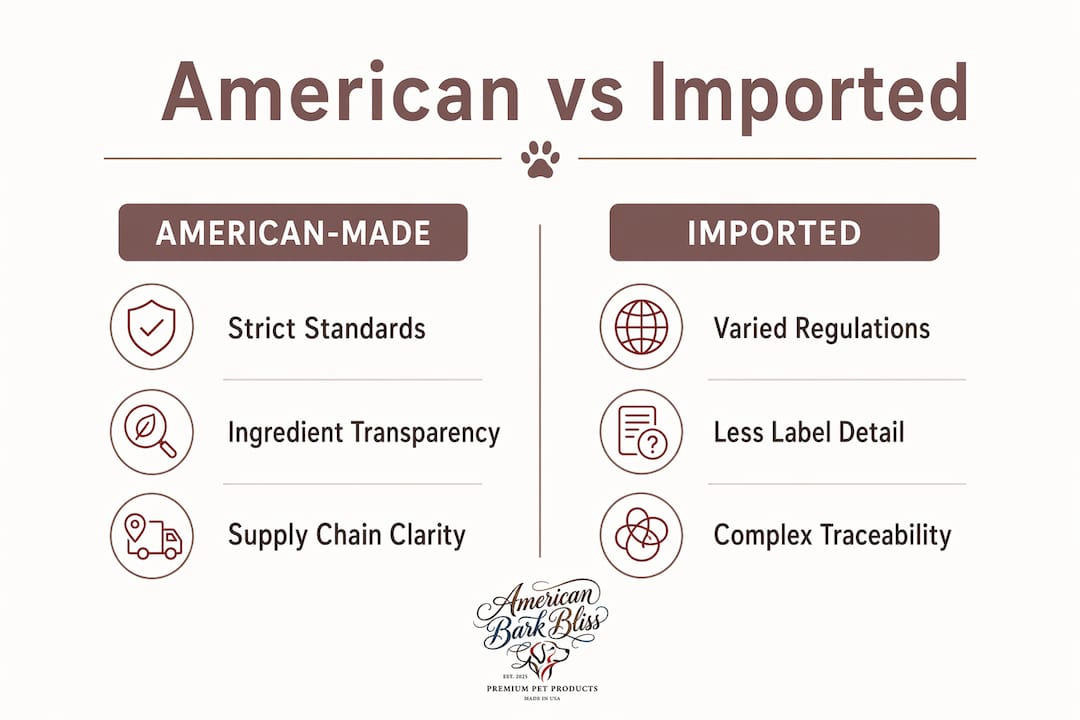
American-made versus imported pet goods differ primarily in regulatory oversight, ingredient transparency, and supply chain accountability. These differences are not just marketing claims. They affect what ends up in your dog’s bowl or between their teeth. The Federal Trade Commission (FTC) and the Food and Drug Administration (FDA) both play roles in shaping what domestic and imported products must meet before reaching store shelves. Understanding those roles helps you cut through label confusion and buy with confidence. Americanbarkbliss was built around exactly this kind of informed purchasing, offering pet owners a curated selection of USA-made products that meet clear quality standards.
What regulatory standards govern American-made and imported pet goods?
The FTC’s “Made in USA” standard requires that “all or virtually all” of a product be made in the United States. That is a stricter definition than most pet owners expect. It means the product’s components, labor, and processing must be predominantly domestic, not just the final packaging or assembly.
The FDA regulates all pet food sold in the U.S., including imports. However, the FDA does not pre-approve imported pet food before it hits store shelves. Instead, the agency relies on prior notice filings and port inspections after the fact. That post-market enforcement model puts the burden of catching problems on inspectors rather than manufacturers.
Domestic manufacturers operate under a different dynamic. Because they produce within U.S. jurisdiction, the FDA can conduct facility inspections, review records, and respond to issues faster. The Alliance for American Manufacturing notes that domestic supply chains offer more transparency and accountability than global ones. That accountability matters when something goes wrong and a recall needs to happen quickly.
Label language adds another layer of complexity. “Manufactured in USA” can mean only the final assembly step happened domestically. The ingredients themselves may have originated overseas. Reading those qualifiers carefully is the first practical skill any informed pet owner needs.
- “Made in USA”: Meets the FTC “all or virtually all” domestic standard
- “Manufactured in USA”: Final assembly is domestic; components may be imported
- “Product of USA”: Typically used for pet food; stricter USDA definition applies to meat ingredients
- No origin label: No guarantee of domestic content at any stage
Pro Tip: Look for brands that disclose both where the product was made and where the ingredients were sourced. A label that only says “Made in USA” without ingredient origin details is telling you only half the story.
How do quality and safety compare between American-made and imported pet products?
Consumer perception strongly favors domestic goods. 78% of Americans believe products made in the United States are of higher quality than those produced overseas. That figure comes from a Consumer Reports survey and reflects a broad, consistent trend across product categories, not just pet goods.

Pet owners back that perception with their wallets. 58% of pet owners actively look for “Made in USA” labels when buying pet food and treats, according to 2024 Packaged Facts survey data confirmed by NielsenIQ. That is a majority of buyers making origin a deliberate filter, not an afterthought.
The quality gap has real-world roots. Imported products from countries with less stringent manufacturing regulations can carry risks that domestic products typically do not. Ingredient substitution, contamination, and inconsistent processing standards are harder to detect when a supply chain spans multiple countries and regulatory environments.
“Pet owners value domestic manufacturing primarily for the transparency and accountability it offers in ingredient sourcing and safety practices.” — Alliance for American Manufacturing
The “Made in USA” label also carries a nuance worth knowing. It signifies where the product was finished, not necessarily where every ingredient originated. Stronger domestic brands go further by specifying both the manufacturing location and the source of their ingredients. That extra disclosure is the real signal of a trustworthy product. You can read more about why American dog products consistently score higher on these transparency measures.
What are the main countries of origin for imported pet goods?
The import market for pet products splits clearly by category. Thailand supplies 42.4% of pet food imports into the U.S. Canada is the second largest pet food source. For pet accessories like collars, leashes, and toys, China supplies 25.6% of imports, with Cambodia and Vietnam also holding significant shares. These figures come from tariff and trade data mapped against HS codes 230910 (pet food) and 4201 (pet accessories).
| Category | Top Import Source | Market Share |
|---|---|---|
| Pet food | Thailand | 42.4% |
| Pet food | Canada | Second largest |
| Pet accessories | China | 25.6% |
| Pet accessories | Cambodia, Vietnam | Significant share |
The cost picture for imported accessories is more complicated than the sticker price suggests. Imported pet accessories face Section 301 tariffs on Chinese goods, with total duty rates ranging from 2.4% to over 11% depending on material, plus additional surcharges. Those costs often get passed to pet owners, narrowing the price gap between imported and domestic goods.
Supply chain complexity compounds the regulatory challenge. Complex global supply chains make traceability and quality control more difficult and opaque than domestic production. When a product passes through multiple countries before reaching a U.S. port, pinpointing the source of a contamination or defect becomes genuinely hard.
Pro Tip: When comparing prices between imported and domestic pet accessories, factor in the tariff-adjusted cost. An imported collar priced $5 less than a domestic one may cost the retailer nearly the same after duties, meaning the quality difference is not offset by a real savings.
How can pet owners make informed choices?
Reading labels critically is the starting point, not the finish line. The distinction between “Made in USA,” “Manufactured in USA,” and “Product of USA” carries real meaning. Inspecting label qualifiers is the most direct way to understand a product’s true domestic content before you buy.
- Check both the manufacturing location and ingredient origin. A product made in the U.S. from imported ingredients still carries supply chain risks. Look for brands that list both.
- Research the manufacturer directly. Reliable brands publish facility information, third-party testing results, and sourcing details on their websites. If that information is absent, treat it as a red flag.
- Understand what tariffs mean for your price comparison. Imported accessories carry duties that affect retail pricing. The apparent savings on an imported product may be smaller than they look.
- Look for third-party certifications. Certifications from bodies like the National Animal Supplement Council (NASC) or USDA Organic add a layer of verified oversight beyond the manufacturer’s own claims.
- Use curated domestic retailers. Platforms like Americanbarkbliss pre-screen products for USA manufacturing standards, reducing the research burden on individual pet owners.
Consumers often misinterpret “Made in USA” labels. Reliable brands provide detailed information beyond the label to build trust. That means ingredient sourcing disclosures, manufacturing facility details, and sometimes batch-level traceability. When a brand offers that level of detail, it is a strong signal that their quality claims are genuine.
Pro Tip: Search for a brand’s recall history through the FDA’s recall database before buying. A clean record combined with transparent sourcing is the strongest quality signal available to pet owners.
For pet owners who want durable, safe options without the research burden, high-quality dog toys made domestically offer a straightforward starting point. The materials, construction standards, and safety testing are easier to verify when the manufacturer operates under U.S. jurisdiction.
Key takeaways
Domestic pet goods offer stronger regulatory accountability and supply chain transparency than imported alternatives, making them the lower-risk choice for pet owners who prioritize safety and ingredient clarity.
| Point | Details |
|---|---|
| FTC “Made in USA” standard | Requires “all or virtually all” domestic content, stricter than most pet owners realize. |
| FDA oversight gap | The FDA does not pre-approve imported pet food; inspections happen after products enter the market. |
| Consumer preference is strong | 58% of pet owners seek “Made in USA” labels; 78% believe domestic goods are higher quality. |
| Label language matters | “Manufactured in USA” may mean only final assembly is domestic; always check ingredient origin too. |
| Tariffs narrow the price gap | Section 301 duties on Chinese accessories range from 2.4% to over 11%, reducing the cost advantage of imports. |
What I’ve learned after years of watching this market
The debate over American-made vs imported pet goods gets framed as a price argument more often than it should. Pet owners assume domestic means expensive and imported means affordable. The tariff data tells a different story. After duties, the real cost difference on accessories is often marginal. What you are actually trading away when you choose an opaque import is not money. It is information.
I have watched the pet industry respond to safety scares with recalls that took weeks to trace back to a source. Every time, the products involved came from supply chains that crossed three or four countries before reaching a U.S. shelf. Domestic manufacturers are not immune to problems, but when something goes wrong, the paper trail is shorter and the response is faster.
The label nuance is the part that frustrates me most. “Manufactured in USA” sounds nearly identical to “Made in USA” to most shoppers. It is not. A toy assembled in Tennessee from components made in Vietnam is not the same product as one built start to finish in Ohio. Brands that blur this distinction are counting on consumer confusion. The ones that spell it out clearly are the ones worth trusting.
My honest advice: treat supply chain transparency as a product feature, not a bonus. If a brand cannot tell you where its ingredients came from, that silence is the answer.
— Christopher
American-made pet products worth buying at Americanbarkbliss
Pet owners who want to skip the label research and buy with confidence have a direct path at Americanbarkbliss.
Americanbarkbliss curates USA-made dog treats and toys that meet verified domestic manufacturing standards. The Americana Chicken Chips for Dogs are a standout: single-ingredient, made in the USA, with clear sourcing you can read before you buy. For dogs that need a durable chew option, the USA-K9 Stars and Stripes Rubber Dog Toy is built and tested domestically. Every product on the platform reflects the same standard: American manufacturing, transparent sourcing, and quality you can verify.
FAQ
What does “Made in USA” actually mean for pet products?
The FTC requires that “all or virtually all” of a product be made in the United States to carry a “Made in USA” claim. This is a stricter standard than “Manufactured in USA,” which may only require final assembly to be domestic.
Does the FDA inspect imported pet food before it reaches stores?
The FDA does not pre-approve imported pet food before it enters the market. It relies on prior notice filings and port inspections, which means enforcement is reactive rather than preventive.
Why are imported pet accessories sometimes not much cheaper than domestic ones?
Section 301 tariffs on Chinese-made pet accessories range from 2.4% to over 11%, plus additional surcharges. Those duties reduce the retail price gap between imported and domestic goods significantly.
How can I verify that a pet product is truly American-made?
Check the label for both manufacturing location and ingredient origin, research the brand’s website for facility and sourcing disclosures, and search the FDA’s recall database for the brand’s history. Brands that publish detailed sourcing information are the most trustworthy.
Are imported pet goods always lower quality than domestic ones?
Not always, but imported goods from countries with less stringent manufacturing regulations carry higher risk of inconsistent quality and contamination. Canada, for example, has regulatory standards close to U.S. levels, while some other major export countries do not.
Leave a comment