

Is an AirTag Safe on a Dog Collar? What Owners Need to Know
An AirTag is not built for dogs, and Apple says so directly. Used with real precautions, it can still work as a limited backup tracker for low-risk dogs in device-dense areas. Two problems keep vets and safety experts cautious: the coin battery inside poses a genuine ingestion hazard, and the tag depends entirely on nearby Apple devices, so it can go silent exactly when you need it most.
Before attaching one, know the constraints:
- The CR2032 battery can leak and cause corrosive injury if swallowed.
- Location updates rely on the crowdsourced Find My network, not GPS, so rural or low-traffic areas mean spotty coverage.
- A microchip, a visible ID tag with current contact info, and a dedicated cellular GPS tracker remain the stronger primary safety stack. An AirTag, at best, rides shotgun.
Key Takeaways
AirTags work only as a limited backup tracker for pets, never as a substitute for a microchip, ID tag, and a securely designed collar.
| Point | Details |
|---|---|
| Battery ingestion is a real risk | The CR2032 coin battery can leak and cause corrosive injury requiring emergency vet care. |
| Coverage depends on device density | AirTags use Bluetooth and Find My, not GPS, so rural areas get spotty or delayed updates. |
| Mounting method changes the risk | Flush, integrated pockets reduce chewing and snagging risk compared with dangling holders. |
| Build a layered safety stack | Combine a microchip, visible ID tag, and a well-designed collar before adding any tracker. |
| Americanbarkbliss supports the foundation | Americanbarkbliss’s American-made collars and grooming tools help owners build the secure, well-fitted base any tracking setup depends on. |
Table of Contents
- Airtag Dog Collar Safety: What Are the Real Health Risks?
- Is an AirTag the Same as a GPS Tracker for Dogs?
- How Should You Mount an AirTag on a Collar Safely?
- When Does an AirTag Actually Make Sense for a Dog?
- Are There Legal or Privacy Issues With Tracking Your Dog?
- Does Wearing an AirTag Stress Out Dogs?
- What Should You Do When You Get an AirTag Alert?
- Sources
- FAQ
Airtag Dog Collar Safety: What Are the Real Health Risks?
The biggest physical risk isn’t the tracking technology itself. It’s the battery inside it. AirTags run on a CR2032 coin cell, and vets who’ve treated ingestion cases describe rapid, corrosive tissue damage once the casing cracks and battery contents reach a dog’s digestive tract. This isn’t a wait-and-see situation. A dog that has swallowed or is suspected of swallowing a coin battery needs emergency veterinary care, not a next-day appointment.
Coin battery ingestion is a documented emergency risk, not a theoretical one. Veterinary sources treating these cases consistently flag the same pattern: a chewed housing, a cracked battery, and a dog that swallowed the pieces before anyone noticed.
Beyond ingestion, three other risks show up repeatedly in vet accounts and owner reports:
- Unexpected beeping. The anti-stalking feature triggers a chime when an AirTag has been separated from its owner’s phone for a while, and some dogs react with stress or anxious behavior to a sound coming from their own collar.
- Choking and snagging. Loose holders or clip-on cases catch on brush, fencing, or crates, and a determined chewer can work a dangling accessory loose fast.
- Skin irritation. Poor placement under a tight collar or against constant friction can rub raw spots, especially on short-haired breeds.
None of this means every dog wearing an AirTag ends up in an emergency room. It means the risk profile is real enough that vets routinely warn against treating it as a casual accessory.
Is an AirTag the Same as a GPS Tracker for Dogs?
No, and this distinction trips up more owners than any other part of the AirTag conversation. An AirTag uses Bluetooth and Apple’s Find My network, not GPS. It doesn’t broadcast its own location. Instead, it pings nearby Apple devices, which then relay that position back to you through the network.
That architecture creates a hard dependency: no nearby iPhones, no updates. In a busy neighborhood with dozens of Apple devices passing by every hour, that system works reasonably well. In a rural area, on a hiking trail, or anywhere foot traffic and phone density drop off, an AirTag can go hours without reporting anything useful, a gap Apple itself acknowledges by explicitly stating AirTags aren’t designed for tracking pets.
A few practical consequences follow from that design:
- No continuous real-time feed. You get pings when a nearby device happens to detect the tag, not a live moving dot.
- Battery life runs roughly a year on the standard coin cell, but you still need to check it monthly once it’s on a dog that’s outdoors daily.
- Cellular GPS trackers, by contrast, offer near-real-time location updates and geofencing alerts that fire the moment a dog crosses a boundary, at the cost of a subscription fee AirTags don’t carry.
How Should You Mount an AirTag on a Collar Safely?
Mounting is where most of the actual risk gets decided, and it’s also where a collar maker’s perspective matters more than a tech reviewer’s. A dangling plastic holder clipped to a D-ring is the riskiest setup you can build. It swings, it snags, and it puts the entire housing within easy reach of a dog’s back teeth. A flush or integrated mount that sits tight against the webbing cuts down on both problems, though it doesn’t eliminate them entirely. A determined chewer can still work at a flush pocket over time.
Collar construction matters just as much as the mount. Wider webbing gives you room to build in a secure internal pocket without weakening the collar. Reinforced stitching around that pocket keeps it from opening under pressure, and placement toward the back of the neck, away from where a dog’s mouth can easily reach, cuts down on casual investigation.
If you’re retrofitting an existing collar rather than buying one designed for it, a sewn-in fabric pocket with a riveted closure beats a snap-on plastic case every time. Riveted housings resist being popped open the way clip cases don’t, and metal enclosures can interfere with the Bluetooth signal, so a fabric or reinforced polymer pocket usually performs better than metal.
Pro Tip: Check any AirTag pocket the same way you’d check a zipper on a dog jacket, by tugging it firmly with your hand before every walk. If you can open it without real effort, your dog can too.
A few design principles worth building into any collar setup:
- Choose integrated or sewn-in housings over clip-on cases whenever possible.
- Favor wider, more rigid webbing that resists being chewed through at the pocket edge.
- Position any electronic device away from the throat and jawline, not dangling near the buckle.
For readers building or upgrading a collar with this in mind, a durable, well-stitched collar designed with secure attachment points in mind is a better foundation than retrofitting a flimsy one, and understanding what makes a collar safe in the first place helps before you add any tracking device at all.
When Does an AirTag Actually Make Sense for a Dog?
An AirTag earns its place as a backup, never a primary safety net. The clearest use case is a low-chew, low-escape dog living in a dense urban or suburban area where Apple devices are constantly passing by. In that setting, owners have reported quick recoveries simply because enough nearby phones picked up the signal fast.
That same setup falls apart in different conditions. A rural property, a dog that hikes off leash, or a heavy chewer who treats every new collar attachment as a puzzle to solve, all of these push the risk calculation the wrong way. Fewer nearby devices mean slower or no updates, and a determined chewer turns even a well-mounted housing into an ingestion risk over time.
The safety stack that actually works starts before any tracker enters the picture:
- A registered microchip remains the single most reliable way a shelter or vet clinic identifies a lost dog, and keeping that registration current matters as much as having the chip at all.
- A visible ID tag with a current phone number lets anyone who finds your dog make contact immediately, no scanner required.
- A dedicated cellular GPS collar, like systems built for continuous location tracking, adds real-time updates and geofencing that an AirTag simply can’t match, at the cost of a monthly fee instead of a one-time battery swap.
Cost is where the trade-off gets concrete. An AirTag needs a new CR2032 roughly once a year and no subscription. A cellular GPS tracker costs more upfront and carries an ongoing fee, but it delivers the continuous coverage an AirTag can’t provide regardless of mounting quality.
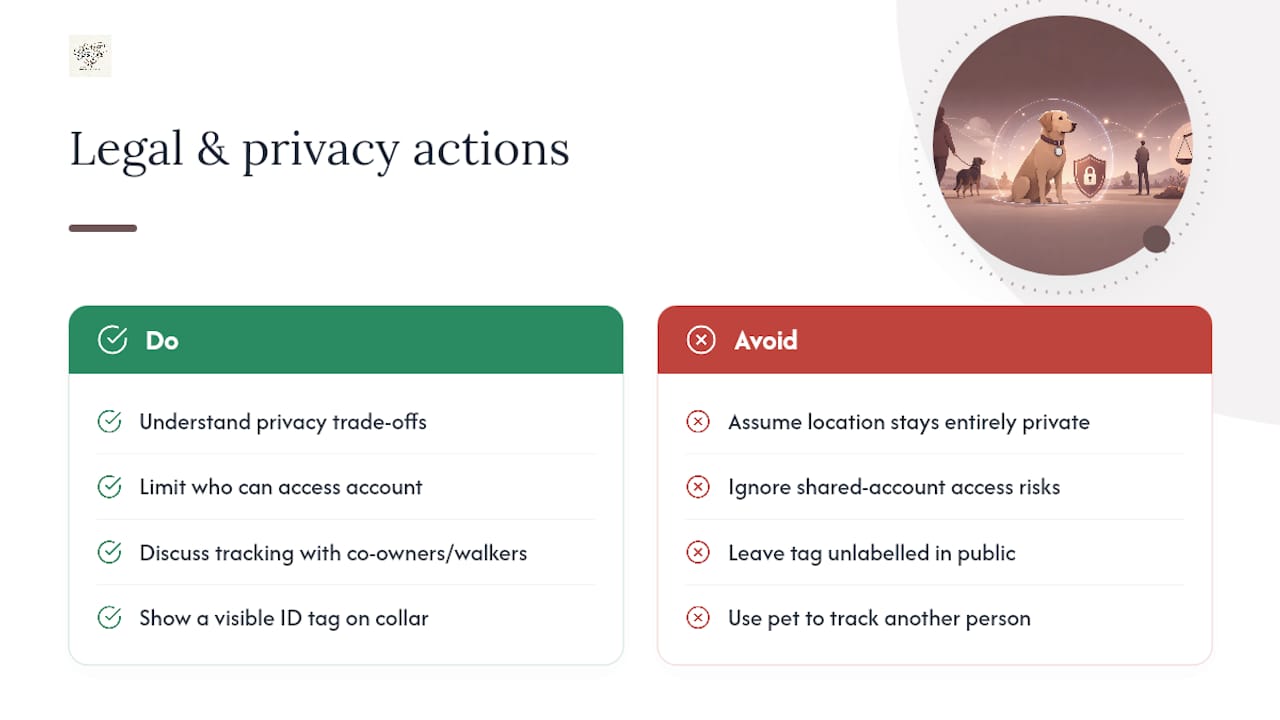
Are There Legal or Privacy Issues With Tracking Your Dog?
Attaching a tracking device to your own pet raises fewer legal questions than tracking a person would, since dogs are legally property and owners generally have wide latitude to manage them as they see fit. Where it gets more complicated is location data itself. Apple’s Find My network works by anonymously relaying signals through other people’s devices, which means your dog’s location history is passing through infrastructure you don’t control and can’t audit.
That’s a privacy trade-off worth understanding, not a legal barrier. The data isn’t shared with strangers in any identifiable way, but it does mean your dog’s movements are logged somewhere in Apple’s ecosystem rather than staying entirely private between you and a dedicated device.
A more practical legal consideration involves shared custody situations, co-owned dogs, or dogs that spend time with dog walkers, boarders, or family members. If a tracker is transmitting location data and a second party has access to that Apple account or a shared Find My setup, they can see where the dog, and often by extension the person walking it, has been. That’s worth a conversation before assuming a tracking device on a shared pet is purely a safety tool with no downstream implications.
There’s also a simpler consideration that has nothing to do with data privacy: an AirTag beeping unexpectedly in public has occasionally led strangers to assume they’re being tracked themselves, since AirTags are widely known as an anti-stalking flashpoint. A tag secured to a dog collar, clearly visible and paired with an ID tag explaining what it is, avoids that kind of confusion.
Does Wearing an AirTag Stress Out Dogs?
Some dogs adjust to a small addition on their collar without any noticeable change in behavior. Others don’t, and the difference usually comes down to two factors: the added weight and bulk, and the beeping.
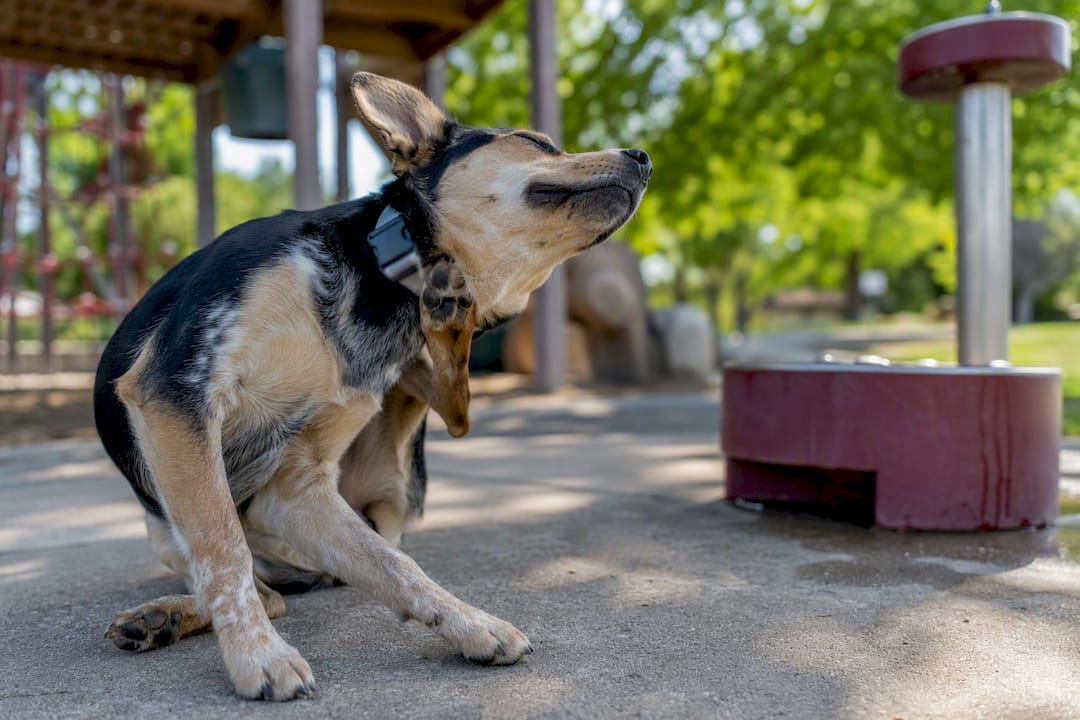
The anti-stalking chime is the more common trigger. It fires when an AirTag has been separated from its paired phone for an extended period, which happens naturally when a dog wanders slightly ahead in a yard or gets separated during a walk. A dog hearing an unfamiliar sound coming from its own collar, with no clear source, can react with the same startle response it would show to any unexplained noise. Veterinarians who’ve fielded these complaints describe dogs pawing at their collars, shaking their heads repeatedly, or trying to bite at the source, all of which increase the odds of the tag getting dislodged or chewed.
Weight and placement play a smaller but real role too. An AirTag adds roughly 11 grams, not much on a large breed, but noticeable on a small or toy dog already wearing a lightweight collar. If it swings from a dangling holder rather than sitting flush, that motion alone can prompt more scratching and head shaking than the weight itself would.
Watch for these signs that a dog isn’t tolerating the addition well:
- Repeated pawing or scratching at the collar area, more than normal grooming.
- Head shaking that starts right after the AirTag is attached.
- Attempts to chew or mouth the collar near the tag’s location specifically.
If you see any of these consistently, remove the tag and reassess the mount rather than assuming the dog will adjust with time.
What Should You Do When You Get an AirTag Alert?
An alert showing your dog’s AirTag has moved or that location has updated isn’t automatically an emergency, but it deserves a fast, calm response rather than a delayed check later in the day.
Start by confirming the basics: check the Find My app for the timestamp on the last update, not just the pin location, since a stale ping from hours ago can show a location your dog has long since left. Cross-reference that against where your dog was last confirmed, whether that’s your backyard, a fenced area, or a walking route.
If the location shown is unexpected and the timestamp is recent, head there directly rather than waiting for another update, since the network can go quiet again once your dog moves out of range of nearby devices. Bring a leash, treats, and if possible, a second person who can call from a different direction, dogs that are anxious after wandering often respond better to a familiar voice than a direct approach.
Set a standing protocol before you ever need it:
- Save your vet clinic and closest emergency animal hospital number in your phone, not just in a drawer somewhere.
- Tell a neighbor or household member how to check the Find My app in case you’re not the one who gets the alert.
- Keep your dog’s microchip registration and ID tag information current, since a tag alert only helps if the AirTag is still attached and functioning when your dog is found.
Treat every alert as worth checking immediately. A pattern of frequent, false, or delayed alerts is also worth noting, since it may mean the mount has loosened or the battery is running low.
A Collar Maker’s Take on Tech Versus Design
Technology gets the headlines, but design decisions determine whether that technology stays attached, stays safe, and actually helps. A well-built collar with a secure internal pocket does more for a dog’s safety than any tracker bolted onto a flimsy one. Explore how thoughtful collar design shapes real-world safety outcomes, not just specs on a box.
— Christopher
Collars and Comfort Built for the Safety Habits That Actually Work
If you’re securing an AirTag or just building a safer everyday setup, the collar and accessories underneath matter more than the gadget on top. Americanbarkbliss makes American-made collars and pet gear designed with the kind of secure stitching and thoughtful placement this guide keeps coming back to, not mass-produced pieces that treat attachment points as an afterthought.

Beyond collars, the same safety mindset applies to the gear around your dog every day. A dog grooming kit helps you catch skin irritation or matting near the collar line before it becomes a bigger issue, and The Tool Kit gives you what you need to inspect and tighten mounts regularly. For downtime after a long walk spent checking on a wandering dog, a Princess Dog Bed Sofa or the Big Paw Plush Pet Sofa Bed gives dogs a calming place to settle back in. Heavy chewers, the exact dogs least suited to a dangling AirTag holder, do better redirected toward the TPR Interactive Dog Chew Toy or the leather chew toy set for aggressive chewers. Browse Americanbarkbliss’s collar and accessory collection to build a setup that keeps your dog secure and comfortable from the collar out.
Sources
- Why AirTags shouldn’t be used on your pet — CNET
- Here’s why you don’t put an AirTag on your dog’s collar — AppleInsider
- Using an Apple Airtag on Your Dog’s Collar? Safety First — Flowery Branch Animal Hospital
- Why Vets Worry About AirTags — PAJ GPS Tracker
- Are AirTags safe for pets? — Pets.StackExchange
FAQ
Is It Safe to Put an AirTag on a Dog Collar?
It’s not designed for that use, and vets warn about battery ingestion risk and unreliable coverage, but a securely mounted AirTag can serve as a limited backup tracker for low-risk dogs.
What Are the Downsides of Using an AirTag on a Dog?
The main downsides are the coin battery ingestion hazard, unreliable location updates in areas without many nearby Apple devices, and unexpected beeping that can stress some dogs.
Is It a Good Idea to Put an AirTag on a Dog?
It can work as a secondary safety layer for a low-chew dog in a device-dense area, but it should never replace a microchip, visible ID tag, and a well-built, secure collar.
Which Is Better for Tracking My Dog, an AirTag or a GPS Tracker?
A dedicated cellular GPS tracker offers real-time location and geofencing that an AirTag can’t match, though it comes with a subscription fee instead of a simple annual battery swap.
Leave a comment